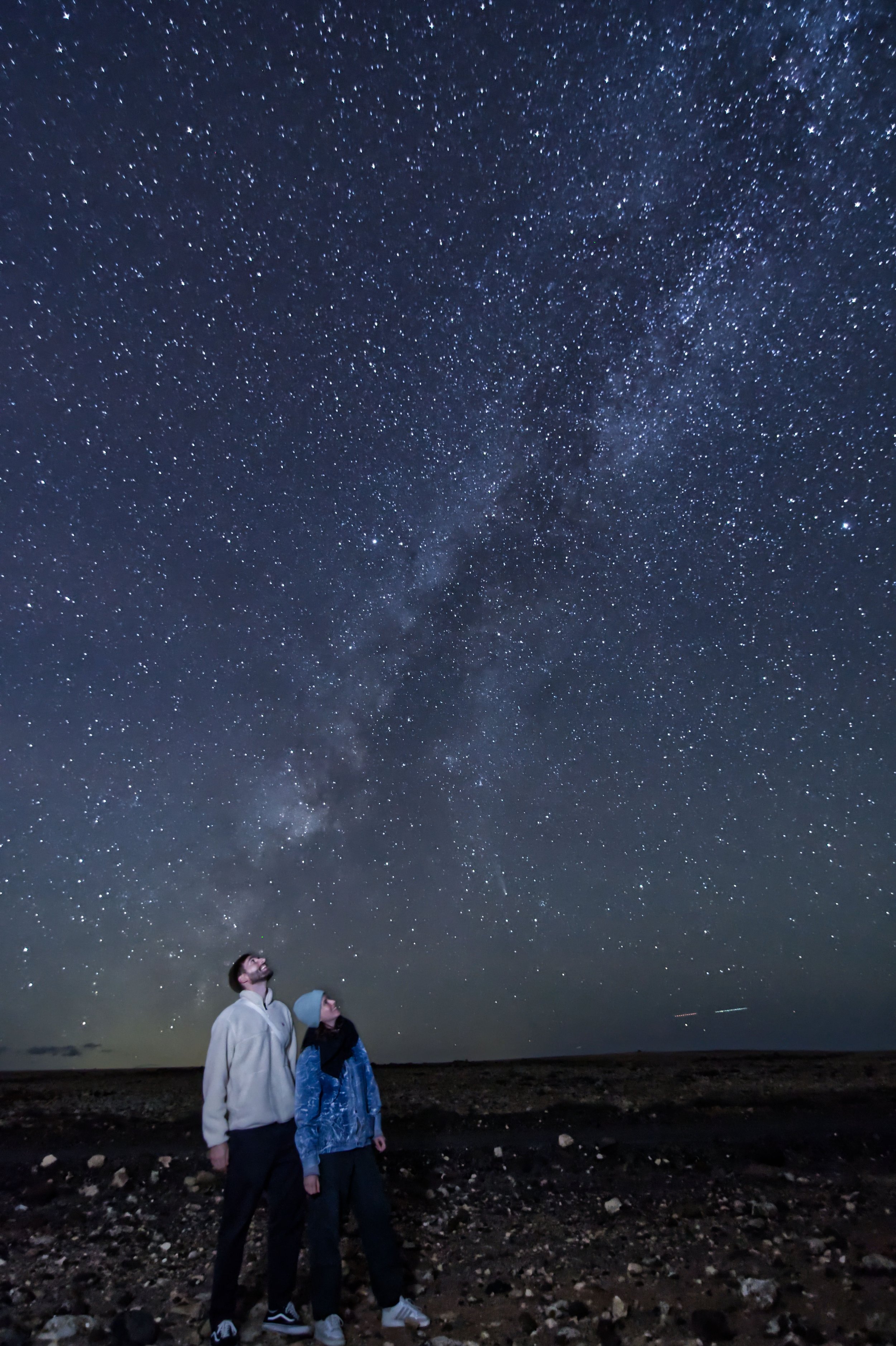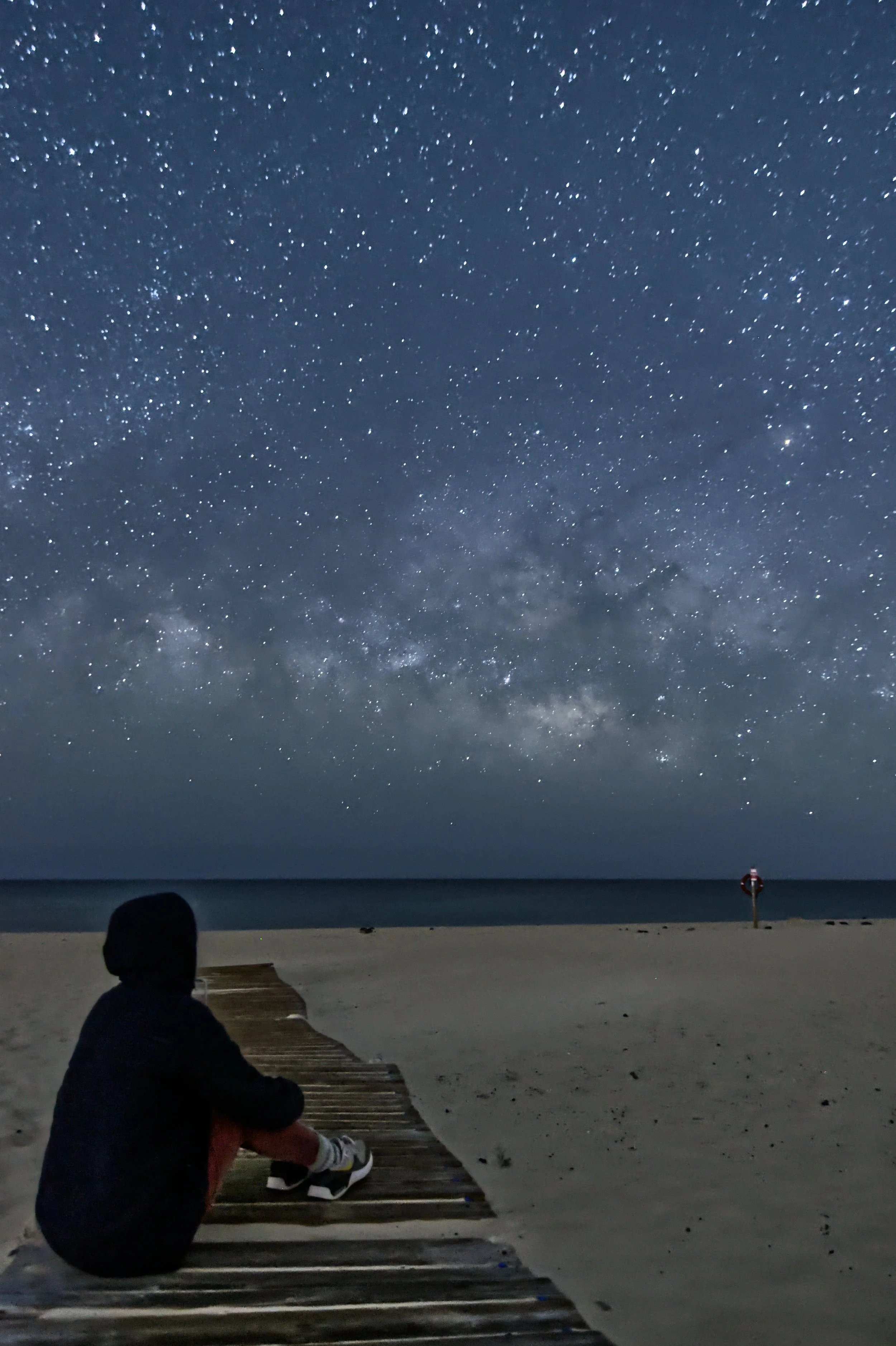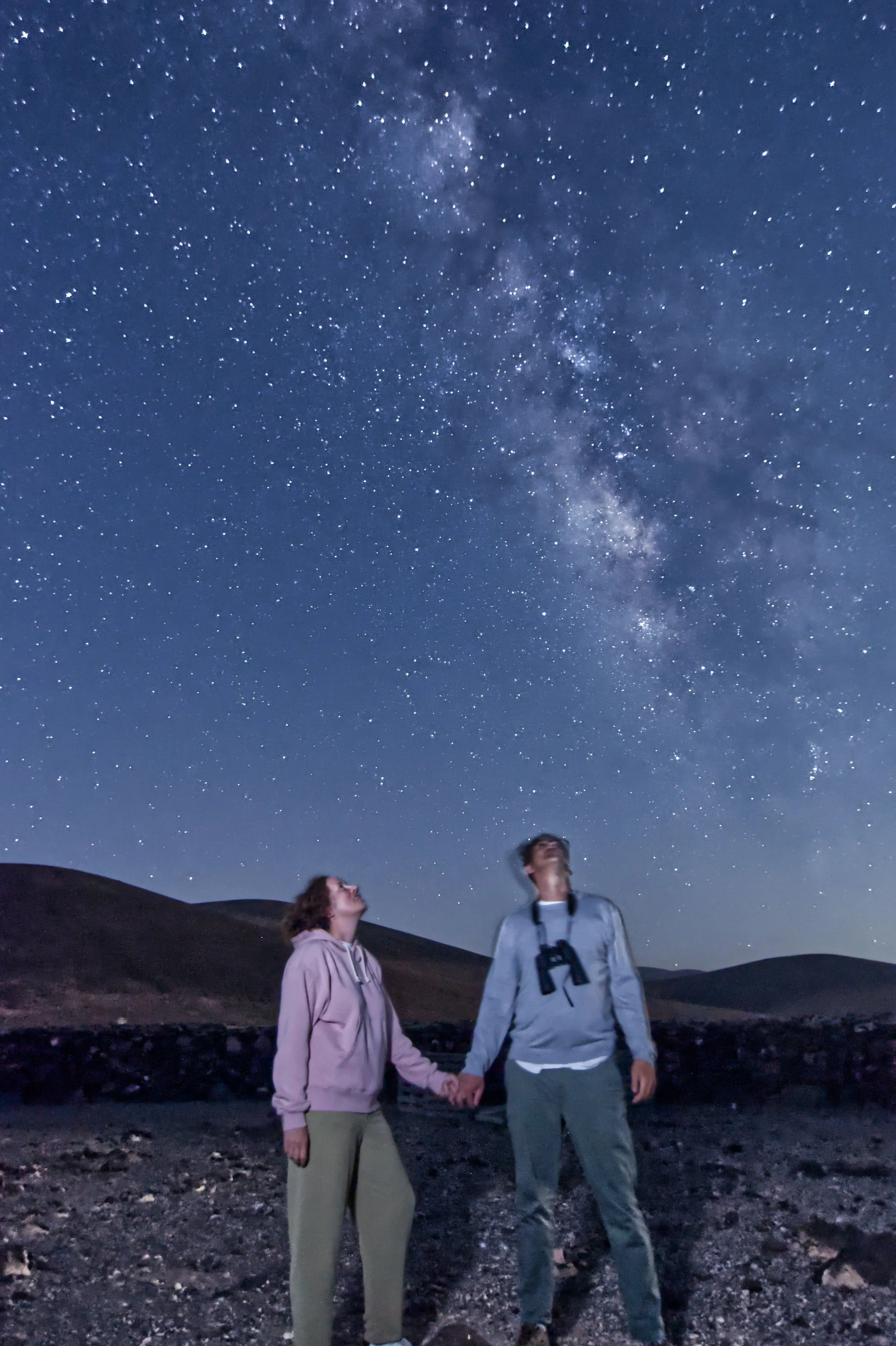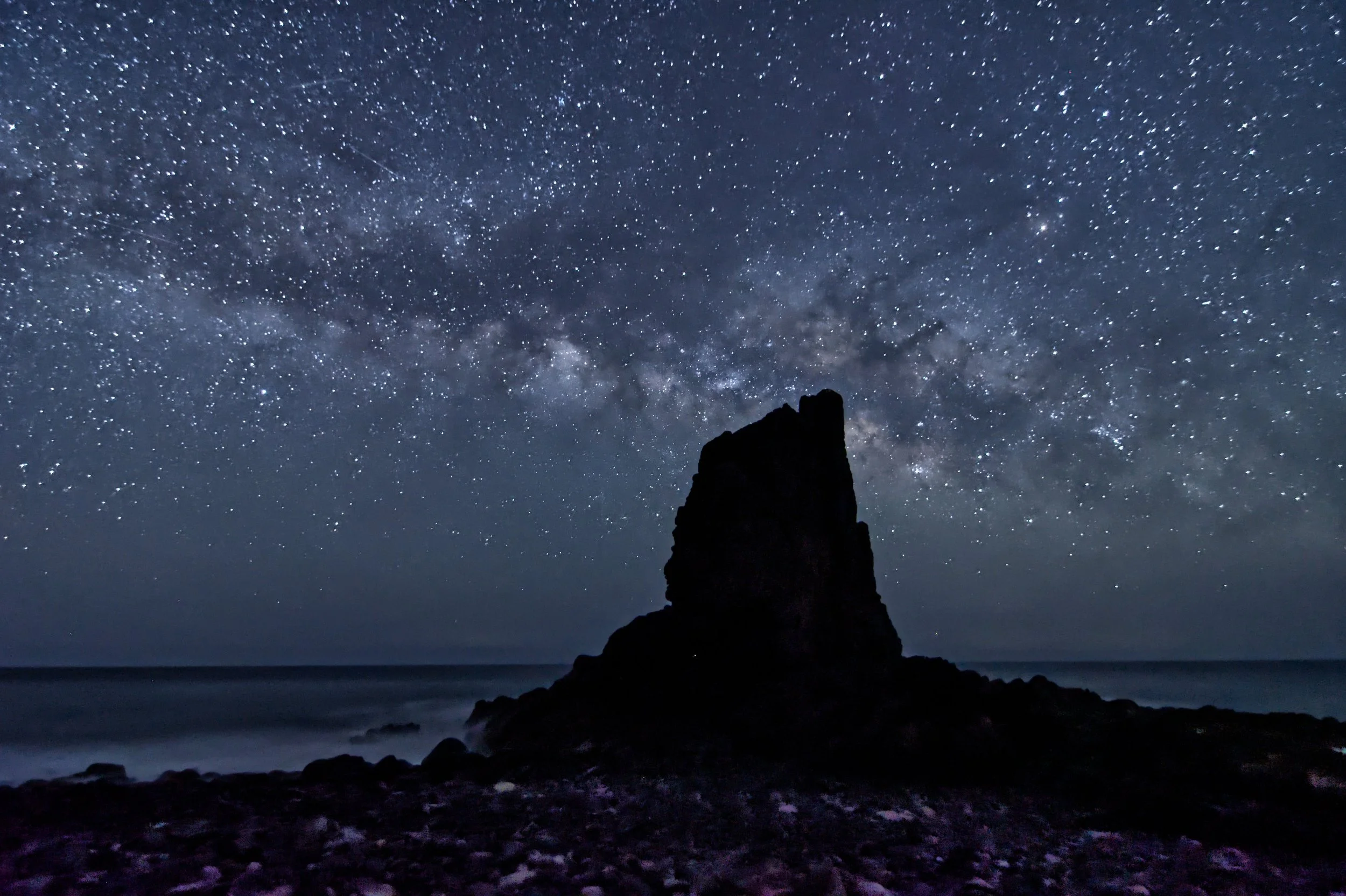
BLOGPOST

....The August 12, 2026 Solar Eclipse.. El eclipse solar del 12 de agosto de 2026....

….Why Fuerteventura Isn’t the Spot..Por qué Fuerteventura no es el lugar ideal….

….(and Where to Go Instead) ..(y adónde ir en su lugar)….

PHOTO: ESA

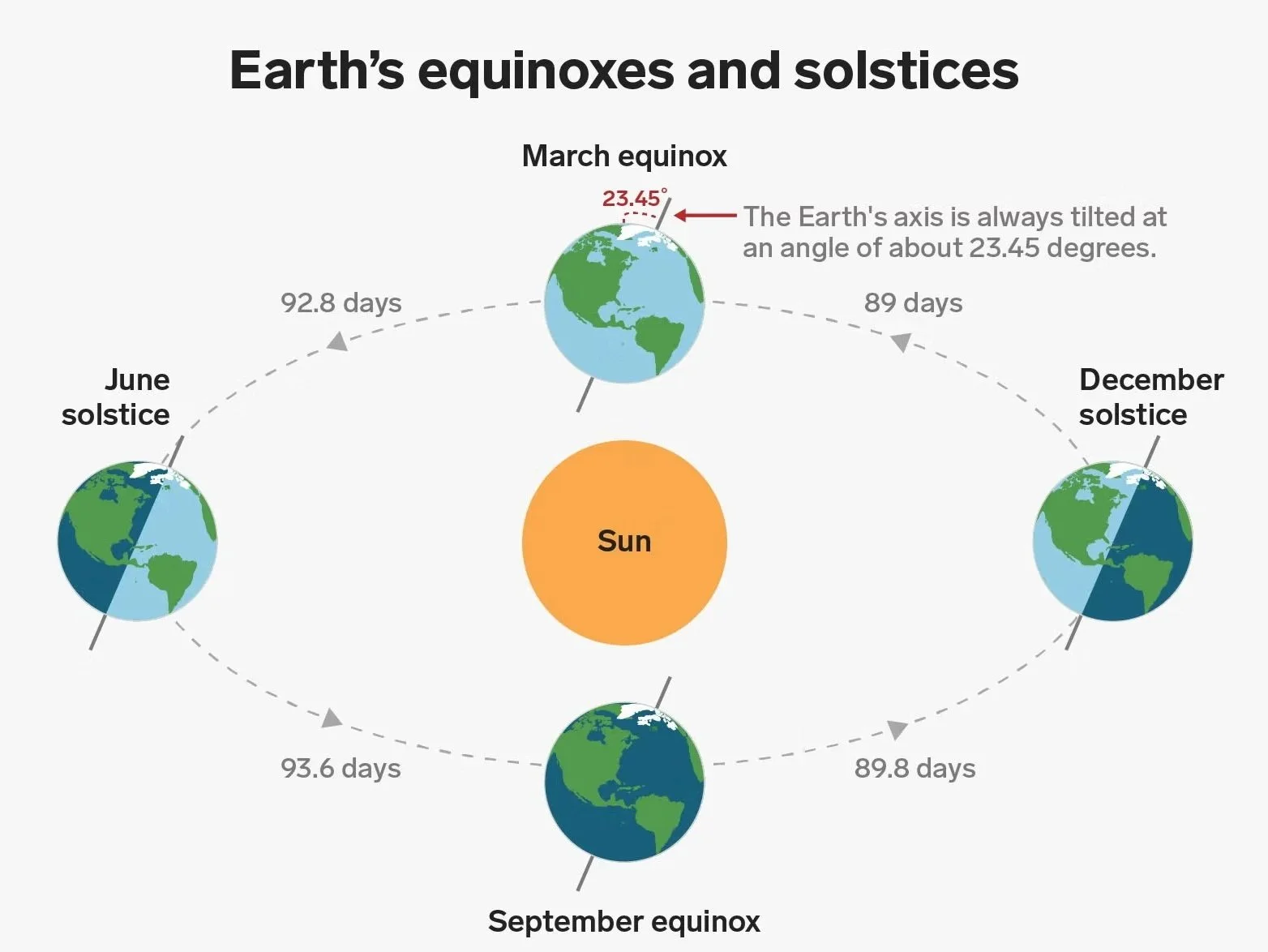
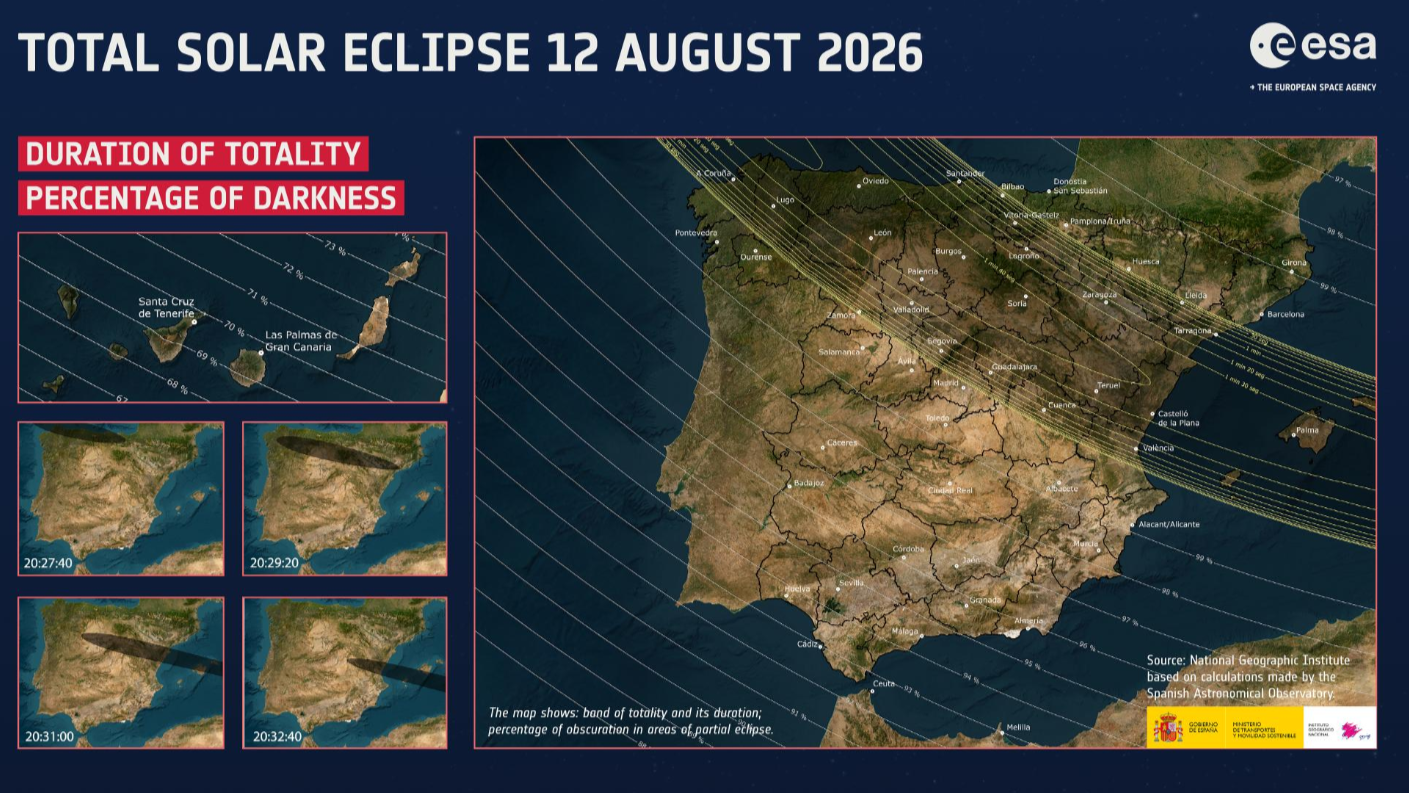
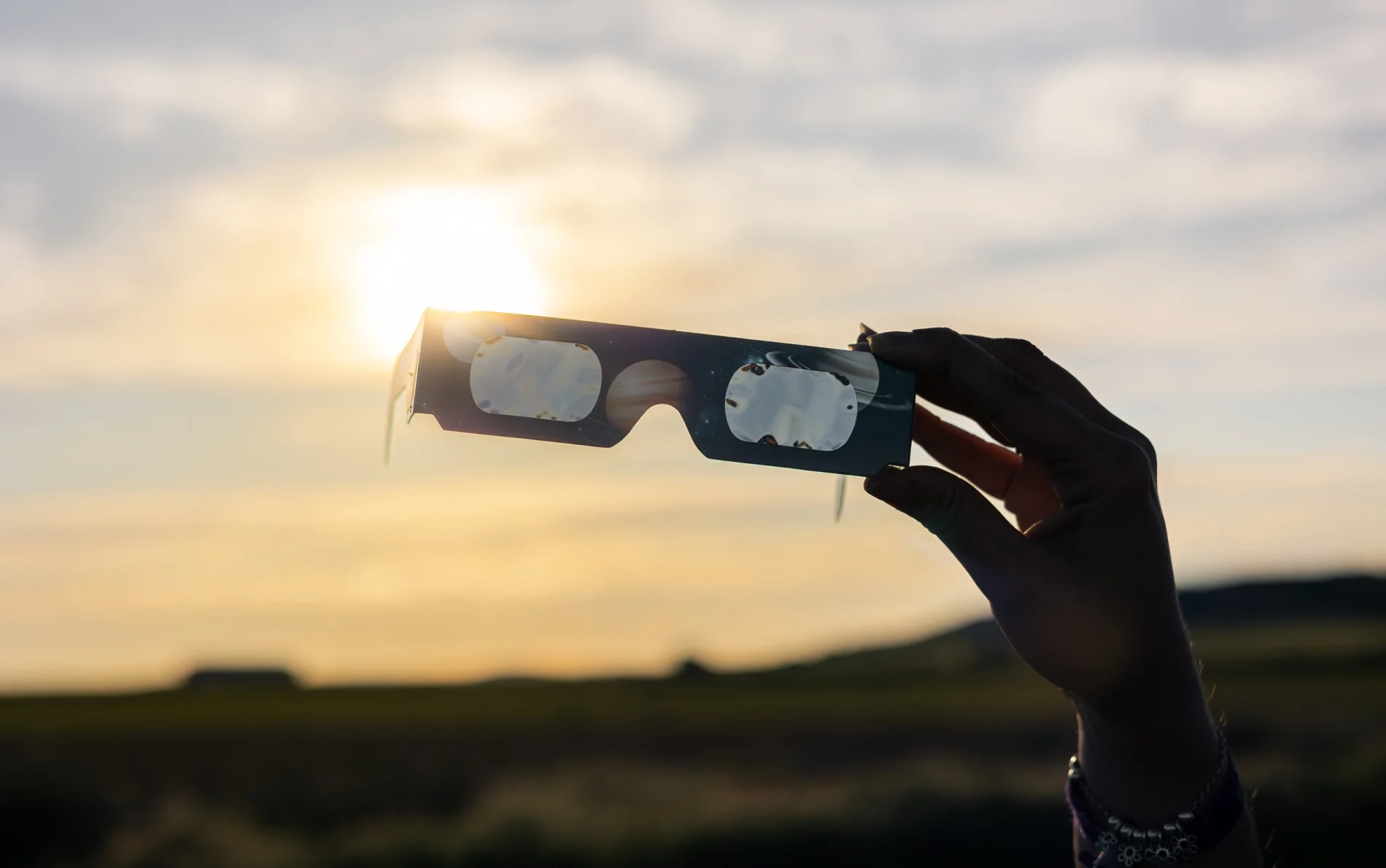
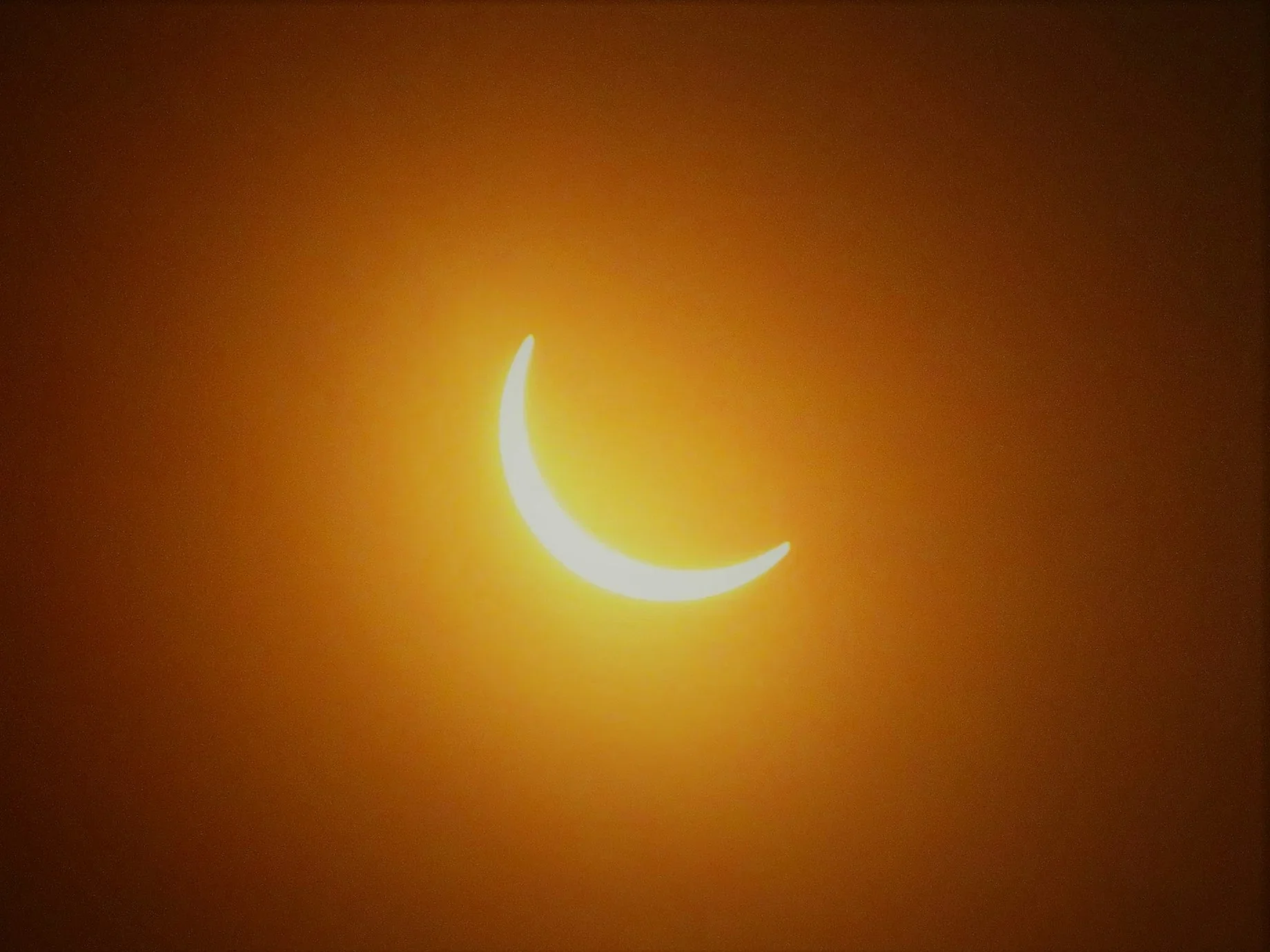
….A total solar eclipse occurs when the Moon passes directly between Earth and the Sun, temporarily blocking the Sun's light and casting a shadow on Earth.  On August 12, 2026, one of the most anticipated astronomical events will take place, a total solar eclipse sweeping across Greenland, Iceland, and northern Spain. If you are currently in Fuerteventura or planning to view it from the island, here is what you need to know about the event and why you might want to travel if you're looking for total darkness.

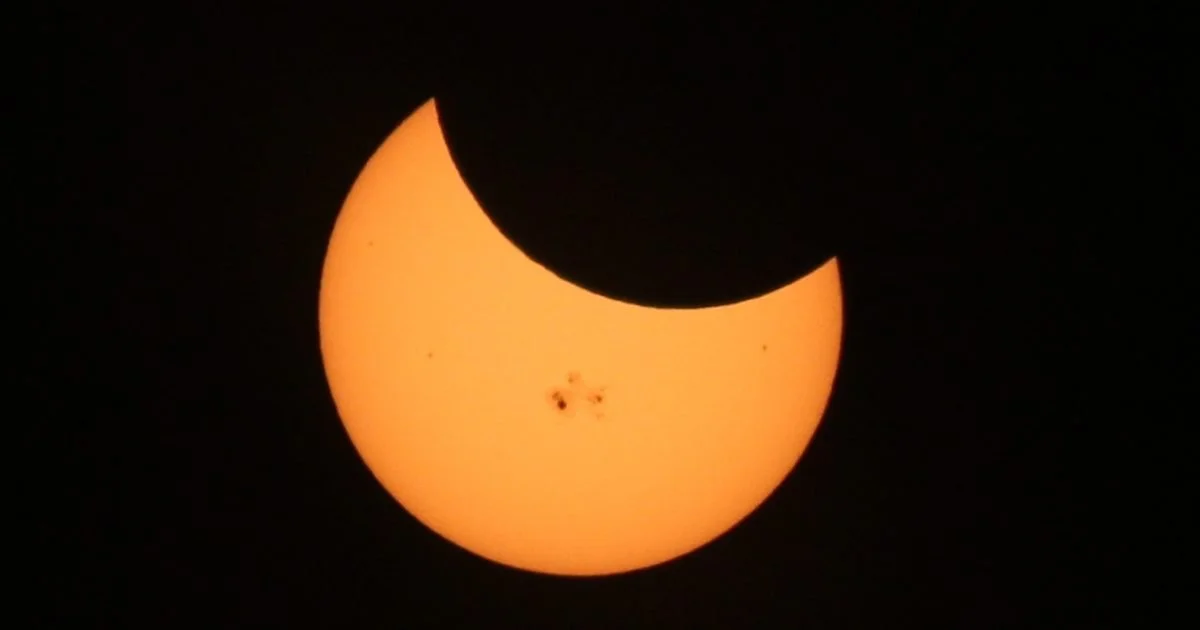
The Reality for Fuerteventura: While the event is creating huge excitement across Europe, Fuerteventura is not a good place to observe this eclipse. There is no totality. The path of total darkness completely misses the Canary Islands. From Fuerteventura, we will only see a partial eclipse (around 66% to 74% coverage). .. Un eclipse solar total ocurre cuando la Luna se interpone directamente entre la Tierra y el Sol, bloqueando temporalmente la luz solar y proyectando una sombra sobre la Tierra. El 12 de agosto de 2026 tendrá lugar uno de los eventos astronómicos más esperados: un eclipse solar total que recorrerá Groenlandia, Islandia y el norte de España. Si te encuentras en Fuerteventura o planeas verlo desde la isla, aquí tienes lo que debes saber sobre el evento y por qué tal vez quieras viajar si buscas la oscuridad total. La situación en Fuerteventura: Aunque el evento está generando gran expectación en toda Europa, Fuerteventura no es un buen lugar para observar este eclipse. No habrá totalidad; la franja de oscuridad total no pasa por las Islas Canarias. Desde Fuerteventura, solo veremos un eclipse parcial (con una cobertura de entre el 66 % y el 74 %). ….

….Ancient Mythology & Meaning..Mitología y significado antiguos ….

….For our ancestors, the sudden vanishing of the Sun was deeply unnerving. Across ancient cultures it was interpreted as a battle in the skies, a divine warning, or a cosmic monster devouring the light. .. Para nuestros antepasados, la repentina desaparición del Sol resultaba profundamente inquietante. En diversas culturas antiguas, este fenómeno se interpretaba como una batalla en los cielos, una advertencia divina o la acción de un monstruo cósmico que devoraba la luz. ….

….In ancient China, people believed a dragon was devouring the Sun, while Norse mythology blamed the sky wolves Sköll and Hati. The Maya, an eclipse was literally the "bite of the Sun," and in Hindu mythology, the severed head of the demon Rahu briefly swallowed it whole. The ancient Greeks, it signalled the Sun god abandoning humanity, hence giving rise to our word eclipse, which stems from the Greek word for abandonment (ekleipsis). .. En la antigua China, se creía que un dragón estaba devorando el Sol, mientras que la mitología nórdica atribuía el hecho a los lobos celestiales Sköll y Hati. Para los mayas, un eclipse era literalmente el “mordisco al Sol”, y en la mitología hindú, la cabeza cercenada del demonio Rahu lo tragaba entero por un breve instante. Para los antiguos griegos, señalaba que el dios Sol abandonaba a la humanidad; de ahí proviene nuestra palabra “eclipse”, derivada del término griego para “abandono” (ekleipsis) ….

….To aid the Sun in its darkest hour, many fought back with noise. The Chinese, as well as the Choctaw and Cherokee tribes, would shout, bang pots, and beat drums to scare off the celestial beast and coax the light back. .. Para ayudar al Sol en su hora más oscura, muchos combatían el fenómeno haciendo ruido. Tanto los chinos como las tribus choctaw y cheroqui gritaban, golpeaban ollas y tocaban tambores para ahuyentar a la bestia celestial y atraer de nuevo la luz. ….

….Not every culture reacted with noise. The Navajo, by contrast, viewed an eclipse as a sacred time for quiet reflection, rest, and inward prayer. .. No todas las culturas reaccionaban haciendo ruido. Los navajos, por el contrario, consideraban el eclipse como un momento sagrado para la reflexión silenciosa, el descanso y la oración interior. ….

….As early astronomers learned to forecast these movements, eclipses gradually shifted from terrifying omens of doom into predictable natural events. .. A medida que los primeros astrónomos aprendieron a predecir estos movimientos, los eclipses pasaron gradualmente de ser presagios aterradores de catástrofe a convertirse en fenómenos naturales predecibles. ….

If you're staying on Fuerteventura on August 12, 2026, keep your expectations modest, it will be a subtle partial show low on the western horizon. But if you're willing to hop a flight up to northern Spain, you'll be treated to one of nature's greatest spectacles!

..

Si te encuentras en Fuerteventura el 12 de agosto de 2026, modera tus expectativas: será un eclipse parcial sutil, visible cerca del horizonte occidental. Pero si estás dispuesto a tomar un vuelo hacia el norte de España, ¡podrás presenciar uno de los espectáculos más grandiosos de la naturaleza! ….

….It will be too Close to Sunset. .. Será demasiado cerca del atardecer. ….

….The eclipse occurs very late in the day. By the time maximum coverage is reached, the Sun will be sitting extremely low on the horizon, just before setting.  Due to the low angle it will be difficult to notice a dramatic change in light or appreciate the grandeur of the event. ..

El eclipse ocurre muy tarde en el día. Para cuando se alcance la cobertura máxima, el Sol estará extremadamente bajo en el horizonte, justo antes de ponerse. Debido a este ángulo bajo, será difícil percibir un cambio drástico en la luz o apreciar la magnificencia del evento. ….

….Where IS a good place to see it?  ..¿Dónde es un buen lugar para verlo? ….

….If you want the full, mind-bending experience of day turning into night, you need to be in the Path of Totality. The prime viewing spots for total darkness include: ..

Si quieres vivir la experiencia completa e impresionante de ver cómo el día se convierte en noche, debes estar en la franja de totalidad. Los mejores lugares para observar la oscuridad total incluyen: ….

….Northern and Eastern Spain: .. Norte y este de España: ….

….Regions stretching from Galicia through Asturias, León, Zaragoza, and down to Valencia and the Balearic Islands will experience 1 to 2 minutes of complete totality right before sunset. .. Las regiones que se extienden desde Galicia, pasando por Asturias, León y Zaragoza, hasta llegar a Valencia y las Islas Baleares, experimentarán entre 1 y 2 minutos de totalidad completa justo antes del atardecer. ….

….Mallorca will be one of the final landmasses in Europe to see totality, offering 1 minute and 36 seconds of dark eclipse over the Mediterranean Sea.

For those wanting to photograph it, Simon Waldram is leading a total eclipse and astrophotography workshop based in Mallorca, taking advantage of its Starlight Reserve skies and coastal views. .. Mallorca será una de las últimas zonas de tierra firme en Europa donde se podrá observar la totalidad, ofreciendo 1 minuto y 36 segundos de oscuridad durante el eclipse sobre el mar Mediterráneo. Para quienes deseen fotografiarlo, Simon Waldram dirige un taller de eclipse total y astrofotografía con sede en Mallorca, aprovechando sus cielos con certificación Starlight y sus vistas costeras. ….

….Iceland & Greenland: Western Iceland and eastern Greenland sit directly under the path.

Modern Science

To modern observers, a total solar eclipse is a showcase of orbital mechanics. It gives scientists a rare window to study the Sun's outer atmosphere (the corona), which is normally blotted out by surface glare. .. Islandia y Groenlandia: el oeste de Islandia y el este de Groenlandia se encuentran directamente bajo la trayectoria. Ciencia moderna Para los observadores actuales, un eclipse solar total es una demostración de mecánica orbital. Ofrece a los científicos una oportunidad excepcional para estudiar la atmósfera exterior del Sol (la corona), la cual normalmente queda oculta por el resplandor de la superficie. ….

….Beyond solar physics, eclipses have shaped our understanding of the universe. In 1919, it provided the first proof of Einstein’s Theory of General Relativity, by showing that gravity bends starlight. Today, researchers continue to leverage eclipses to track sudden shifts in Earth’s ionosphere, measure microclimate drops, and record animal behaviour as day briefly turns to night. .. Más allá de la física solar, los eclipses han moldeado nuestra comprensión del universo. En 1919, proporcionaron la primera prueba de la teoría de la relatividad general de Einstein al demostrar que la gravedad curva la luz de las estrellas. Hoy en día, los investigadores siguen aprovechando los eclipses para monitorear cambios repentinos en la ionosfera terrestre, medir descensos en el microclima y registrar el comportamiento animal a medida que el día se convierte brevemente en noche. ….

NASA Scientific Visualization Studio of Eclipse Path

Visualizer: Ernie Wright

Producer: Joy Ng

....The Summer Triangle & how to locate it from Fuerteventura .. Presentando el Triángulo de Verano y cómo localizarlo desde Fuerteventura ....

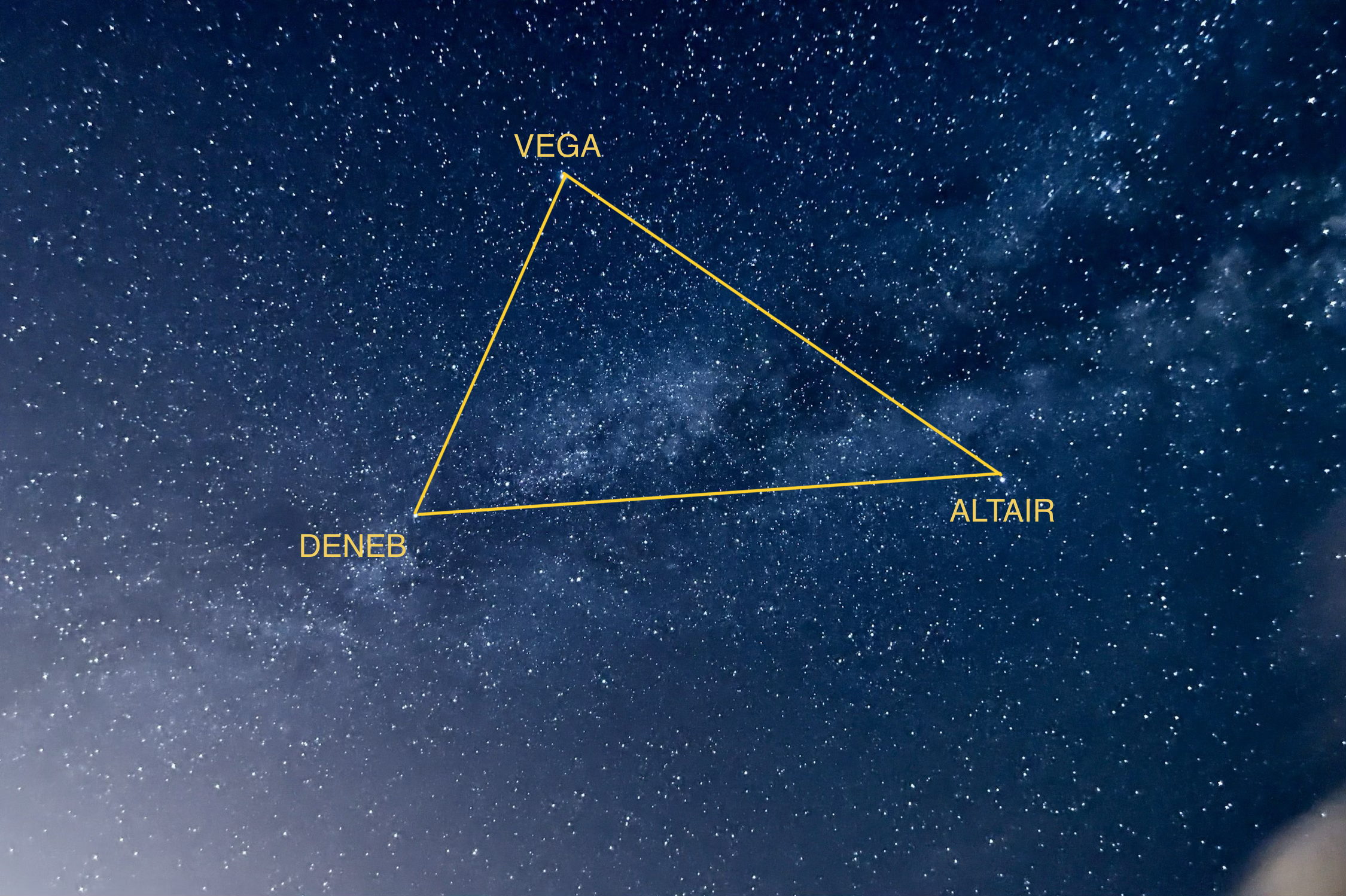
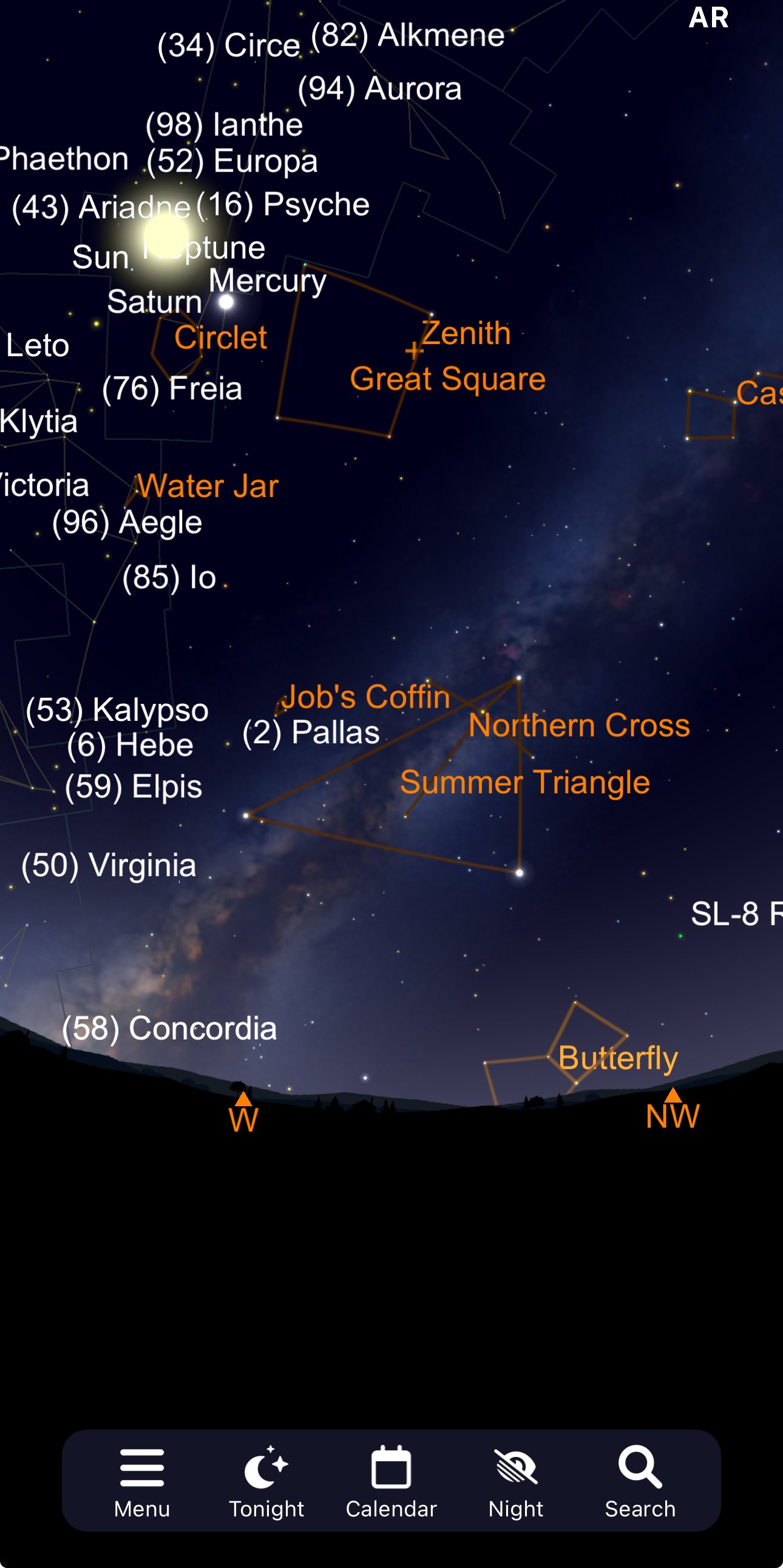
….The Summer Triangle is formed by three dazzling stars, each belonging to a different constellation and each remarkable in its own right. Although the triangle itself isn't an official constellation, astronomers classify it as an asterism, a recognisable pattern of stars, it is one of the most useful landmarks in the summer sky. Think of it as a celestial roadmap: once you've found its three bright anchor points, exploring the rest of the night sky becomes a little easier. It's the perfect place to begin your journey under the summer stars. 

..

El Triángulo de Verano está formado por tres estrellas deslumbrantes, cada una perteneciente a una constelación diferente y destacable por derecho propio. Aunque el triángulo en sí no es una constelación oficial, los astrónomos lo clasifican como un asterismo (un patrón reconocible de estrellas) y es uno de los puntos de referencia más útiles del cielo nocturno estival. Piensa en él como un mapa de carreteras celestial: una vez que hayas localizado sus tres puntos de anclaje brillantes, explorar el resto del cielo nocturno resulta un poco más fácil. Es el lugar perfecto para comenzar tu viaje bajo las estrellas del verano. ….

Photo: Karen Moore (Lead Star Guide)

….Fuerteventura is positioned close to the equator, so the Summer Triangle behaves a bit differently here than it does in mainland Europe. It climbs incredibly high, eventually sitting directly overhead by midnight. It is also one of the easiest ways for beginners to find the Milky Way. Under Fuerteventura’s dark skies, the galaxy’s glowing river of stars stretches across the Summer Triangle, offering a spectacular introduction to our home galaxy. 

Here is how to find the Summer Triangle from the beaches, dunes, and volcanic viewpoints of Fuerteventura right now:

..

Fuerteventura está situada cerca del ecuador, por lo que el Triángulo de Verano se comporta de manera un poco diferente aquí que en la Europa continental. Asciende a una altura increíble, llegando a situarse directamente sobre la cabeza a medianoche. Además, es una de las formas más sencillas para que los principiantes encuentren la Vía Láctea. Bajo los cielos oscuros de Fuerteventura, el río brillante de estrellas de la galaxia se extiende a través del Triángulo de Verano, ofreciendo una introducción espectacular a nuestra galaxia.

Aquí te explicamos cómo encontrar el Triángulo de Verano desde las playas, dunas y miradores volcánicos de Fuerteventura en este momento:

….

….Meet the Three Cosmic Anchors.. Conoce las tres anclas cósmicas ….

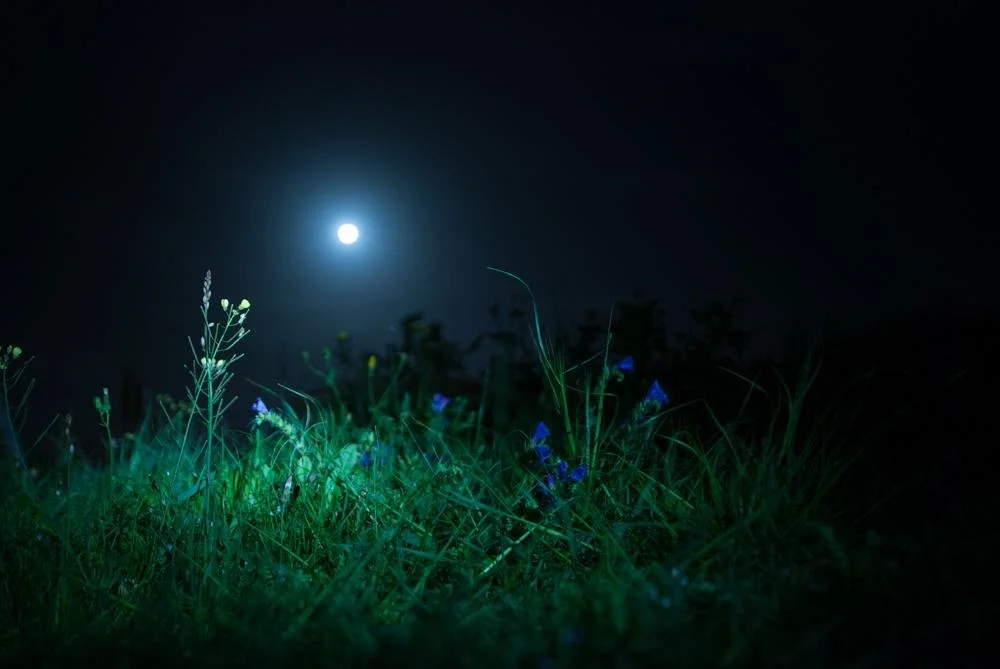
….The triangle is made up of three incredibly bright stars, visible even under the glare of the Full Moon. .. El triángulo está formado por tres estrellas increíblemente brillantes, visibles incluso bajo el resplandor de la Luna Llena. ….

….First up is Vega, which forms the highest and brightest point of the trio. Located in the small constellation of Lyra (the Harp), Vega is the fifth-brightest star in the entire night sky. It shines with a brilliant, unmistakable bright white tint that makes it incredibly easy to pick out. .. En primer lugar está Vega, que forma el punto más alto y brillante del trío. Situada en la pequeña constelación de Lira (el Arpa), Vega es la quinta estrella más brillante de todo el cielo nocturno. Brilla con un tinte blanco brillante e inconfundible que la hace increíblemente fácil de distinguir.

….

….To the lower left of Vega, you will find Deneb, marking the tail of Cygnus (the Swan). Deneb is a mind-boggling white supergiant star. Even though it looks roughly as bright as the other two stars to our naked eyes, it is actually located over 1600 light-years away from us. It is so massive that it’s light easily pierces across the depths of time to shine bright over the summer nights. .. Abajo a la izquierda de Vega encontrarás a Deneb, que marca la cola de Cisne (el Cisne). Deneb es una estrella supergigante blanca alucinante. Aunque a simple vista parece casi tan brillante como las otras dos estrellas, en realidad se encuentra a más de 1600 años luz de nosotros. Es tan masiva que su luz atraviesa fácilmente las profundidades del tiempo para brillar con fuerza en las noches de verano. ….

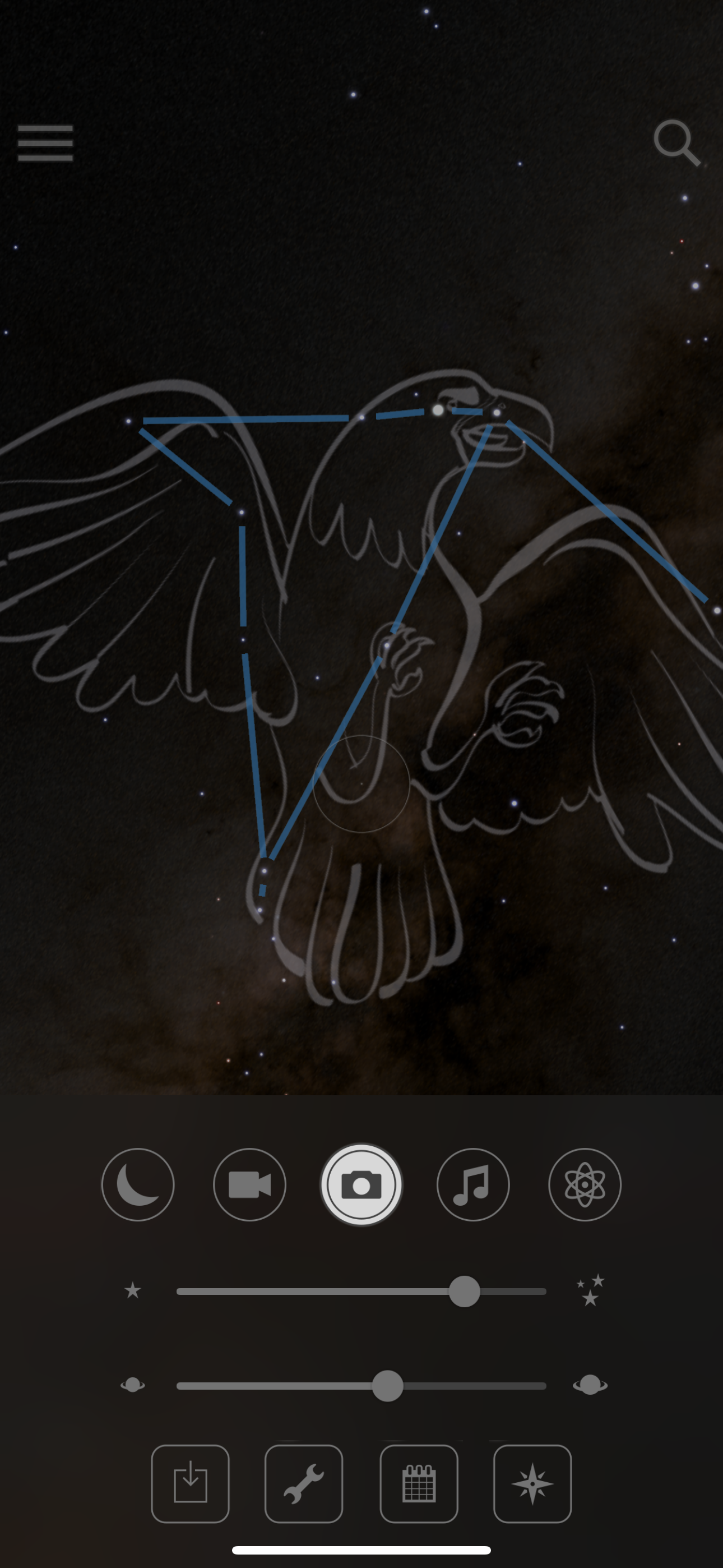
….Completing the shape at the bottom right is Altair, the eye of Aquila (the Eagle). In stark contrast to Deneb, Altair is a close neighbour of ours, sitting just 19 light-years away. ..

Completando la forma en la parte inferior derecha está Altair, el ojo de Águila (el Águila). En marcado contraste con Deneb, Altair es una vecina cercana, situada a solo 19 años luz de distancia.

….

….How to Find It from Fuerteventura over Summer months.. Cómo encontrarlo desde Fuerteventura durante los meses de verano ….

….Step 1: Timing is everything .. Paso 1: El momento adecuado lo es todo….

….Head outside after the sky gets fully dark, around 22:30. Walk away from the direct glare of hotel streetlights in places like Corralejo or Caleta de Fuste. .. Sal afuera una vez que el cielo se vuelva completamente oscuro, alrededor de las 22:30. Aléjate del resplandor directo de las farolas de los hoteles en lugares como Corralejo o Caleta de Fuste. ….

….Step 2: Look toward the East..Paso 2: Mira hacia el Este….

….Face east-northeast. Tilt your head up, way up. The first star to catch your eye will be Vega. It is so bright that it easily grabs your attention. .. Oriéntate hacia el este-noreste. Inclina la cabeza hacia arriba, bien arriba. La primera estrella que te llamará la atención será Vega. Es tan brillante que capta tu atención fácilmente. ….

….Step 3: Drop down and left for Deneb ..Paso 3: Baja hacia la izquierda para encontrar a Deneb….

….Look to the lower left of Vega (about the distance of an outstretched hand at arm's length). You will spot Deneb, which marks the tail of Cygnus the Swan, with its open wings, flying through the night sky. .. Mira hacia abajo y a la izquierda de Vega (aproximadamente a la distancia de una mano extendida con el brazo estirado). Localizarás a Deneb, que marca la cola de Cygnus, el Cisne, que vuela por el cielo nocturno con sus alas desplegadas. ….

….Step 4: Complete the shape with Altair..Paso 4: Completa la forma con Altair….

….Look to the lower right of Vega to find Altair. You have now connected the dots to complete the massive celestial triangle. .. Mira hacia abajo y a la derecha de Vega para encontrar a Altair. Ahora has conectado los puntos para completar el enorme triángulo celestial. ….


….The Secret Reward: Tracking the Milky Way..Paso 5: La recompensa secreta: localizar la Vía Láctea….

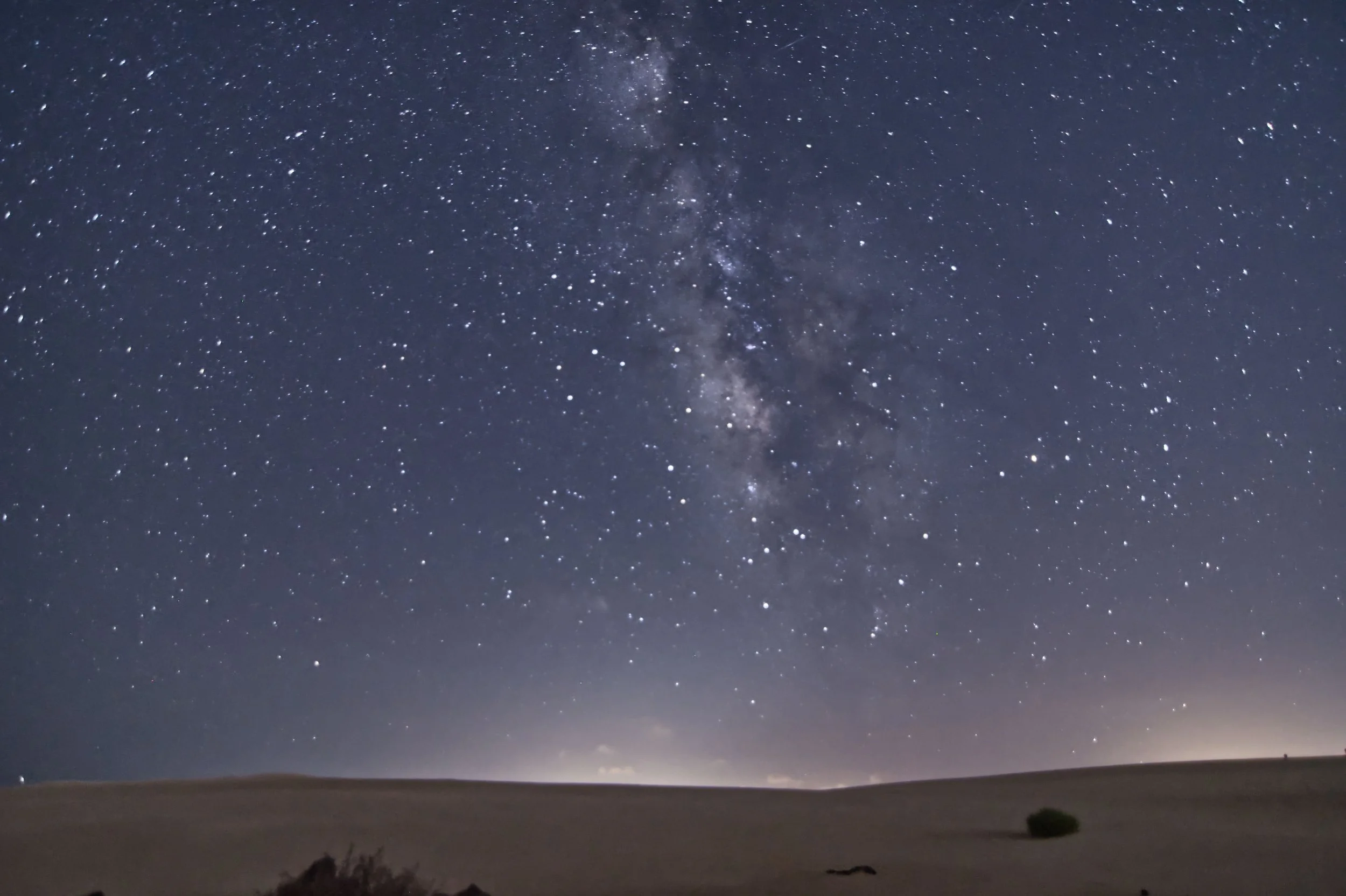
CORRALEJO DUNES & MILKY WAY

….Finding the Summer Triangle is only the beginning. The real reward comes once your eyes have fully adjusted to the darkness, allow around 15 to 20 minutes, and avoid looking at your phone or any other bright light sources. Don’t forget to check the Moon phase, as at even 40% illumination the Milky Way will start to disappear. .. Localizar el Triángulo de Verano es solo el comienzo. La verdadera recompensa llega una vez que tus ojos se han adaptado por completo a la oscuridad,deja pasar entre 15 y 20 minutos, y evitas mirar el teléfono o cualquier otra fuente de luz intensa. No olvides consultar la fase lunar, ya que, con tan solo un 40 % de iluminación, la Vía Láctea empezará a desaparecer. ….

….From one of Fuerteventura's dark-sky locations, you'll soon notice a soft, misty band of light stretching across the night sky and passing directly through the triangle. This is the Milky Way, the combined light of billions of distant stars within our home galaxy.  .. Desde una de las ubicaciones con cielos oscuros de Fuerteventura, pronto notarás una franja de luz suave y brumosa que se extiende a través del cielo nocturno y pasa directamente por el triángulo. Se trata de la Vía Láctea, la luz combinada de miles de millones de estrellas distantes dentro de nuestra propia galaxia. ….

Deneb lies almost directly within this glowing river of stars, while Vega and Altair sit on either side, making the Summer Triangle a perfect signpost for tracing the Milky Way across the sky. .. Deneb se encuentra casi directamente dentro de este río brillante de estrellas, mientras que Vega y Altair se sitúan a ambos lados, lo que convierte al Triángulo de Verano en una señal perfecta para rastrear la Vía Láctea a lo largo del cielo. ….

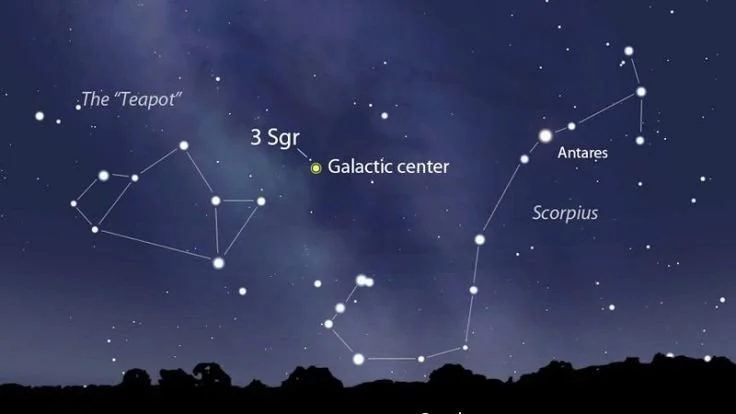
THE TEAPOT AND SCORPIUS.

photo: EARTHSKY.ORG

….Follow this celestial river towards the southern horizon and you'll eventually reach two of summer's most recognisable constellations: Sagittarius and Scorpius. Sagittarius is famous for the distinctive outline of its brightest stars, which resemble a teapot, while Scorpius is instantly recognisable by its long, curved tail and the brilliant red star Antares, marking the scorpion's heart. .. Sigue este río celestial hacia el horizonte sur y eventualmente llegarás a dos de las constelaciones más reconocibles del verano: Sagitario y Escorpio. Sagitario es famosa por el contorno distintivo de sus estrellas más brillantes, que se asemejan a una tetera, mientras que Escorpio es reconocible al instante por su larga cola curvada y la brillante estrella roja Antares, que marca el corazón del escorpión. ….

MILY WAY´S OUTER ARMS

Photo: IFScience.com

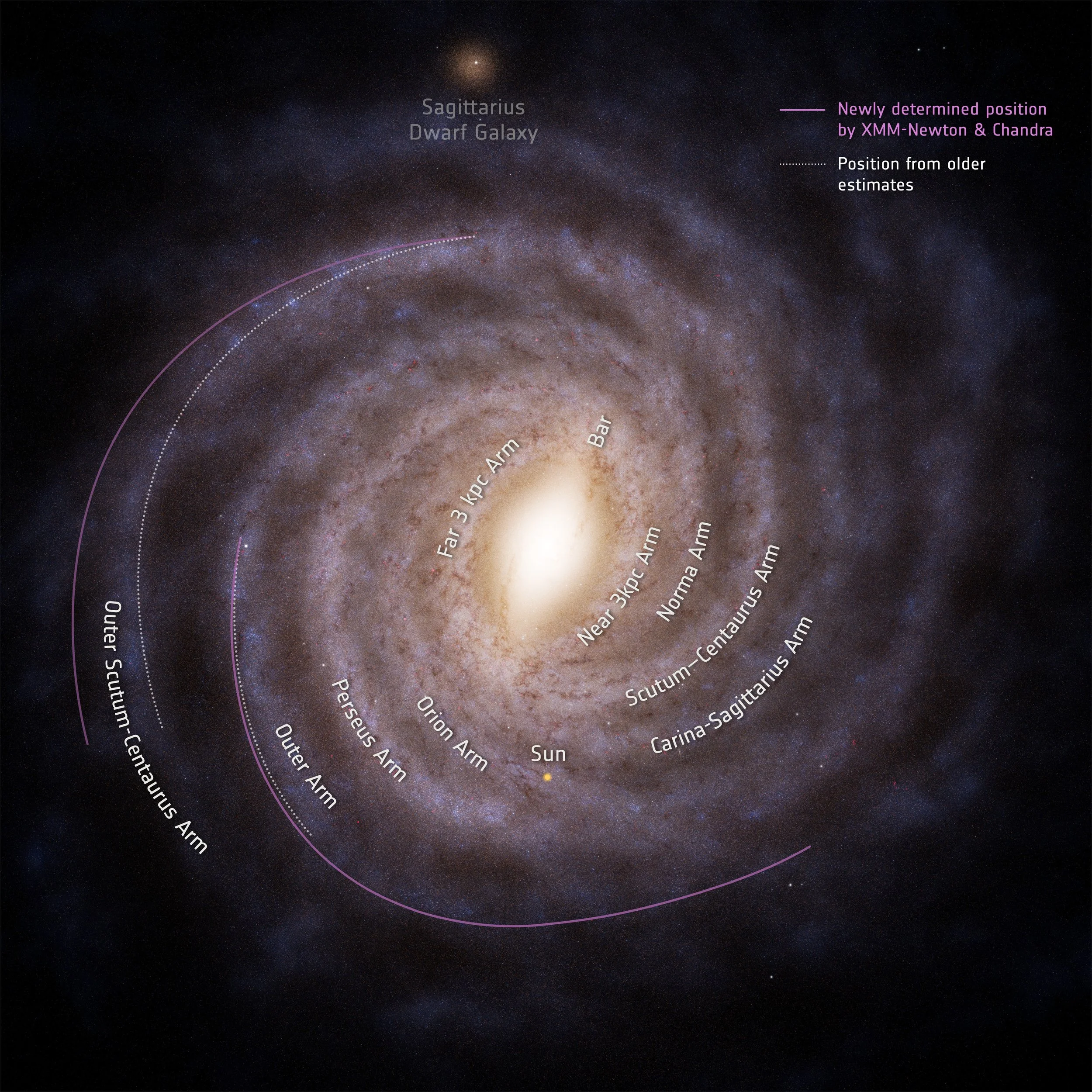
….This is where the Milky Way is at its most spectacular. Looking towards Sagittarius, you're gazing into the direction of the galactic centre, where the star clouds become brighter, denser and richer than anywhere else in the night sky. Here, the Milky Way glows with exceptional brilliance as countless stars, nebulae and dark dust lanes merge into one breathtaking panorama. We believe that our Galaxy is spiral in shape, with up to 6 arms. Earth is located in the Orion Arm and we have the Perseus Arm passing through the Summer Triangle and the Sagittarius Arm passing from the tail of the Scorpion over Sagittarius. 

The Summer Triangle is far more than a simple pattern of stars. It is a reliable guide that opens the door to exploring our galaxy and a reminder that you don't need expensive equipment to enjoy the wonders of the universe. Under Fuerteventura's exceptionally dark skies, three bright stars are all it takes to begin an unforgettable journey through the cosmos.

So, the next time you find yourself beneath the Majorero sky, look up, find the Summer Triangle, and let it guide you across the Milky Way. Happy stargazing!

..

Aquí es donde la Vía Láctea se muestra en todo su esplendor. Al mirar hacia Sagitario, estás contemplando la dirección del centro galáctico, donde las nubes de estrellas se vuelven más brillantes, densas y ricas que en cualquier otra parte del cielo nocturno. Aquí, la Vía Láctea brilla con un esplendor excepcional a medida que innumerables estrellas, nebulosas y franjas de polvo oscuro se funden en un panorama impresionante. Se cree que nuestra galaxia tiene forma de espiral, con hasta seis brazos. La Tierra está ubicada en el Brazo de Orión, mientras que el Brazo de Perseo pasa a través del Triángulo de Verano y el Brazo de Sagitario se extiende desde la cola del Escorpión sobre Sagitario.

El Triángulo de Verano es mucho más que un simple patrón de estrellas. Es una guía fiable que abre las puertas a la exploración de nuestra galaxia y un recordatorio de que no se necesita un equipo costoso para disfrutar de las maravillas del universo. Bajo los cielos excepcionalmente oscuros de Fuerteventura, tres estrellas brillantes son todo lo que hace falta para comenzar un viaje inolvidable a través del cosmos.

Así que, la próxima vez que te encuentres bajo el cielo majorero, mira hacia arriba, busca el Triángulo de Verano y deja que te guíe a través de la Vía Láctea. ¡Feliz observación de las estrellas!

….

....Sustainability: The Word of the moment but what does it mean to You? .. Sostenibilidad: la palabra de moda, pero ¿qué significa para ti? ....

….Recently I made a very short video talking, about my love for Nature and true sustainability. It came from a place of frustration and was poorly executed, but still a friend understood what I was trying to articulate. His response filled me with so much hope and love that I wanted to share it with you all. To inspire us all to think about what sustainability actually means. HIs words resonated with me. I agree, with all but one point, but that is ok. The point that I was trying to make with my video was to encourage people to think for themselves what sustainability means to them. Thank you Carlos for taking the time to share your thoughts. .. Hace poco grabé un vídeo muy breve en el que hablaba de mi amor por la naturaleza y la verdadera sostenibilidad. Lo hice movido por la frustración y no lo hice muy bien, pero aun así un amigo entendió lo que intentaba expresar. Su respuesta me llenó de tanta esperanza y cariño que quería compartirla con todos vosotros. Para inspirarnos a todos a reflexionar sobre lo que realmente significa la sostenibilidad. Sus palabras me llegaron al alma. Estoy de acuerdo con todo menos con un punto, pero no pasa nada. Lo que intentaba transmitir con mi vídeo era animar a la gente a pensar por sí misma qué significa la sostenibilidad para cada uno. Gracias, Carlos, por tomarte el tiempo de compartir tus reflexiones. ….

…. TO ACHIEVE A SUSTAINABLE SOCIO-ECONOMIC SYSTEM:

We need a shift in consciousness based on LOVE, EMPATHY and RESPECT for human beings, amongst ourselves and towards all other living beings with whom we share the limited space of our small planet Earth.

To achieve this, we must free ourselves from the control of the insatiable EGO, which governs and has governed the general behaviour and destiny of our human species since its inception, being the root of all conflicts, wars, suffering and unhappiness. In fact, the ego lies at the heart of the socio-economic system that currently prevails, based on fierce COMPETITION which, all too often, ignores and violates the most basic rules of ethics and morality.

The alternative to competition (where gain for some implies loss for others) is COOPERATION, where everyone works together, helping one another to achieve a common goal.

Achieving the eradication of the EGO in the world, or at least keeping it in check, may seem like a utopian dream, but I believe it is possible, even if it is by no means an easy task, as it involves changing something that is deeply ingrained in today’s society. To achieve this, it would be necessary to implement an education system based on a scale of values and priorities that is motivating and facilitates the awakening of people’s consciousness.

Having addressed the above, to ensure that a socio-economic system is self-sustaining, I would highlight the following specific actions, amongst others:

• Diversify productive activities within each region, across all sectors, to avoid as far as possible a reliance on products imported from distant regions; thereby moving ever closer to the ideal of a self-sufficient system.

• Regulate the management of the region’s resources, respecting natural cycles and maintaining biodiversity within a balanced and self-sustaining ecosystem.

• Limit population growth so that it remains within limits proportional to available resources.

• Manufacture products of the highest possible quality, selecting the most suitable materials for each application, with the aim of extending their useful life as much as possible. (One of the measures that should be taken in this regard is the development of legislation penalising ‘planned obsolescence’).

• When designing a product, ensure that the assembly and disassembly of its components are simplified to facilitate maintenance, repair and recycling at the end of its useful life.

• Optimise energy production and use, striving to utilise non-polluting renewable sources and avoiding unnecessary waste (avoiding the use of fossil fuels that emit toxic and greenhouse gases, using more efficient and environmentally friendly lighting, improving the thermal insulation of homes, etc.).

• Optimise the means of transport for people and goods, improving their efficiency and availability; promoting the use of public transport and thereby reducing the need for private vehicles.

However, big business and the enormous power of large multinational corporations depend on our consciousness remaining dormant and controlled by the ego; so, with the support of many leaders, they will continue to use all their resources to prevent us from waking up, as that would spell their end.

Our hope lies in the fact that the group of people who have already begun to wake up is growing ever larger.

In any case, sooner or later the system will collapse, as it is unsustainable; then that collapse and the ensuing severe crisis will make the awakening of consciousness inevitable.

Carlos Vera Hernández, Lajares, 4 June 2026

..

PARA LOGRAR UN SISTEMA SOCIO-ECONÓMICO SOSTENIBLE:

      Necesitamos un cambio de conciencia basado en el AMOR, la EMPATÍA y el RESPETO de los seres humanos, entre cada uno de nosotros y hacia el resto de los seres vivos con quienes compartimos el limitado espacio de nuestro pequeño planeta Tierra.

      Para llegar a eso, tenemos que liberarnos del control del insaciable EGO, que es quién rige y ha regido el comportamiento general y el destino de nuestra especie humana desde sus inicios, siendo la raíz de todos los conflictos, guerras, sufrimiento e infelicidad. De hecho, el ego está en la base del sistema socio-económico que rige en la actualidad, basado en una COMPETICIÓN feroz que, con demasiada frecuencia, ignora y vulnera las reglas más elementales de la ética y la moral.

      La alternativa a la competición (donde la ganancia para unos implica la pérdida para otros) es la COOPERACIÓN, donde todos colaboran ayudándose unos a otros para lograr un mismo fin.

      Conseguir acabar con el EGO en el mundo, o al menos mantenerlo a raya, puede parecer una utopía, pero yo creo que es posible aunque no sea una tarea nada fácil, ya que supone cambiar algo que está muy arraigado en la sociedad actual. Para ello sería necesario implantar un sistema educativo basado en una escala de valores y prioridades que sea motivadora y facilite el despertar de la conciencia en las personas.

      Una vez superado lo antes citado, para lograr que un sistema socio-económico sea autosostenible yo destacaría, entre otras, las siguientes acciones concretas:      

    • Diversificar las actividades productivas en cada territorio, en todos los sectores, para evitar en lo posible la dependencia de productos importados desde otros territorios lejanos; acercándonos así, cada vez más, al ideal de un sistema autosuficiente.

    • Regular la gestión sobre el uso de los recursos de la región, respetando los ciclos naturales y el mantenimiento de la biodiversidad dentro de un ecosistema equilibrado y autosostenible.

    • Limitar el crecimiento de la población de modo que se mantenga dentro de unos límites proporcionales a los recursos disponibles.

    • Fabricar productos de la máxima calidad posible, eligiendo los materiales más adecuados para cada uso, con el objetivo de alargar en todo lo posible la vida útil de los mismos.

      (Una de las medidas que deberían tomarse al respecto es el desarrollo de una legislación que penalice la “obsolescencia programada”).

    • Al diseñar un producto, procurar hacerlo teniendo en cuenta la simplificación de los pasos de montaje y desmontaje de los componentes del mismo, para facilitar las tareas de mantenimiento, reparación y también del reciclaje al final de su vida útil.

    • Optimizar la producción y el uso de la energía, procurando utilizar fuentes renovables no contaminantes y evitando el desperdicio innecesario de la misma (evitar el uso de combustibles fósiles que emiten gases tóxicos y de efecto invernadero, usar un alumbrado más eficiente y respetuoso con el medio ambiente, mejorar el aislamiento térmico de las viviendas, etc.).

    • Optimizar los medios de transporte de personas y de mercancías, mejorando la eficiencia y disponibilidad de los mismos; promocionando el uso del transporte público y reduciendo así la necesidad de los vehículos privados      

Pero, el gran negocio y el enorme poder de las grandes empresas multinacionales, depende de que nuestra conciencia siga dormida y controlada por el ego, así que, con el apoyo de muchos gobernantes, van a seguir empleando todos sus recursos para evitar que despertemos, ya que eso sería su fin.

Nuestra esperanza está en que el grupo de personas que ya hemos empezado a despertar cada vez va siendo mayor.

De todas formas, tarde o temprano el sistema va a colapsar, ya que es insostenible; entonces ese desplome y la grave crisis consiguiente hará que el despertar de la conciencia sea inevitable 😜😃

        Carlos Vera Hernández, Lajares, 04 de junio de 2026. ….

….what does sunstainability mean to you? We would love to hear your feedback below..¿Qué significa para ti la sunstainability? Nos encantaría conocer tu opinión en los comentarios a continuación. ….

....10 Constellations Every Beginner Stargazer Should Know..10 constelaciones que todo astrónomo aficionado principiante debería conocer....

….

The night sky can feel like an overwhelming canvas of countless stars. But all you really need to get started is a clear night! With 88 official constellations filling the heavens, where should you begin? Here are 10 essential constellations every beginner should learn. These star patterns are bright, easy to find, and serve as cosmic signposts to discovering planets, deep-sky objects, and even other constellations.

..

El cielo nocturno puede parecer un lienzo abrumador de innumerables estrellas. ¡Pero lo único que necesitas para empezar es una noche despejada! Con 88 constelaciones oficiales que llenan el firmamento, ¿por dónde deberías empezar? Aquí tienes 10 constelaciones imprescindibles que todo principiante debería aprender. Estas figuras estelares son brillantes, fáciles de localizar y sirven como puntos de referencia cósmicos para descubrir planetas, objetos del cielo profundo e incluso otras constelaciones.

….

URSA MAJOR

(images curtesy of Sky Tonight App)

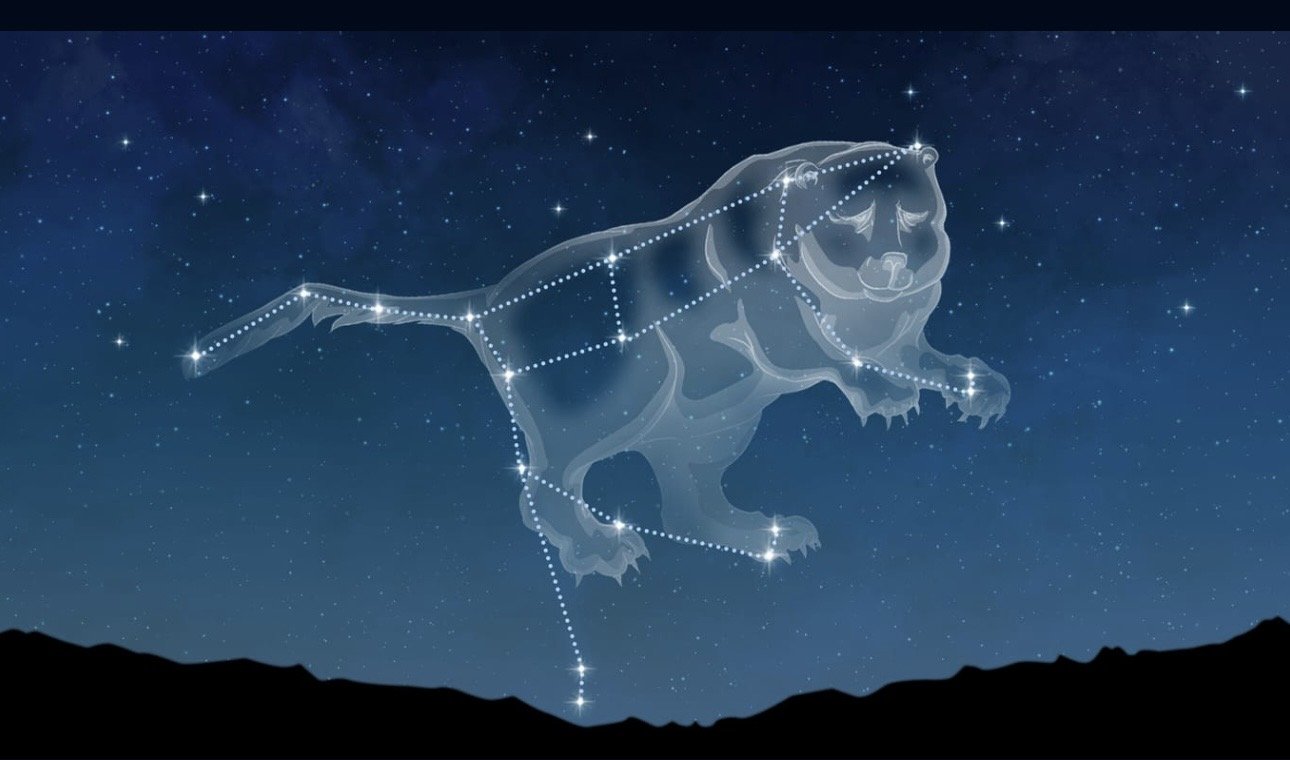
….1.Ursa Major (The Great Bear).. 1. La Osa Mayor (La Gran Osa)….

  • ….Best Seen: Year-round (Northern Hemisphere) .. La mejor época para visitarlo: todo el año (hemisferio norte) …..

  • ….Key Feature: The Big Dipper (an asterism within the larger constellation)..Característica destacada: La Osa Mayor (un asterismo dentro de la constelación más amplia)….

  • ….Deep-Sky Targets: M101 (Pinwheel Galaxy) and M81/M82 galaxies..Objetos del cielo profundo: M101 (Galaxia del Molinete) y las galaxias M81/M82….

….Often the first pattern many people learn, the Big Dipper isn't technically a constellation itself, but rather an asterism (a recognizable pattern of stars) within Ursa Major. Its seven bright stars form a distinctive ladle shape that ancient cultures associated with a bear. .. La Osa Mayor, que suele ser la primera constelación que aprenden muchas personas, no es técnicamente una constelación en sí misma, sino más bien un asterismo (una formación reconocible de estrellas) dentro de la constelación de la Osa Mayor. Sus siete estrellas brillantes forman una característica forma de cucharón que las culturas antiguas asociaban con un oso. ….

….Why it's important: It is your ultimate cosmic compass. The two stars at the end of the Dipper's "bowl" (Dubhe and Merak) act as pointer stars. Draw an imaginary line through them and extend it about five times the distance between them, and you'll land right on Polaris, the North Star. .. Por qué es importante: Es tu brújula cósmica definitiva. Las dos estrellas situadas en los extremos del «cuenco» de la Osa Mayor (Dubhe y Merak) actúan como estrellas guía. Traza una línea imaginaria que pase por ellas y alárgala hasta alcanzar aproximadamente cinco veces la distancia que hay entre ambas, y llegarás directamente a Polaris, la Estrella Polar. ….

URSA MINOR

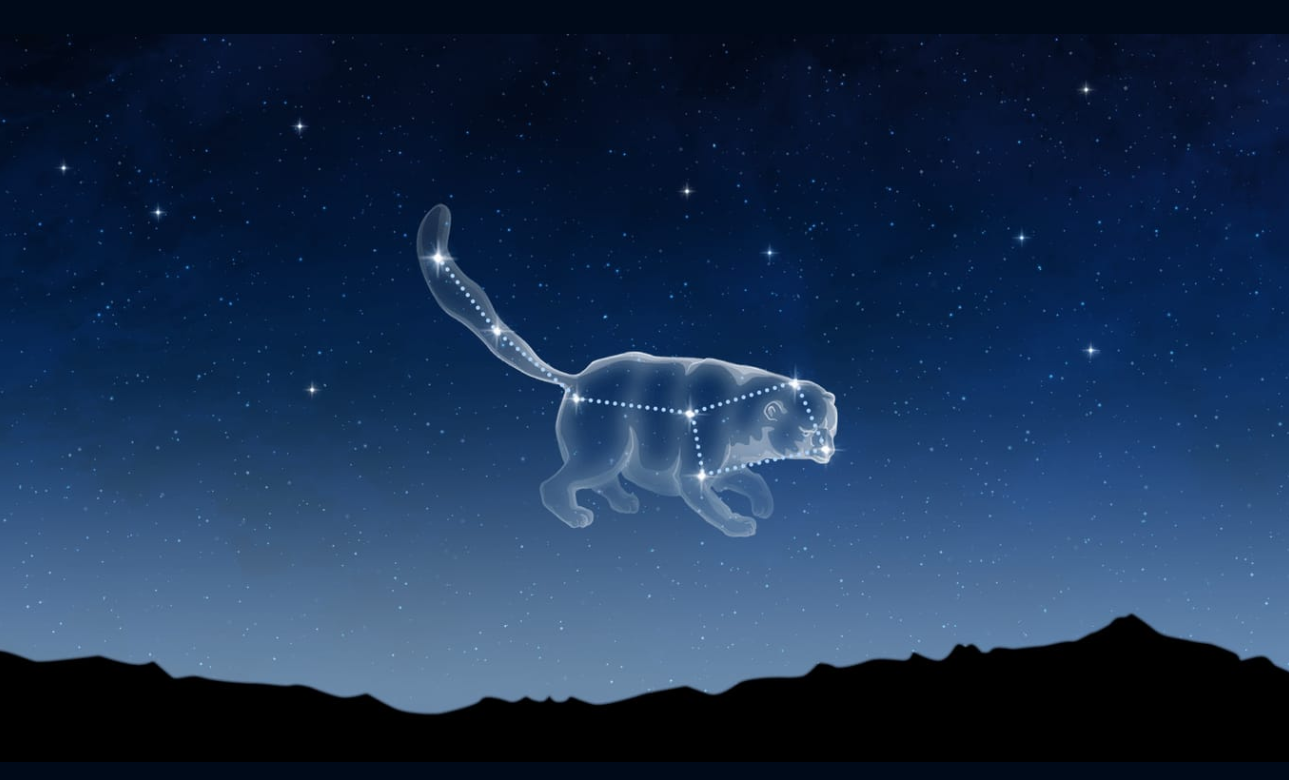
….2.Ursa Minor (The Little Bear).. 2.La Osa Menor (La Osa Pequeña)….

  • ….Best Seen: Year-round (Northern Hemisphere).. La mejor época para visitarlo: todo el año (hemisferio norte)….

  • ….Key Feature: The Little Dipper asterism..Característica destacada: el asterismo de la Osa Menor….

  • ….Key Star: Polaris (The North Star)..Estrella destacada: Polaris (la Estrella Polar)….

….The Little Dipper is the smaller, fainter companion to Ursa Major. While its stars are dimmer and can be tough to see in light-polluted cities, it holds the most important star in the northern sky. .. La Osa Menor es la compañera más pequeña y menos brillante de la Osa Mayor. Aunque sus estrellas son más tenues y pueden resultar difíciles de ver en ciudades con contaminación lumínica, alberga la estrella más importante del cielo del norte. ….

….Why it's important: Polaris sits at the very tip of the Little Dipper’s handle. Because it sits directly above Earth's North Pole, it stays fixed in the sky while all other stars appear to rotate around it. Finding it solidifies your navigational skills. .. Por qué es importante: Polaris se encuentra en el extremo del mango de la Osa Menor. Como está situada justo encima del Polo Norte de la Tierra, permanece fija en el cielo, mientras que todas las demás estrellas parecen girar a su alrededor. Encontrarla te ayuda a consolidar tus habilidades de orientación…..

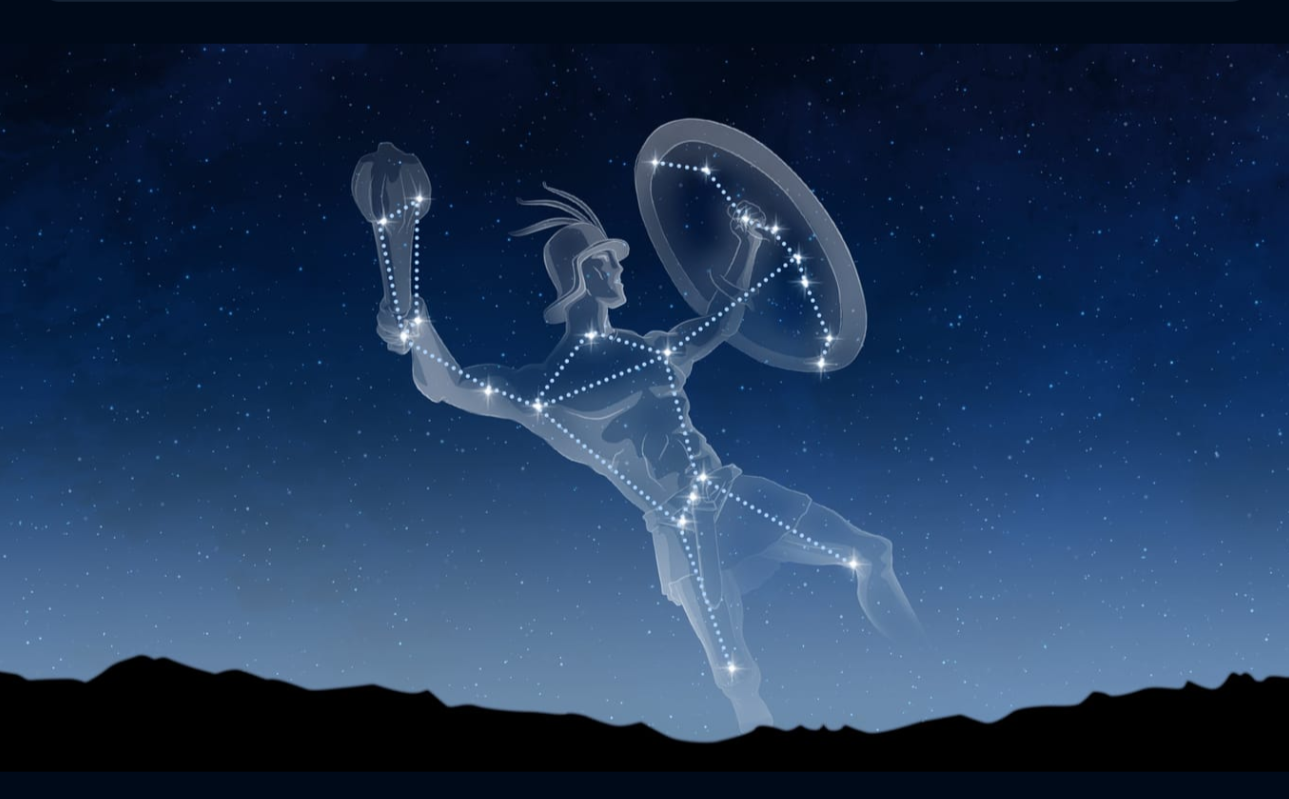
….3.Orion (The Hunter).. 3.Orión (El Cazador)….

ORION

  • ….Best Seen: Winter (Northern Hemisphere) / Summer (Southern Hemisphere)..La mejor época para visitarlo: invierno (hemisferio norte) / verano (hemisferio sur)….

  • ….Key Stars: Betelgeuse (red supergiant) and Rigel (blue supergiant)..Estrellas destacadas: Betelgeuse (supergigante roja) y Rigel (supergigante azul)….

  • ….Deep-Sky Targets: The Orion Nebula (M42)..Objetos del cielo profundo: la Nebulosa de Orión (M42)….

….Orion is arguably the most magnificent and easily recognised constellation in the entire night sky. It is dominated by Orion’s Belt—a perfectly straight line of three bright stars representing the hunter's waist. .. Podría decirse que Orión es la constelación más magnífica y fácilmente reconocible de todo el cielo nocturno. En ella destaca el Cinturón de Orión, una línea perfectamente recta formada por tres estrellas brillantes que representan la cintura del cazador. ….

….Why it's important: Orion is a brilliant display of stellar evolution, contrasting the dying red supergiant Betelgeuse with the young, furious blue supergiant Rigel. Follow the belt downwards, and it points directly to Sirius, the brightest star in the sky. Look just below the belt, and you can see the Orion Nebula, a massive stellar nursery, with the naked eye. .. Por qué es importante: Orión es un magnífico ejemplo de evolución estelar, en el que contrasta la supergigante roja moribunda Betelgeuse con la joven y furiosa supergigante azul Rigel. Si sigues el cinturón hacia abajo, este apunta directamente a Sirio, la estrella más brillante del cielo. Si miras justo debajo del cinturón, podrás ver a simple vista la Nebulosa de Orión, una enorme cuna estelar. ….

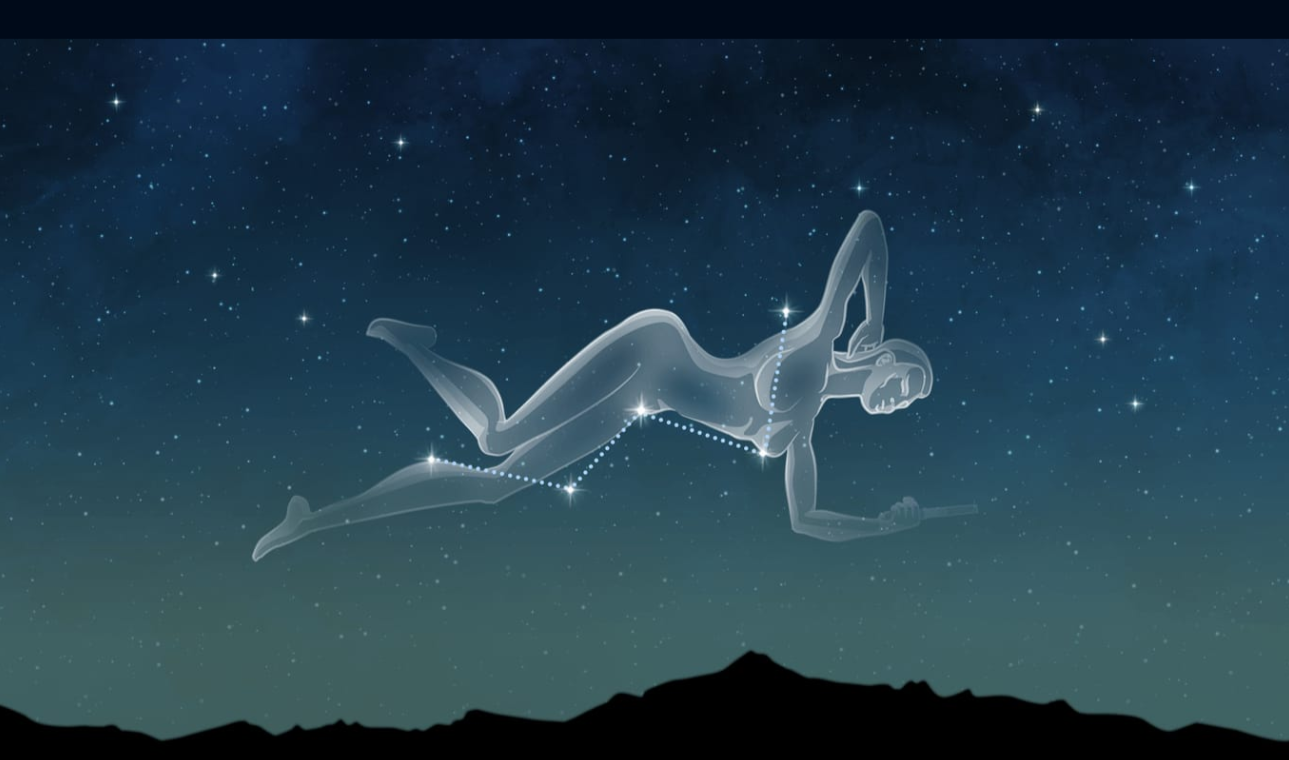
….4.Cassiopeia (The Queen).. 4.Casiopea (La Reina)….

CASSIOPEIA

  • ….Best Seen: Year-round (Northern Hemisphere) .. La mejor época para visitarlo: todo el año (hemisferio norte) ….

  • ….Key Feature: A distinctive "W" or "M" shape.. Característica principal: una forma distintiva de “W” o “M” ….

  • ….Deep-Sky Targets: The Andromeda Galaxy (M31)..Objetos del cielo profundo: la Galaxia de Andrómeda (M31)….

….Representing a vain queen on her throne, Cassiopeia consists of five bright stars that form a highly recognisable zig-zag shape. It sits directly opposite the Big Dipper, circling Polaris. .. Casiopea, que representa a una reina vanidosa en su trono, está formada por cinco estrellas brillantes que dibujan una figura en zigzag muy reconocible. Se encuentra justo enfrente de la Osa Mayor, girando en torno a la Estrella Polar. ….

….Why it's important: When the Big Dipper dips too low toward the horizon, Cassiopeia rises high, making it an excellent alternative guidepost for finding North. Furthermore, its unique shape acts as a cosmic arrow that helps observers locate the Andromeda Galaxy, the nearest major galaxy to our own Milky Way. .. Por qué es importante: Cuando la Osa Mayor se inclina demasiado hacia el horizonte, Casiopea se eleva en el cielo, lo que la convierte en un excelente punto de referencia alternativo para orientarse hacia el norte. Además, su forma única actúa como una flecha cósmica que ayuda a los observadores a localizar la Galaxia de Andrómeda, la galaxia mayor más cercana a nuestra Vía Láctea. ….

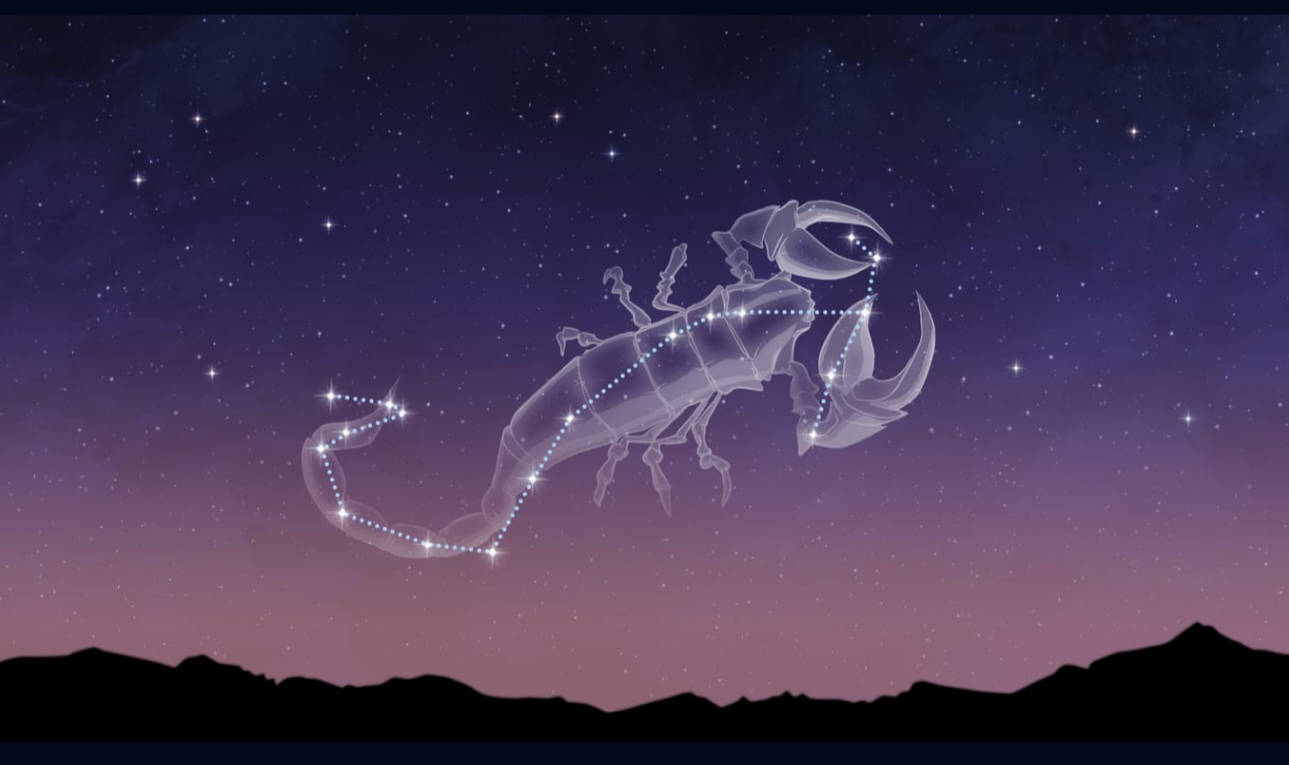
5. ….Scorpius (The Scorpion).. Escorpio (El Escorpión)….

SCORPIUS

  • ….Best Seen: Summer (Northern Hemisphere)/ Winter (Southern Hemisphere) .. Mejor época para visitarlo: verano (hemisferio norte)/invierno (hemisferio sur) ….

  • ….Key Star: Antares (a red supergiant known as the "Heart of the Scorpion") .. Estrella principal: Antares (una supergigante roja conocida como el “Corazón del Escorpión”) ….

  • ….Deep-Sky Targets: The Ptolemy Cluster (M7) and Butterfly Cluster (M6) .. Objetos del cielo profundo: el cúmulo de Ptolomeo (M7) y el cúmulo de la Mariposa (M6) ….

….Scorpius is one of the few constellations that actually looks exactly like its namesake. A striking, S-shaped curve of bright stars realistically traces out the body, claws, and curled stinger of a scorpion. .. Escorpio es una de las pocas constelaciones que se parece exactamente a lo que da nombre. Una llamativa curva en forma de S formada por estrellas brillantes traza de forma realista el cuerpo, las pinzas y el aguijón curvado de un escorpión. ….

….Why it's important: At the center of the scorpion's chest sits Antares, a fiery red supergiant so bright it is often mistaken for the planet Mars. Because Scorpius lies directly in front of the center of the Milky Way, its curved tail acts as a gateway to a dense playground packed with nebulae and star clusters. .. Por qué es importante: En el centro del pecho del escorpión se encuentra Antares, una supergigante de color rojo intenso tan brillante que a menudo se confunde con el planeta Marte. Dado que la constelación de Escorpio se encuentra justo delante del centro de la Vía Láctea, su cola curvada actúa como puerta de entrada a un denso espacio repleto de nebulosas y cúmulos estelares. ….

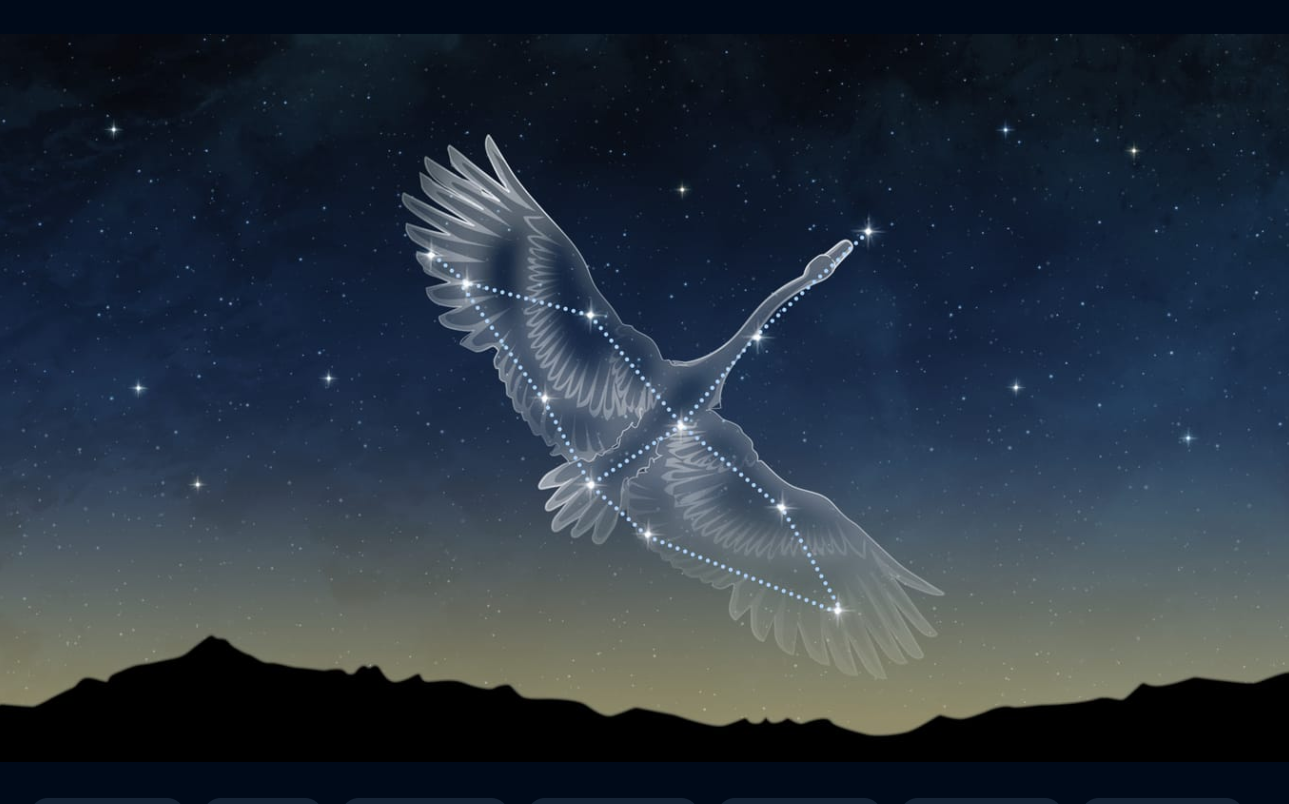
6. ….Cygnus (The Swan).. Cygnus (El Cisne)….

CYGNUS

  • ….Best Seen: Summer and Autumn (Northern Hemisphere) .. La mejor época para visitarlo: verano y otoño (hemisferio norte) ….

  • ….Key Feature: The Northern Cross asterism .. Característica destacada: el asterismo de la Cruz del Norte….

  • ….Key Stars: Deneb (supergiant) and Albireo (double star) .. Estrellas destacadas: Deneb (supergigante) y Albireo (estrella doble) ….

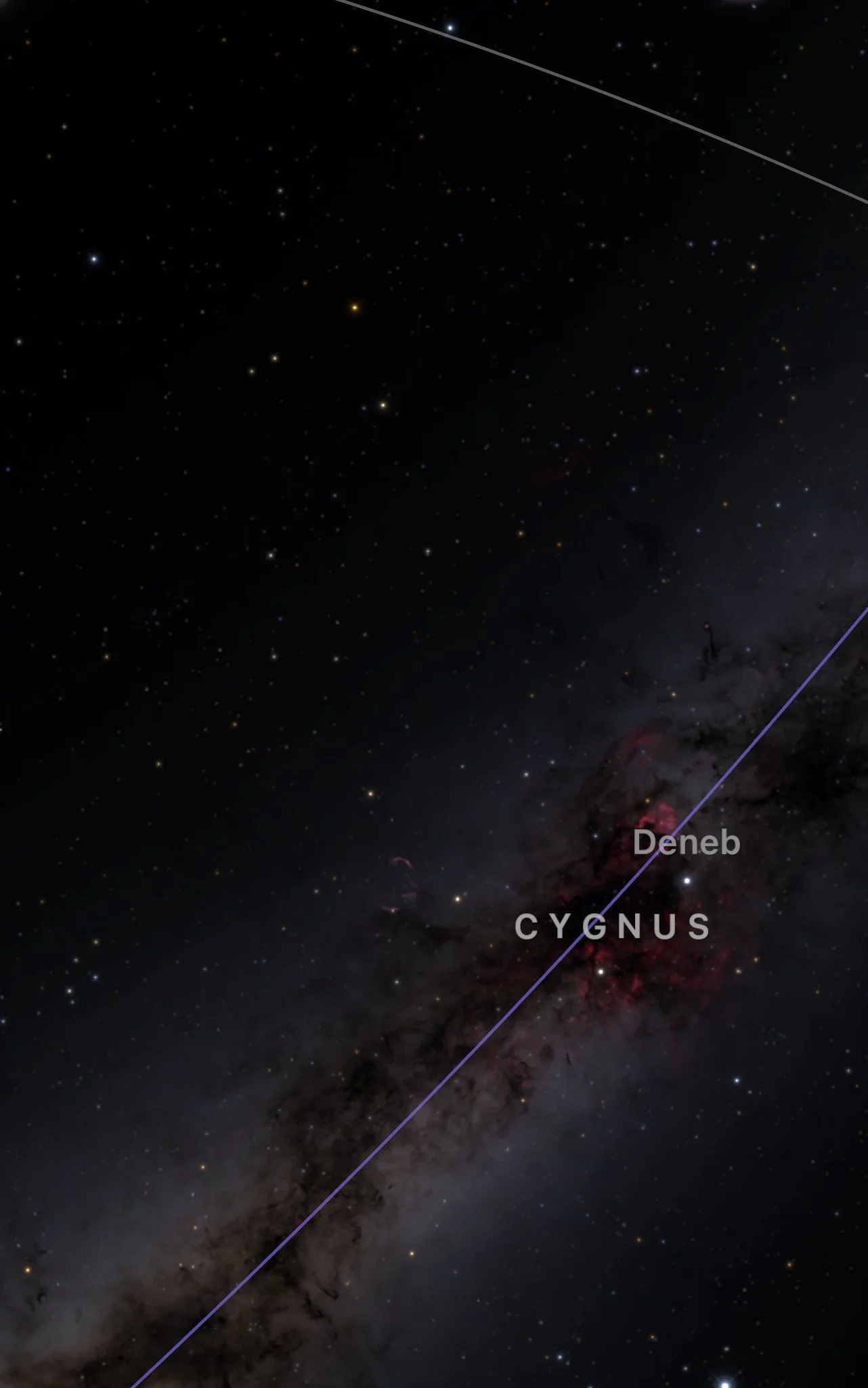
….Cygnus flies gracefully down the band of the Milky Way. Its brightest stars form the "Northern Cross," a geometric shape where the long vertical axis traces out the elegant neck of a flying swan. Deneb marks the swan's tail, while Albireo marks its beak. .. La constelación de Cygnus se extiende con elegancia a lo largo de la franja de la Vía Láctea. Sus estrellas más brillantes forman la «Cruz del Norte», una figura geométrica cuyo largo eje vertical traza el elegante cuello de un cisne en vuelo. Deneb marca la cola del cisne, mientras que Albireo marca su pico. ….

….Why it's important: Cygnus acts as a giant window into the structure of our own galaxy. Through binoculars, Albireo splits into a stunning double star of contrasting sapphire-blue and gold. Cygnus also famously houses Cygnus X-1, the very first confirmed black hole ever discovered. .. Por qué es importante: Cygnus es como una ventana gigante a la estructura de nuestra propia galaxia. A través de unos prismáticos, Albireo se divide en una impresionante estrella doble que contrasta el azul zafiro con el dorado. Cygnus también es famosa por albergar Cygnus X-1, el primer agujero negro confirmado que se descubrió jamás. ….

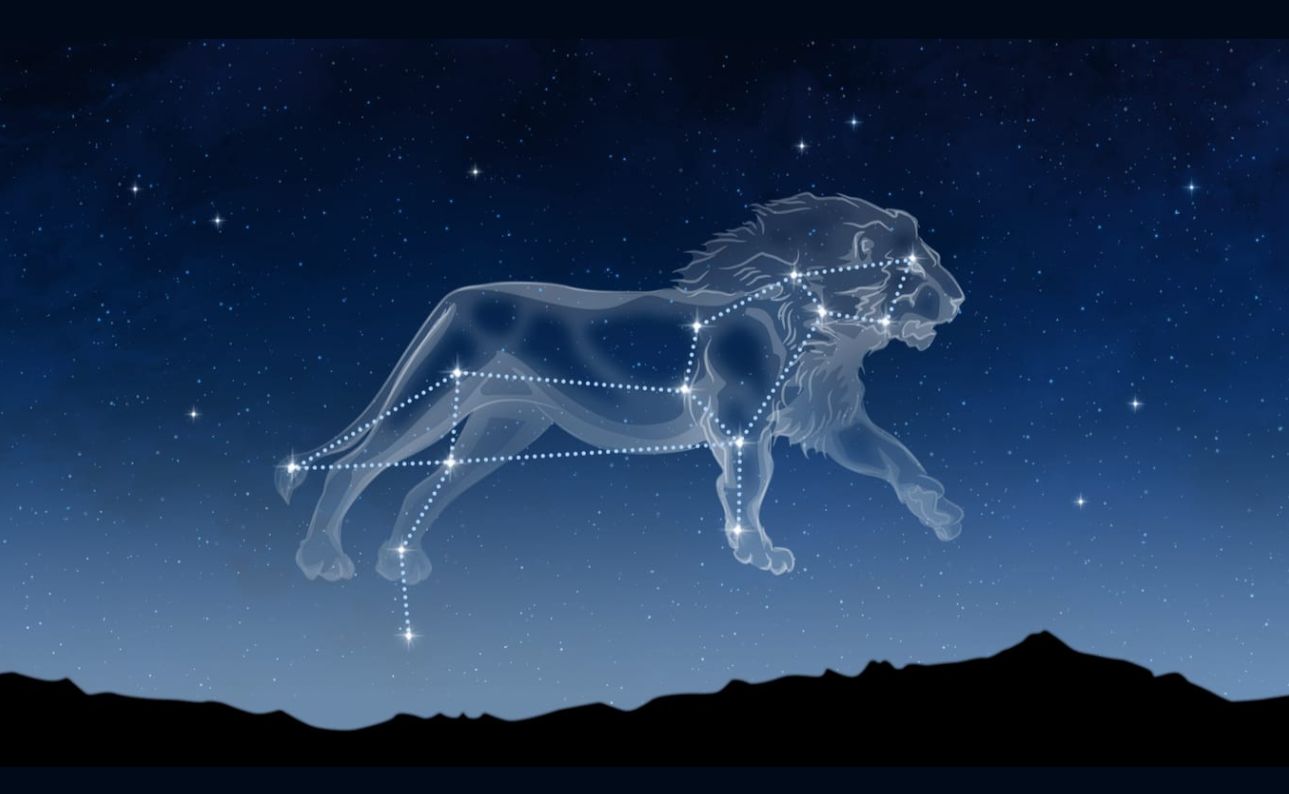
7. ….Leo (The Lion).. Leo (El León)….

LEO

  • ….Best Seen: Spring (Northern Hemisphere)..La mejor época para visitarlo: primavera (hemisferio norte)….

  • ….Key Feature: The "Sickle" asterism (resembling a backward question mark).. Característica destacada: el asterismo “Sickle” (que se asemeja a un signo de interrogación al revés) ….

  • ….Key Star: Regulus (the lion's heart) .. Estrella clave: Regulus (el corazón del león)….

….East of Cancer lies Leo, a prominent zodiac constellation that actually resembles a crouching lion. The lion's head and mane are formed by a distinctive backward question mark pattern called "The Sickle." .. Al este de Cáncer se encuentra Leo, una destacada constelación del zodíaco que, de hecho, se asemeja a un león agazapado. La cabeza y la melena del león están formadas por un característico patrón en forma de signo de interrogación invertido llamado “La Hoza”. ….

….Why it's important: Regulus, Leo's brightest star, was heavily relied upon by ancient navigators. For modern stargazers, Leo serves as a fantastic landmark in the spring sky and acts as the perfect guidepost for locating the "Leo Triplet"—a beautiful trio of interacting galaxies visible through binoculars or small telescopes. .. Por qué es importante: Regulus, la estrella más brillante de Leo, era un punto de referencia fundamental para los navegantes de la antigüedad. Para los observadores de estrellas actuales, Leo constituye un fantástico punto de referencia en el cielo primaveral y sirve de guía perfecta para localizar el «Trío de Leo», un hermoso trío de galaxias que interactúan entre sí y que se puede observar con prismáticos o pequeños telescopios. ….

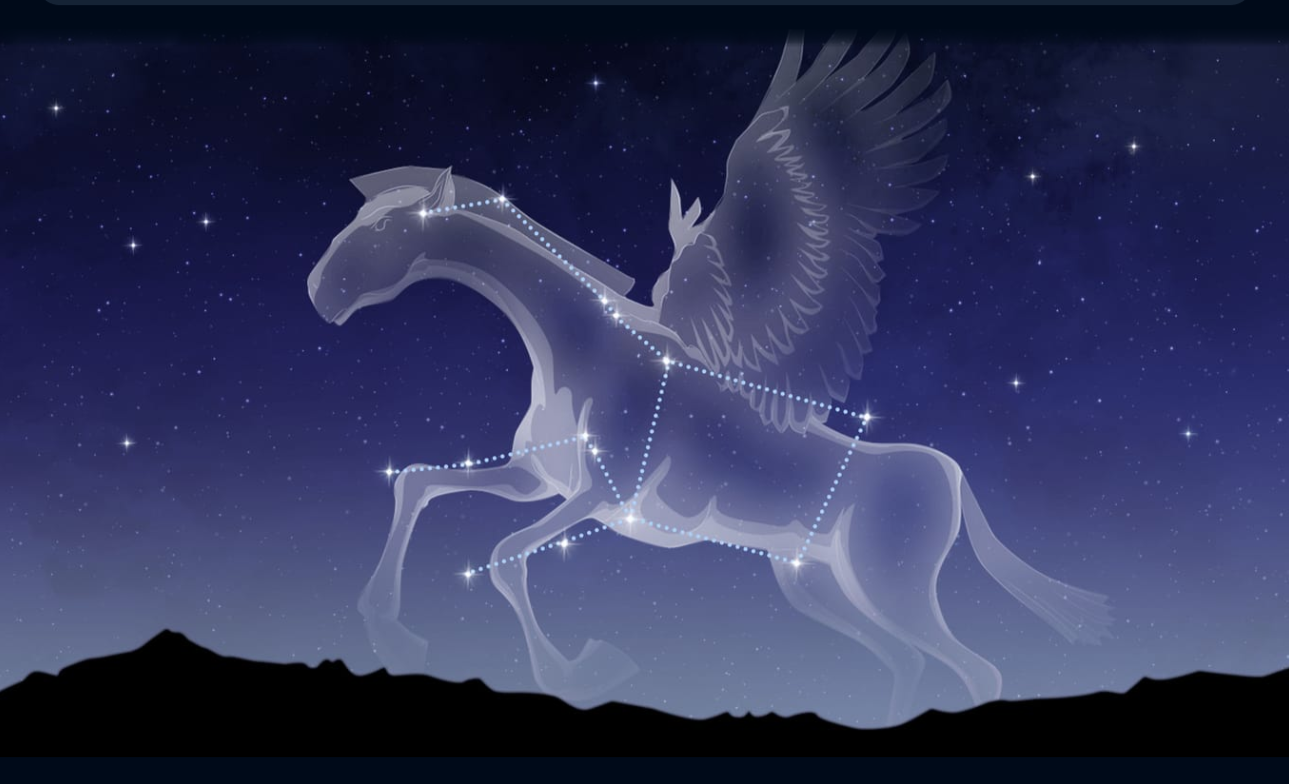
8. ….Pegasus (The Winged Horse).. Pegaso (el caballo alado) ….

PEGASUS

  • Best Seen: Autumn (Northern Hemisphere)

  • Key Feature: The Great Square of Pegasus

  • Deep-Sky Targets: M15 (a dense globular star cluster)

….Dominating the autumn evening sky, Pegasus is representing the mythical winged horse. Stargazers should look for the "Great Square," a massive, distinct four-star pattern that forms the main body of the horse. .. Pegaso, que domina el cielo de las tardes de otoño, representa al mítico caballo alado. Los observadores de estrellas deberían buscar el «Gran Cuadrado», una formación enorme y bien definida de cuatro estrellas que conforma el cuerpo principal del caballo. ….

….Why it's important: Pegasus is a fundamental navigational gateway to the autumn sky, helping you locate neighboring constellations like Andromeda and Pisces. Historically, it is also famous for housing 51 Pegasi, the very first sun-like star discovered to host an orbiting exoplanet. .. Por qué es importante: Pegaso es una referencia fundamental para orientarse en el cielo otoñal, ya que ayuda a localizar constelaciones vecinas como Andrómeda y Piscis. Históricamente, también es famosa por albergar a 51 Pegasi, la primera estrella similar al Sol en la que se descubrió un exoplaneta en órbita. ….

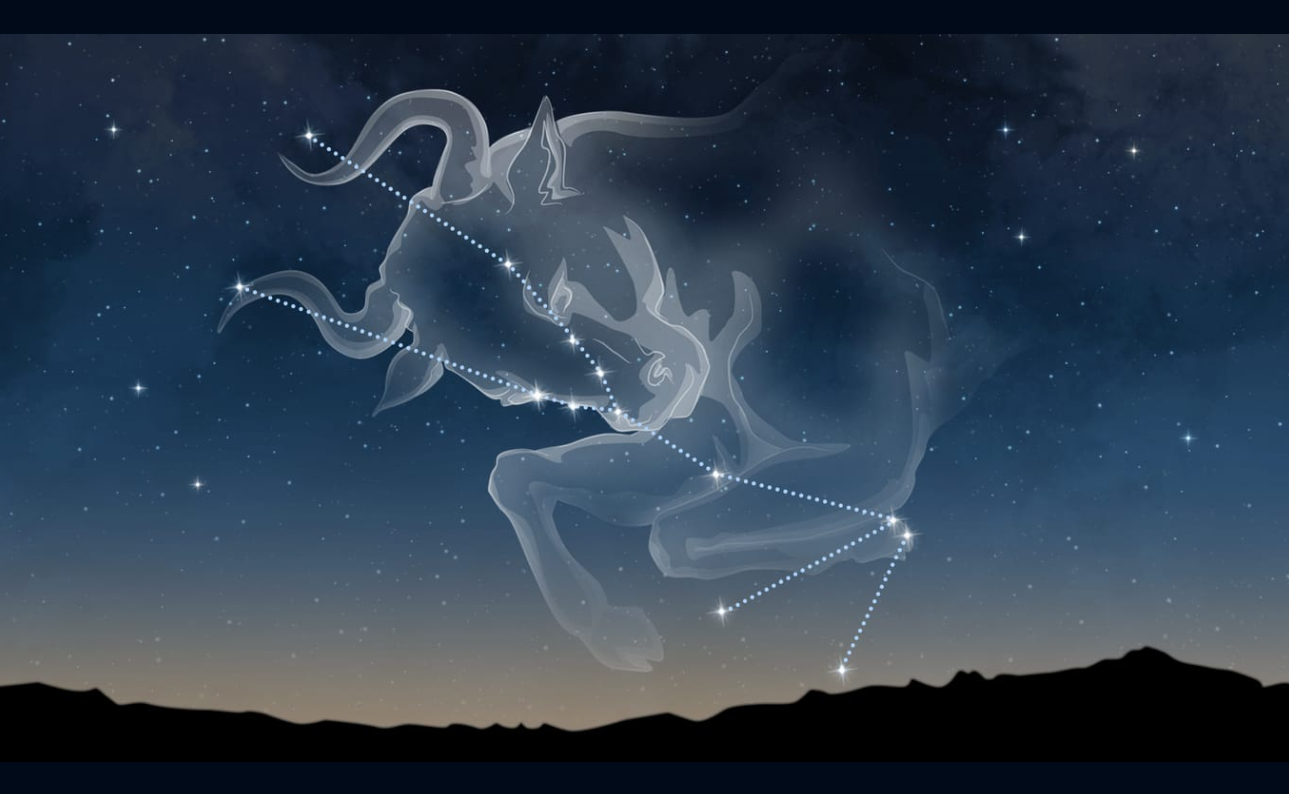
TAURUS

9. ….Taurus (The Bull).. Tauro (El Toro)….

  • ….Best Seen: Winter (Northern Hemisphere) .. La mejor época para visitarlo: invierno (hemisferio norte) ….

  • ….Key Star: Aldebaran (a red giant marking the bull's eye) .. Estrella principal: Aldebarán (una gigante roja que marca el ojo del toro) ….

  • …. Deep-Sky Targets: The Pleiades (Seven Sisters) and the Crab Nebula (M1) .. Objetos del cielo profundo: las Pléyades (las Siete Hermanas) y la Nebulosa del Cangrejo (M1) ….

….Located right next to Orion, Taurus is an iconic winter constellation. The face of the bull is formed by a V shaped cluster of stars called the Hyades, anchored by the fiery, reddish orange glare of the giant star Aldebaran. .. Situada justo al lado de Orión, Tauro es una constelación emblemática del invierno. La cara del toro está formada por un cúmulo de estrellas en forma de V llamado las Híades, con el resplandor ardiente, de color rojo anaranjado, de la estrella gigante Aldebarán como punto de referencia. ….

….Why it's important: Taurus is a masterclass in deep-sky objects. Just above the bull's shoulder sits the Pleiades (the Seven Sisters), a stunning, fuzzy cluster of blue stars easily visible to the naked eye. Taurus also contains the Crab Nebula, the ghostly, expanding remnant of a supernova observed by astronomers in the year 1054. .. Por qué es importante: Tauro es un auténtico ejemplo de objetos del cielo profundo. Justo por encima del hombro del toro se encuentran las Pléyades (las Siete Hermanas), un impresionante y difuso cúmulo de estrellas azules fácilmente visible a simple vista. Tauro también alberga la Nebulosa del Cangrejo, el fantasmal y en expansión remanente de una supernova observada por los astrónomos en el año 1054. ….

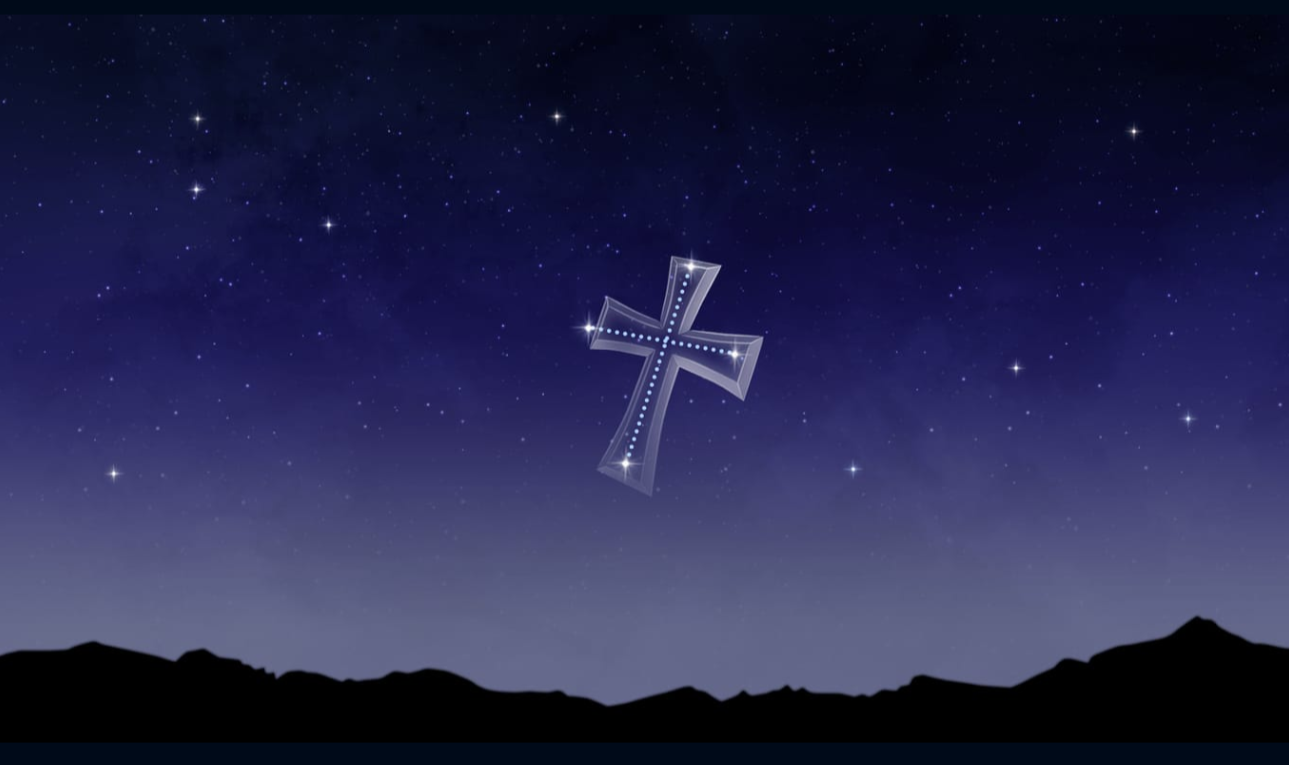
10. ….Crux (The Southern Cross)..Crux (La Cruz del Sur)….

CRUX

  • ….Best Seen: Year-round (Southern Hemisphere) .. Mejor época para visitarlo: todo el año (hemisferio sur) ….

  • ….Key Feature: A compact cross flanked by the "Southern Pointers" .. Característica destacada: una cruz compacta flanqueada por los “Southern Pointers” ….

  • ….Deep-Sky Targets: The Jewel Box Cluster and the Coalsack Nebula .. Objetos del cielo profundo: el cúmulo «Jewel Box» y la nebulosa “Coalsack” ….

….Tucked inside the larger constellation Centaurus, Crux is the smallest of all 88 official constellations, but what it lacks in size, it makes up for in brightness. Four brilliant stars form a distinct, compact cross shape. .. Escondida en el interior de la constelación más grande, Centauro, Crux es la más pequeña de las 88 constelaciones oficiales, pero lo que le falta en tamaño lo compensa con su brillo. Cuatro estrellas brillantes forman una cruz bien definida y compacta. ….

….Why it's important: Crux is the ultimate celestial anchor for the Southern Hemisphere. Because there is no "South Star," stargazers use the long axis of the cross (guided by the nearby bright "Pointer Stars," Alpha and Beta Centauri) to locate the South Celestial Pole. It is so culturally iconic that it is proudly featured on the national flags of Australia, New Zealand, Brazil, Papua New Guinea, and Samoa. .. Por qué es importante: Crux es el punto de referencia celeste por excelencia del hemisferio sur. Dado que no existe una “Estrella del Sur”, los observadores del cielo utilizan el eje largo de la cruz (guiados por las brillantes «estrellas indicadoras» cercanas, Alfa y Beta Centauri) para localizar el polo sur celeste. Es un símbolo cultural tan emblemático que aparece con orgullo en las banderas nacionales de Australia, Nueva Zelanda, Brasil, Papúa Nueva Guinea y Samoa. ….

….By mastering just these 10 constellations, you’ve unlocked the basic road map of the universe. They will serve as your lifelong anchors, helping you orient yourself no matter where you travel in the world.

The next time you get a clear, moonless night, step outside, let your eyes adjust to the dark for 15 minutes, and look up. Start with what you know, and let the cosmic signposts guide you from there.

Happy stargazing!

..

Con solo dominar estas 10 constelaciones, habrás descifrado la hoja de ruta básica del universo. Te servirán de puntos de referencia para toda la vida, ayudándote a orientarte vayas donde vayas por el mundo.

La próxima vez que haya una noche clara y sin luna, sal al exterior, deja que tus ojos se adapten a la oscuridad durante 15 minutos y mira hacia arriba. Empieza por lo que ya conoces y deja que las señales cósmicas te guíen a partir de ahí.

¡Disfruta de la observación de las estrellas!

….

....Fuerteventura’s Milky Way: When to Witness the Galactic Core..La Vía Láctea en Fuerteventura: cuándo contemplar el núcleo galáctico....

….Fuerteventura isn’t just about golden beaches and volcanic landscapes. As one of Europe’s last sanctuaries with minimal light pollution, this Canary Island provides a front-row view of the Milky Way’s glittering core, where billions of stars converge into a celestial river. But when is this galactic marvel visible from Fuerteventura? .. Fuerteventura no es solo playas doradas y paisajes volcánicos. Al ser uno de los últimos santuarios de Europa con una contaminación lumínica mínima, esta isla canaria ofrece una vista privilegiada del resplandeciente núcleo de la Vía Láctea, donde miles de millones de estrellas convergen en un río celestial. Pero, ¿cuándo se puede contemplar esta maravilla galáctica desde Fuerteventura? ….

….Fuerteventura: Europe’s Cosmic Portal.. Fuerteventura: el portal cósmico de Europa….

….Geography Meets Astronomy The island is situated around 28° north of the equator. An incredible window to the Universe, with the whole of the Northern hemisphere and a large part of the Southern hemisphere being visible. The Milky Way, referring to the Sagittarius Arm and the Perseus Arm, are present in our sky for around 6 months of the Year! However, timing is everything as best viewing is when there is NO moon in the sky. Even with only 25% illumination, stars start to disappear and at 75% illumination the Milky Way is no longer visible.

Being an ancient volcanic island, with a fairly small population means that we have incredibly dramatic and beautifully wild and dark locations to observe this phenomena with your naked eyes, and also take some awesome photos! ..

La geografía se une a la astronomía. La isla está situada a unos 28° al norte del ecuador. Es una ventana increíble al universo, desde la que se puede ver todo el hemisferio norte y gran parte del hemisferio sur. ¡La Vía Láctea, concretamente el brazo de Sagitario y el brazo de Perseo, están presentes en nuestro cielo durante unos seis meses al año! Sin embargo, el momento lo es todo, ya que la mejor observación se produce cuando NO hay luna en el cielo. Incluso con solo un 25 % de iluminación, las estrellas empiezan a desaparecer y, con un 75 % de iluminación, la Vía Láctea ya no es visible.

Al ser una antigua isla volcánica con una población bastante reducida, contamos con lugares increíblemente espectaculares, bellos, salvajes y oscuros para observar este fenómeno a simple vista, ¡y también para hacer unas fotos impresionantes! ….

….When to Go: Milky Way visibility shifts slightly yearly due to Earth’s orbit. For 2026, core viewing begins in April, rising in the early hours of the morning, through to mid October, with optimal conditions from June to August.

Observing the Milky Way, with its billions of stars flowing through the night sky can leave you feeling a little small! It is that funny old paradox, you are completely insignificant but at the same time completely significant.

If you want to catch the Milky Way during our observations book in from mid June to mid October. BUT always check moon phase before planning a trip! ..

Cuándo ir: La visibilidad de la Vía Láctea varía ligeramente cada año debido a la órbita de la Tierra. En 2026, el periodo de observación principal comienza en abril, cuando sale en las primeras horas de la mañana y se prolonga hasta mediados de octubre, con condiciones óptimas de junio a agosto.

¡Observar la Vía Láctea, con sus miles de millones de estrellas surcando el cielo nocturno, puede hacerte sentir un poco pequeño! Es esa vieja y curiosa paradoja: eres completamente insignificante, pero al mismo tiempo completamente significativo.

Si quieres contemplar la Vía Láctea durante nuestras observaciones, reserva tu plaza desde mediados de junio hasta mediados de octubre. ¡PERO comprueba siempre la fase lunar antes de planificar un viaje! ….

Check here at: TimeandDate

…. Ideal Viewing Times .. Horarios ideales para observarla ….

…. May: core visible around midnight .. Mayo: el núcleo es visible alrededor de la medianoche….

….June: core visible from 11pm..Junio: el núcleo es visible a partir de las 23:00….

….July - September: visible from 10 PM ..Julio - septiembre: visible a partir de las 22:00 ….

….October: Catch it right after sunset (~8:30 PM). ..Octubre: se puede ver justo después de la puesta de sol (alrededor de las 20:30). ….

….Weather & Challenges..Clima y dificultades….

….Calima: Sahara dust storms (can haze skies). .. Calima: tormentas de polvo del Sáhara (pueden provocar neblina en el cielo). ….

….Moon phase: with only 25% illumination of the Moon, the Milky Way will start to disappear. Check Moon phase, including time of rising and setting to not be disappointed. .. Fase lunar: con solo un 25 % de iluminación de la Luna, la Vía Láctea empezará a desaparecer. Consulta la fase lunar, incluyendo la hora de salida y puesta, para no llevarte una decepción. ….

….Why Book a Guided Tour?..¿Por qué reservar una visita guiada?….

….Local expertise: Professional Guides with a passion to share their knowledge. ..Conocimiento de la zona: guías profesionales con ganas de compartir sus conocimientos. ….

….Gear included: Telescopes, binoculars and Lazer pointer, camera, rugs and blankets. Transport. .. Equipo incluido: telescopios, prismáticos, puntero láser, cámara, alfombras y mantas. Transporte. ….

….Photography-Focused: knowledge of all the best shooting locations .. Enfocado a la fotografía: conocimiento de los mejores lugares para hacer fotos. ….

….Tips:..Consejos:….

….Use a star tracker app: Stellarium or PhotoPills to locate the Milky Way..Utiliza una aplicación de seguimiento de estrellas, como Stellarium o PhotoPills, para localizar la Vía Láctea. ....

….Shoot with F2.8 or wider and sterdy tripod..Haz las fotos con una apertura de F2,8 o mayor y un trípode estable…..

….Shoot in RAW format to capture maximum detail for editing. .. Dispara en formato RAW para capturar el máximo detalle de cara a la edición. ….

….Dress warmly: Desert temps drop sharply at night. .. Abrígate bien: las temperaturas del desierto bajan mucho por la noche. ….

….Don’t Miss the Cosmic Show - with most of us living in light polluted cities, the stars are lost. Spending time in the darkness surrounded by the volcanic dessert landscape is a moment to re connect with Nature, with ourselves. To witness the Milky Way has got to be on the bucket list! ..

No te pierdas este espectáculo cósmico: como la mayoría vivimos en ciudades con contaminación lumínica, las estrellas se pierden de vista. Pasar un rato en la oscuridad, rodeado del paisaje desértico volcánico, es un momento para volver a conectar con la naturaleza y con nosotros mismos. ¡Contemplar la Vía Láctea tiene que estar en tu lista de cosas que hacer antes de morir! ….

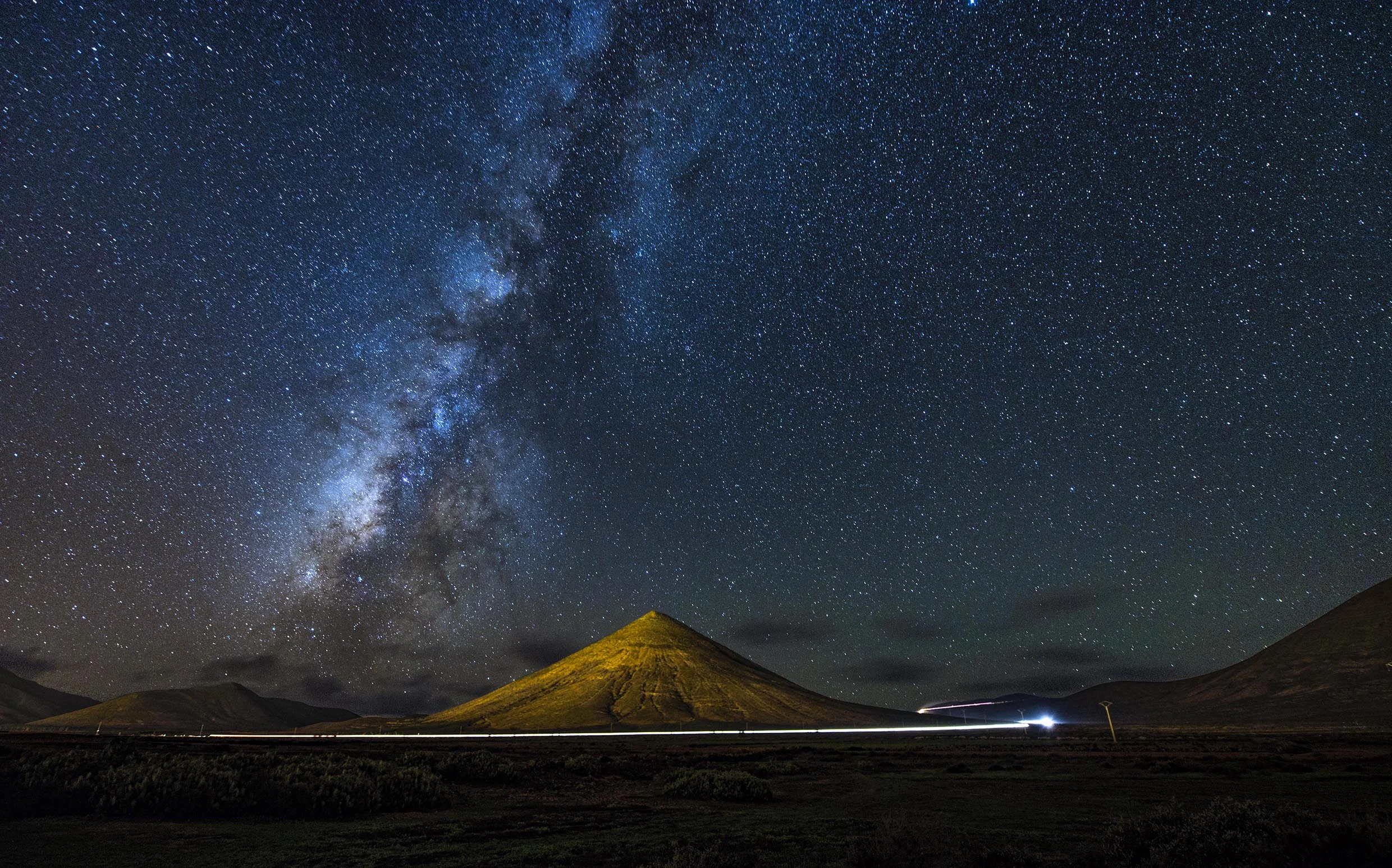
Milky Way over Fuerteventura

....Photographing the Full Moon: iPhone 15 Plus vs. the Corralejo Night Sky .. Fotografiar la luna llena: el iPhone 15 Plus frente al cielo nocturno de Corralejo ....

L to R: Main Camera 21:09, AstroShader 21:11, MoonTake 21:13,

BlackSight 21:26, NightCam 21:30, Lumina 21:37

Yamera 21:38, Fjorden 21:39, Pro Camera 21:40

….There's something magical about a full moon, especially when it hangs low over a dramatic landscape. Last month, the Pink Moon offered just such a spectacle, rising over the unique contours of the Corralejo Dunes here in Fuerteventura. Armed with my iPhone 15 Plus, a tripod, and a healthy dose of ambition, I set out to capture it. (Please note, my photos were severely lacking and too amateur. This is just an experiment for using apps on an iphone to capture the moon.) .. Hay algo mágico en la luna llena, sobre todo cuando se cierne baja sobre un paisaje espectacular. El mes pasado, la Luna Rosa nos ofreció precisamente ese espectáculo, al salir sobre los contornos únicos de las dunas de Corralejo, aquí en Fuerteventura. Armado con mi iPhone 15 Plus, un trípode y una buena dosis de ambición, me dispuse a capturarla. (Tened en cuenta que mis fotos dejaban mucho que desear y eran demasiado amateur. Esto no es más que un experimento para probar el uso de aplicaciones en un iPhone para fotografiar la luna). ….

….The Initial Hurdle: The Non-Pro Phone..El primer obstáculo: el teléfono no profesional….

….Right away, I knew I was facing an uphill battle. My iPhone 15 Plus is a fantastic phone, but it's not the "Pro" model. This primarily means less direct access to the manual camera controls that are crucial for tricky lighting situations like night photography. The native iPhone camera app, while brilliant for everyday snaps, tends to struggle when trying to balance an incredibly bright subject (the moon) against a very dark foreground (the dunes at night). Getting both in focus and properly exposed automatically? Nearly impossible. It usually results in either a blown-out white blob where the moon should be, or a completely black landscape.

Focus was the immediate and persistent enemy. Tapping to focus on the distant moon often left the dunes blurry, and focusing on the nearer dunes turned the moon into that dreaded bright smudge. Manual control was clearly needed. .. Desde el primer momento supe que me esperaba una tarea ardua. Mi iPhone 15 Plus es un móvil fantástico, pero no es el modelo «Pro». Esto significa, sobre todo, un menor acceso directo a los controles manuales de la cámara, que son cruciales en situaciones de iluminación complicadas, como la fotografía nocturna. La aplicación nativa de la cámara del iPhone, aunque es genial para las fotos cotidianas, suele tener dificultades a la hora de equilibrar un sujeto increíblemente brillante (la luna) con un primer plano muy oscuro (las dunas por la noche). ¿Conseguir que ambos estén enfocados y correctamente expuestos de forma automática? Casi imposible. Normalmente el resultado es o bien una mancha blanca sobreexpuesta donde debería estar la luna, o bien un paisaje completamente negro.

El enfoque era el enemigo inmediato y persistente. Al tocar la pantalla para enfocar la luna lejana, las dunas solían quedar borrosas, y al enfocar las dunas más cercanas, la luna se convertía en esa temida mancha brillante. Era evidente que se necesitaba el control manual. ….

….Gear Up: My Makeshift Setup..Prepárate: mi montaje improvisado….

….Knowing stability was key, I brought a tripod. However, attaching the phone securely needed some improvisation. I actually unscrewed the head from my regular tripod and replaced it with the phone clamp from a motorbike phone holder I had. It worked surprisingly well and even had a small spirit level on it, helping me keep things straight! .. Como sabía que la estabilidad era fundamental, me llevé un trípode. Sin embargo, para fijar bien el móvil tuve que improvisar un poco. De hecho, desatornillé la rótula de mi trípode habitual y la sustituí por la pinza para móvil de un soporte de moto que tenía. ¡Funcionó sorprendentemente bien e incluso tenía un pequeño nivel de burbuja que me ayudó a mantener todo recto! ….

….The App Store Deep Dive: A Quest for Control (on a Budget) .. Análisis en profundidad de la App Store: en busca del control (sin gastar mucho) ….

….Since the native app wasn't cutting it, I embarked on a digital quest, downloading a host of third-party camera apps renowned for offering more manual control or specific night modes. Crucially, I was sticking to free options or the free tiers of paid apps. Here’s the rundown of my experience: .. Como la aplicación nativa no me convencía, me lancé a una búsqueda digital y me descargué un montón de aplicaciones de cámara de terceros conocidas por ofrecer un mayor control manual o modos nocturnos específicos. Lo más importante es que me limité a las opciones gratuitas o a las versiones gratuitas de las aplicaciones de pago. Este es el resumen de mi experiencia: ….

  1. Native Camera: ….As mentioned, great for point-and-shoot, but inadequate for this specific challenge due to lack of accessible manual controls and focusing difficulties. .. como ya se ha mencionado, es ideal para «apuntar y disparar», pero resulta inadecuada para este reto concreto debido a la falta de controles manuales accesibles y a las dificultades para enfocar. ….

  2. AstroShader: ….This one took a different approach, automating much of the process. It did a good job, essentially asking you only to handle the focus. While the results were decent, the process felt a little clunky, and I prefer having more direct control. .. Este adoptó un enfoque diferente, automatizando gran parte del proceso. Funcionó bien, ya que básicamente solo te pedía que te encargaras del enfoque. Aunque los resultados fueron aceptables, el proceso me pareció un poco torpe, y prefiero tener un control más directo. ….

  3. Moontake: ….Gave this one a try, part of the initial wave of apps I downloaded. This app was genuinely amazing... for just the moon. It delivered crisp shots of the lunar surface. However, its singular focus meant I couldn't incorporate the beautiful dune landscape I was aiming for. A great tool, but not for this particular vision. .. Probé esta aplicación, que formaba parte de la primera tanda de aplicaciones que descargué. La aplicación era realmente increíble… pero solo para la Luna. Ofrecía imágenes nítidas de la superficie lunar. Sin embargo, al centrarse exclusivamente en eso, no me permitió incluir el precioso paisaje de dunas que quería capturar. Una herramienta estupenda, pero no para esta idea concreta. ….

  4. Blacksight: ….I really liked Blacksight. It seemed to handle the low light well and offered good control. I managed to get some promising shots lined up... until I reviewed them. The free version places a watermark directly over the center of the image, rendering it unusable for my purposes. A real shame, as the underlying tech felt capable. .. Blacksight me gustó mucho. Parecía gestionar bien las condiciones de poca luz y ofrecía un buen control. Conseguí encuadrar algunas fotos prometedoras… hasta que las revisé. La versión gratuita coloca una marca de agua justo en el centro de la imagen, lo que la hace inservible para mis fines. Es una verdadera lástima, ya que la tecnología subyacente parecía prometedora. ….

  5. Nightcam: ….Simple and easy to use. It even had a dedicated "Moon Mode." While convenient, the lack of a RAW option was a limitation for serious editing later. .. Sencillo y fácil de usar. Incluso tenía un “modo Luna” específico. Aunque resultaba muy práctico, la falta de una opción RAW suponía una limitación a la hora de realizar ediciones más avanzadas posteriormente. ….

  6. Lumina: ….This turned out to be a pleasant surprise. It offered basic, clear manual controls (ISO, shutter speed, focus) and, importantly, allowed saving in RAW format. Of all the apps I tried, Lumina felt the easiest to quickly jump into and adjust everything manually without intrusive prompts or limitations on the core function. .. Resultó ser una agradable sorpresa. Ofrecía controles manuales básicos y claros (ISO, velocidad de obturación, enfoque) y, lo que es más importante, permitía guardar las fotos en formato RAW. De todas las aplicaciones que probé, Lumina me pareció la más fácil de manejar desde el primer momento y la que permitía ajustar todo manualmente sin mensajes molestos ni limitaciones en las funciones básicas. ….

  7. Yamera: ….I found Yamera interesting for its ability to manipulate imagery in the dark. It seemed geared towards adjusting things after the fact or in challenging low light, which was useful, but didn't fully solve the initial capture problem. .. Yamera me pareció interesante por su capacidad para manipular las imágenes en la oscuridad. Parecía estar pensada para retocar las fotos a posteriori o en situaciones difíciles con poca luz, lo cual resultaba útil, pero no resolvía del todo el problema de la captura inicial. ….

  8. Fjorden: ….Visually, this was the most beautiful and elegantly designed app of the bunch. I'd read reviews suggesting it was free to use, but it seems that's changed. It now offers a 30-day free trial, after which it apparently becomes limited unless you purchase their physical camera grip accessory. A bit disappointing, as the interface was lovely. .. Visualmente, era la aplicación más bonita y con el diseño más elegante de todas. Había leído reseñas que sugerían que era gratuita, pero parece que eso ha cambiado. Ahora ofrece una prueba gratuita de 30 días, tras la cual, al parecer, las funciones se ven limitadas a menos que compres su accesorio físico de empuñadura para la cámara. Es un poco decepcionante, ya que la interfaz era preciosa. ….

  9. Pro Camera: ….This app looked promising! It boasted loads of options: slow shutter, burst, time-lapse, RAW capture, bracketing, even fisheye and AI settings. The catch? The free version was almost unusable due to constant pop-ups asking me to subscribe (€14.99 one-time or €9.99/year). Every adjustment triggered the prompt, making the experience incredibly frustrating. .. ¡Esta aplicación parecía prometedora! Ofrecía un montón de opciones: obturador lento, ráfaga, time-lapse, captura en RAW, bracketing e incluso ajustes para objetivos ojo de pez e inteligencia artificial. ¿El inconveniente? La versión gratuita era prácticamente inutilizable debido a las constantes ventanas emergentes que me pedían que me suscribiera (14,99 € de pago único o 9,99 € al año). Cada ajuste activaba el mensaje, lo que hacía que la experiencia resultara increíblemente frustrante. ….

….The Lingering Struggle: Focus, Focus, Focus .. La lucha que aún persiste: concentración, concentración, concentración ….

….Even with apps offering manual controls, achieving sharp focus on both the moon and the dunes remained the biggest challenge. The tiny screen, the distance differences, and the low light conspired against me. Peaking assistants in some apps helped, but it was a constant battle of trial and error. .. Aunque algunas aplicaciones ofrecen controles manuales, conseguir un enfoque nítido tanto de la luna como de las dunas siguió siendo el mayor reto. La pantalla diminuta, las diferencias de distancia y la escasa luz se confabularon en mi contra. Las funciones de ayuda al enfoque de algunas aplicaciones me ayudaron, pero fue una lucha constante de prueba y error. ….

….The Verdict: Learning More Than Capturing..El veredicto: aprender más que capturar….

….Did I get the award-winning, perfectly crisp shot of the Pink Moon hanging majestically over sharply defined dunes? Honestly, no. The limitations of the non-Pro phone sensor, the inherent difficulty of the shot, and the compromises of free apps meant the results were more 'attempt' than 'triumph'.

However, the experience was far from a failure. I learned a ton about the capabilities and limitations of my iPhone 15 Plus for night photography. I discovered the frustrating realities of free app tiers (watermarks, paywalls) and the different philosophies behind camera app design – from the fully automated (AstroShader) to the elegantly manual (Lumina) and the feature-rich but restricted (Classic Pro Camera).

Lumina emerged as my favourite free tool for manual control and RAW capture in this scenario. Blacksight showed promise but was torpedoed by the watermark. Moonshot proved excellent for its specific niche (moon only).

While I didn't capture the exact image I envisioned, the process of trying – experimenting with apps, wrestling with focus, and enjoying the quiet beauty of the dunes under the Pink Moon – was its own reward. And maybe, just maybe, it's time to start saving for that Pro model... or at least invest in the full version of an app that truly delivers.

..

¿Conseguí esa foto premiada, perfectamente nítida, de la Luna Rosa suspendida majestuosamente sobre unas dunas de contornos bien definidos? Sinceramente, no. Las limitaciones del sensor de un móvil que no es de gama alta, la dificultad inherente a la toma y las restricciones de las aplicaciones gratuitas hicieron que los resultados fueran más un «intento» que un “triunfo”.

Sin embargo, la experiencia distó mucho de ser un fracaso. Aprendí muchísimo sobre las capacidades y limitaciones de mi iPhone 15 Plus para la fotografía nocturna. Descubrí las frustrantes realidades de las versiones gratuitas de las aplicaciones (marcas de agua, barreras de pago) y las diferentes filosofías que hay detrás del diseño de las aplicaciones de cámara: desde las totalmente automatizadas (AstroShader) hasta las elegantemente manuales (Lumina) y las ricas en funciones pero con restricciones (Classic Pro Camera).

Lumina se reveló como mi herramienta gratuita favorita para el control manual y la captura en formato RAW en este contexto. Blacksight parecía prometedora, pero la marca de agua le echó por tierra. Moonshot demostró ser excelente para su nicho específico (solo la luna).

Aunque no capturé exactamente la imagen que tenía en mente, el proceso de intentarlo —experimentar con aplicaciones, luchar con el enfoque y disfrutar de la tranquila belleza de las dunas bajo la Luna Rosa— fue una recompensa en sí mismo. Y tal vez, solo tal vez, sea hora de empezar a ahorrar para ese modelo Pro… o al menos invertir en la versión completa de una aplicación que realmente cumpla con lo prometido.

….

….Have you tried capturing the moon with your phone? What apps or techniques have worked for you? Share your experiences in the comments below! .. ¿Has probado a fotografiar la luna con tu móvil? ¿Qué aplicaciones o técnicas te han funcionado? ¡Comparte tus experiencias en los comentarios!….

....Shooting Stars Alert: Don’t Miss the Lyrid Meteor Shower! .. Alerta de estrellas fugaces: ¡no te pierdas la lluvia de meteoros de las Líridas! ....

….Catch the Ancient Lyrid Meteor Shower Over Fuerteventura! .. ¡No te pierdas la histórica lluvia de estrellas de las Líridas sobre Fuerteventura! ….

….As mid-April skies darken over Fuerteventura, one of history's most storied meteor showers returns: the Lyrids! Mark your calendars – peaking soon, this annual celestial event offers a chance to witness shooting stars under potentially fantastic viewing conditions available across the island. Here’s what you need to know to catch the show. ..

Al oscurecer los cielos de Fuerteventura a mediados de abril, regresa una de las lluvias de estrellas más legendarias de la historia: ¡las Líridas! Marca la fecha en tu calendario: este evento celeste anual, que pronto alcanzará su punto álgido, brinda la oportunidad de contemplar estrellas fugaces bajo condiciones de observación potencialmente magníficas en toda la isla. Aquí tienes todo lo que necesitas saber para disfrutar del espectáculo.

....

…. What Are the Lyrids & Why Are They Special? .. ¿Qué son las Líridas y por qué son especiales? ….

….

The Lyrid meteor shower happens each April as Earth plows through the dusty trail left by Comet C/1861 G1 (Thatcher). When these tiny particles slam into our atmosphere at high speed (around 110,000 mph / 49 km/s), they vaporize brilliantly as meteors. ..

La lluvia de meteoros de las Líridas ocurre cada mes de abril, cuando la Tierra atraviesa el rastro de polvo dejado por el cometa C/1861 G1 (Thatcher). Cuando estas diminutas partículas chocan contra nuestra atmósfera a gran velocidad (unos 110.000 mph o 49 km/s), se vaporizan brillantemente convirtiéndose en meteoros. ….

….Key highlights make the Lyrids stand out: .. Algunos aspectos destacados hacen que las Líridas resalten: ….

  • ….An Ancient Legacy: They are the oldest documented meteor shower still observed, with Chinese astronomers recording them nearly 2,700 years ago in 687 BC! Watching connects us across millennia. .. Un legado ancestral: se trata de la lluvia de meteoros documentada más antigua que aún se observa; ¡los astrónomos chinos la registraron hace casi 2700 años, en el 687 a. C.! Su observación nos conecta a través de los milenios. ….

  • ….Potential for Surprises: While typically modest (10-20 meteors/hour peak), the Lyrids occasionally unleash dramatic 'outbursts' with over 100 per hour, as seen in 1982. .. Posibilidad de sorpresas: Aunque por lo general son modestas (con un pico de 10 a 20 meteoros por hora), las Líridas ocasionalmente protagonizan espectaculares «estallidos» de más de 100 meteoros por hora, como ocurrió en 1982. ….

  • ….Bright Meteors & Fireballs: They often produce bright meteors, frequently leaving persistent trails, and can sometimes produce exceptionally bright fireballs. .. Meteoros brillantes y bolas de fuego: A menudo producen meteoros brillantes, que frecuentemente dejan estelas persistentes, y a veces pueden generar bolas de fuego excepcionalmente brillantes. ….

  • ….Radiant Point: The meteors appear to originate from near the bright star Vega in the constellation Lyra (hence 'Lyrids'), which rises in the northeast later in the evening. .. Radiante: Los meteoros parecen originarse cerca de la brillante estrella Vega, en la constelación de Lyra (de ahí el nombre de «Líridas»), la cual sale por el noreste más avanzada la noche. ….

….Echoes Through Time: Myths and Legends .. Ecos a través del tiempo: mitos y leyendas ….

….This long and visible history means the Lyrids have naturally woven themselves into human culture and sky lore: .. Esta larga y visible historia ha hecho que las Líridas se integren de forma natural en la cultura humana y en la tradición asociada al cielo: ….

  • ….In Greek mythology, the shower appears to stream from near the constellation Lyra. This celestial lyre represents the magical instrument of Orpheus, the legendary musician said to possess the power to charm gods, humans, animals, and even inanimate objects with his music. He famously journeyed to the underworld attempting to retrieve his love, Eurydice. Witnessing stars fall from near his lyre could evoke powerful themes of music, love, loss, fate, and the profound connection between the heavens and earthly emotions. .. En la mitología griega, la lluvia de estrellas parece emanar de las proximidades de la constelación de Lyra. Esta lira celestial representa el instrumento mágico de Orfeo, el legendario músico a quien se atribuía el poder de cautivar a dioses, humanos, animales e incluso objetos inanimados con su música. Es célebre su viaje al inframundo en un intento por recuperar a su amada, Eurídice. Contemplar cómo caen estrellas cerca de su lira puede evocar temas profundos como la música, el amor, la pérdida, el destino y la conexión íntima entre el firmamento y las emociones humanas. ….

  • For ancient Chinese astronomers, who provided the earliest written records ('stars falling like rain'), keen observation of the skies was paramount for both calendrical and astrological purposes. While specific tales focused solely on the Lyrids are varied, meteors ( or falling stars) were often interpreted as significant omens or celestial messages. Depending on context and other celestial events, they might be seen as 'sky dragons' heralding vital rain for crops, or perhaps portents of important terrestrial events like battles or shifts in power.

When and Where to Watch in Fuerteventura (2025)

  • Activity Window: Generally active from about April 16 to April 25, 2025.

  • Peak Viewing: The best time to watch is during the predicted peak on the night of April 22-23, 2025. Aim for the hours between midnight and dawn, once the radiant (Lyra) is higher in the sky and the sky is darkest.

  • Moon Advantage: Fortunately, the Moon phase is ideal for the 2025 peak! A very thin waxing crescent moon will set early in the evening, leaving beautifully dark skies across Fuerteventura for meteor watching.

….Viewing Tips for Fuerteventura: .. Consejos para la observación en Fuerteventura: ….

  • …. Seek Darkness: Find the darkest possible location away from the lights of towns like Corralejo, Puerto del Rosario, Morro Jable, or other bright areas. Fuerteventura offers many beaches, inland plains, and viewpoints with reduced light pollution – essential for seeing fainter meteors. .. Busca la oscuridad: Busca el lugar más oscuro posible, lejos de las luces de localidades como Corralejo, Puerto del Rosario, Morro Jable u otras zonas iluminadas. Fuerteventura cuenta con numerosas playas, llanuras en el interior y miradores con escasa contaminación lumínica, algo esencial para ver los meteoros más tenues. ….

  • ….Adapt Your Eyes: Give your eyes at least 15-20 minutes to fully adjust to the darkness. Resist looking at your bright phone screen – use red light mode briefly only if absolutely necessary. .. Adapta la vista: Deja que tus ojos se acostumbren por completo a la oscuridad durante al menos 15 o 20 minutos. Evita mirar la pantalla brillante del móvil; utiliza el modo de luz roja brevemente solo si es estrictamente necesario. ….

  • …. Look Up & Be Patient: Lie back comfortably (a reclining chair or blanket helps) and gaze generally overhead or towards the northeast (where Lyra rises later). While the meteors radiate from Lyra, they can appear anywhere across the vast expanse of the sky. Patience is crucial – plan for at least an hour of observation. .. Mira hacia arriba y ten paciencia: Túmbate cómodamente (una silla reclinable o una manta te vendrán bien) y dirige la mirada hacia el cenit o hacia el noreste (donde sale la constelación de Lyra más tarde). Aunque los meteoros parecen irradiar desde Lyra, pueden aparecer en cualquier punto de la inmensidad del cielo. ….

  • ….Check the Weather: Hope for clear skies! Check the local Fuerteventura forecast closer to the peak nights. .. La paciencia es clave: reserva al menos una hora para la observación. Consulta la previsión meteorológica: ¡Esperemos que el cielo esté despejado! Consulta el pronóstico del tiempo en Fuerteventura a medida que se acerquen las noches de mayor actividad. ….

….The Harp in the Heavens: Connecting to Constellation Lyra

The name "Lyrid" itself is steeped in mythology. Meteor showers are named after the constellation from which they appear to radiate, and in this case, it's Lyra, the Harp.

In Greek mythology, Lyra is associated with the legendary musician Orpheus. Gifted a lyre by the god Apollo, Orpheus' music was said to be so beautiful it could charm even inanimate objects. One prominent myth tells of Orpheus' journey to the underworld to retrieve his deceased love, Eurydice, his music softening the hearts of Hades and Persephone. Though he tragically lost her again, his lyre was eventually placed in the heavens as the constellation Lyra, a testament to his musical talent and enduring love.

Therefore, when you witness the Lyrid meteors streaking across the sky, imagine them as celestial tears or perhaps even the lingering notes of Orpheus' mythical harp, forever echoing in the cosmos. Some depictions of the constellation even show an eagle carrying the lyre, adding another layer to the visual narrative in the night sky.

Beyond specific myths, "falling stars" held diverse cultural meanings. Some beliefs linked them to the passage of souls on celestial journeys. More widespread is the hopeful tradition, born from their fleeting beauty, of making a wish upon seeing one – a practice still cherished today.

Final Thought: A Cosmic Reminder

Meteor showers like the Lyrids remind us that Earth is constantly moving through space, sweeping up ancient comet dust. Each shooting star is a fleeting spark from the depths of the solar system, don’t miss your chance to wish upon one!

..

El arpa en los cielos: conectando con la constelación de Lyra

El propio nombre “Líridas” está impregnado de mitología. Las lluvias de meteoritos reciben el nombre de la constelación desde la que parecen irradiar y, en este caso, se trata de Lyra, el arpa.

En la mitología griega, Lyra se asocia con el legendario músico Orfeo. Se dice que la música de Orfeo, a quien el dios Apolo obsequió con una lira, era tan hermosa que podía encantar incluso a los objetos inanimados. Un mito destacado narra el viaje de Orfeo al inframundo para recuperar a su amada fallecida, Eurídice, y cómo su música ablandó los corazones de Hades y Perséfone. Aunque, trágicamente, volvió a perderla, su lira acabó colocándose en los cielos como la constelación de Lyra, un testimonio de su talento musical y de su amor eterno.

Por lo tanto, cuando veas las estrellas fugaces de las Líridas surcando el cielo, imagínalas como lágrimas celestiales o quizás incluso como las notas persistentes del mítico arpa de Orfeo, resonando para siempre en el cosmos. Algunas representaciones de la constelación muestran incluso un águila que lleva la lira, lo que añade otra dimensión a la narrativa visual del cielo nocturno.

Más allá de los mitos concretos, las «estrellas fugaces» tenían diversos significados culturales. Algunas creencias las vinculaban al paso de las almas en sus viajes celestiales. Más extendida es la tradición esperanzadora, nacida de su belleza fugaz, de pedir un deseo al ver una , una práctica que aún hoy se mantiene viva.

Reflexión final: un recordatorio cósmico

Las lluvias de meteoritos como las Líridas nos recuerdan que la Tierra se mueve constantemente por el espacio, arrastrando polvo de cometas ancestrales. Cada estrella fugaz es una chispa fugaz procedente de las profundidades del sistema solar: ¡no pierdas la oportunidad de pedir un deseo al ver una!

….

The Magic of Meteors: Shooting Stars, Fireballs, and Cosmic Debris

Have you ever gazed at the inky expanse of a clear night sky and witnessed a fleeting streak of light, a "shooting star" gracefully slicing through the darkness? It's a magical moment, a reminder of the vast universe surrounding us. But what exactly are these celestial sparklers, and when's the best time to catch them? Meteors—those breathtaking "shooting stars"—are among the most accessible and awe-inspiring astronomical phenomena. Let's explore what they are, their origins, and why they illuminate the night.

Why Do Some Meteors Glow Different Colors?

As a meteoroid plunges into Earth's atmosphere at incredible speeds, friction with the air molecules generates intense heat. This heat causes the meteoroid to vaporize, and the atoms within it become excited. When these excited atoms return to their normal energy state, they emit light at specific wavelengths, which we perceive as different colors. Think of it like a cosmic fireworks display! The colour depends on two things:

1. Chemical Composition

When a meteoroid burns up, its minerals ionize the air, creating different hues:

Yellow/Orange - Sodium

Yellow: Can also be sodium, but sometimes iron.

Green - Magnesium, Nickel

Blue - Ionized Calcium

Red - Atmospheric Nitrogen & Oxygen

2. Speed & Temperature

  • Faster meteors (like those from the Perseid shower) burn hotter and often appear white or blue.

  • Slower meteors (like the Leonids) may glow red or orange.

What Is a Meteor?

A meteor, often called a shooting star or falling star, is the flash of light we see when a small piece of space debris (a meteoroid) burns up as it enters Earth's atmosphere due to friction.

  • Meteoroid: A tiny rock or dust particle floating in space (usually from comets or asteroids).

  • Meteor: The bright streak of light produced as the meteoroid vaporizes.

  • Meteorite: If a meteoroid survives its fiery descent and hits the ground, it earns this name.

Most meteors are caused by particles no larger than a grain of sand, yet they create dazzling displays as they disintegrate at speeds of 30,000 to 160,000 mph!

Earth’s Rotation & Orbit: Imagine Earth as a car driving through rain—the windshield (the side facing forward) catches more raindrops than the rear window.

  • Before Midnight: You’re on Earth’s "trailing" side, so only fast-moving meteors can catch up.

  • After Midnight: You’re on the "leading" side, plowing directly into space debris, resulting in more frequent and brighter meteors.

Fireballs & Bolides: When Meteors Put on a Show

While most shooting stars are caused by tiny dust grains, a more spectacular event occurs when a larger meteoroid, typically pebble-sized or bigger, slams into our atmosphere. The increased mass and speed generate significantly more energy, resulting in an ultra-bright fireball.Occasionally, a larger meteoroid (pebble-sized or bigger) enters the atmosphere, creating an ultra-bright fireball.

  • Fireball: A meteor brighter than Venus (can even cast shadows!).

  • Bolide: A fireball that explodes (sometimes with a sonic boom).

Busting the Myth: Shooting Stars Aren't Dying Stars

Shooting stars have nothing to do with actual stars. Stars are enormous, light-years away. What we see is a tiny particle, often no bigger than a grain of dust (called a meteoroid), burning up in our atmosphere due to friction.

  • Stars (like our Sun) are massive, distant balls of plasma.

  • Meteors are tiny space rocks burning up in our atmosphere—some as small as a grain of dust!

So, the next time you make a wish upon a shooting star, remember that you're wishing on a tiny speck of cosmic dust making its dramatic, albeit brief, entrance into our world.

PHOTO: Simon Waldram @fuerteshoot

Meteorites: When Space Rocks Reach Earth

Few meteoroids survive their plunge to Earth, but those that do become meteorites. There are three main types:

  1. Stony (Chondrites) – Most common, made of silicate minerals.

  2. Iron – Dense, metallic, often from asteroid cores.

  3. Stony-Iron – A rare mix of both.

10 of the most famous meteorites in history, known for scientific importance, size, or dramatic falls:

Murchison Meteorite (Life’s Building Blocks)

Location: Victoria, Australia
Weight: ~100 kg
Fall: 1969
Type: CM2 Carbonaceous Chondrite
Key Discovery: Contains 70+ amino acids (some not found on Earth).

Sikhote-Alin Meteorite (Largest Iron Meteor Shower)

Location: Siberia, Russia
Weight: ~23 tons (scattered fragments)
Fall: Feb 12, 1947
Type: Iron (IIAB)
Impact: Created 122 craters (largest is 26m wide).

Canyon Diablo (Meteor Crater’s Origin)

Location: Arizona, USA
Weight: ~30 tons (fragments)
Impact: ~50,000 years ago
Type: Iron (IAB)
Legacy: Formed Barringer Crater (1.2 km wide).

Fukang Meteorite (Most Beautiful Pallasite)

Location: Xinjiang, China
Weight: ~1,003 kg
Found: 2000
Type: Pallasite (olivine crystals in iron-nickel)
Appearance: Looks like stained glass when sliced.

Nakhla Meteorite (The "Mars Meteorite")

Location: Egypt
Weight: ~10 kg
Fall: 1911 (hit a dog—allegedly!)
Type: Martian (Shergottite)
Importance: Proved Mars has water (contains hydrated minerals).

Hoba Meteorite (Largest Intact Meteorite)

Location: Namibia, Africa
Weight: ~60 tons (largest single meteorite on Earth)
Discovered: 1920
Type: Iron (84% Fe, 16% Ni)
Impact: Never moved—still in its original impact site!

Allende Meteorite (Most Studied Carbonaceous Chondrite)

Location: Chihuahua, Mexico
Weight: ~2 tons (fell as thousands of fragments)
Fall: 1969 (just before Apollo moon missions)
Type: CV3 Carbonaceous Chondrite
Importance: Contains pre-solar grains (older than the Sun!)

Chelyabinsk Meteorite (Most Dramatic Modern Impact)

Location: Chelyabinsk, Russia
Weight: ~1,400 kg (main fragment)
Fall: Feb 15, 2013 (exploded mid-air, injuring 1,500+)
Blast Force: ~30x Hiroshima nuke (non-nuclear)
Type: Ordinary Chondrite (LL5)
Famous For: Viral dashcam videos of the explosion.

Tunguska Event (Largest Meteor Airburst in History)

Location: Siberia, Russia
Estimated Size: ~50–100m wide (never found)
Event: June 30, 1908 (flattened 2,000 km² of forest)
Energy: ~10–15 megatons of TNT
Effect: Knocked people off feet 60 km away


Meteor Showers: Nature’s Fireworks Visible from Fuerteventura

1. Quadrantids

When: Late December – Early January (Peak: Jan 3–4)
Best Time: Pre-dawn hours
Rate: 60–120 meteors/hour (but brief peak)
Parent Body: Asteroid 2003 EH1
Notes: Fast, bright meteors; often has fireballs.

2. Lyrids

When: Mid-April (Peak: Apr 21–22)
Best Time: After midnight
Rate: 10–20 meteors/hour (sometimes outbursts)
Parent Body: Comet Thatcher (C/1861 G1)
Notes: Known for occasional bright fireballs.

3. Perseids (Best for Summer Viewing!)

When: Mid-July – Late August (Peak: Aug 12–13)
Best Time: Late night to dawn
Rate: 50–100 meteors/hour
Parent Body: Comet Swift-Tuttle
Notes: Bright, fast meteors; great for warm summer nights.

4. Orionids

When: October (Peak: Oct 20–21)
Best Time: After midnight
Rate: 10–20 meteors/hour
Parent Body: Halley’s Comet
Notes: Fast meteors, often leaves persistent trains.

5. Leonids

When: Mid-November (Peak: Nov 17–18)
Best Time: Late night to dawn
Rate: 10–15 meteors/hour (but can have storms every ~33 years)
Parent Body: Comet Tempel-Tuttle
Notes: Famous for historic meteor storms (next big one ~2033).

6. Geminids (Best of the Year!)

When: Early–Mid December (Peak: Dec 13–14)
Best Time: After 10 PM
Rate: 100–150 meteors/hour
Parent Body: Asteroid 3200 Phaethon
Notes: Bright, slow meteors; one of the most reliable showers.

Meteor showers are one of nature’s most magical displays—reminding us that the universe is alive with wonder, even in our own cosmic backyard. Whether you’re a seasoned stargazer or a first-time observer, there’s nothing quite like the thrill of spotting a shooting star streak across the night sky.


Exploring the Night Sky: A Guide to Stargazing Apps and Apple Watch integration. 

….As someone who loves exploring the wonders of the night sky, I’ll admit, it can feel overwhelming at times. There’s so much to see, so much to learn, and honestly, I often forget what’s even up there. That’s why I rely on stargazing apps to guide me. Unlike our seasoned lead Star Guide, who can glance up and effortlessly tell you the story behind a constellation or name every star in sight, I’m more of a novice. But that’s where these apps shine. There’s something truly magical about pointing my phone at the sky and instantly seeing the names of stars, planets, and constellations light up on my screen. It’s like having a personal tour guide to the cosmos, right in my pocket.

That said, these apps are a helpful tool, not a replacement for the experience of an actual stargazing tour. On our tours, we encourage you to switch off your devices, immerse yourself in nature, and simply gaze at the wonder of the night sky. It’s a chance to explore the breathtaking locations of Fuerteventura, disconnect from the digital world, and reconnect with the universe in its purest form. But when you’re not on a tour, these apps can be a fantastic way to continue your journey of discovery.

Let me be clear, I’m no expert, and I’m not here to declare these as the absolute best apps available. But they are the ones I’ve personally tried, enjoyed, and found accessible without being pushed into a subscription right off the bat. 

A quick note: I tested all of these apps on my iPhone 15 Plus and Apple Watch SE (2nd Generation), so my experience is based entirely on the iOS ecosystem. I haven’t tried them on Android, but I imagine the experience would be similar, as most of these apps are available on both platforms.

Below, I’ll walk you through the ones I’ve tested (not in order of preference): Sky TonightStar Walk 2Sky GuideNight SkyStellariumSkySafari, and SkyView Lite/SkyView.

..

Como amante de explorar las maravillas del cielo nocturno, tengo que admitir que a veces puede resultar abrumador. Hay tanto que ver, tanto que aprender y, sinceramente, a menudo se me olvida qué hay ahí arriba. Por eso confío en las aplicaciones para observar las estrellas para que me guíen. A diferencia de nuestro experimentado guía astronómico, que con solo levantar la vista puede contarte sin esfuerzo la historia que hay detrás de una constelación o nombrar todas las estrellas a la vista, yo soy más bien un novato. Pero ahí es donde estas aplicaciones brillan con luz propia. Hay algo verdaderamente mágico en apuntar con mi móvil hacia el cielo y ver al instante cómo se iluminan en mi pantalla los nombres de las estrellas, los planetas y las constelaciones. Es como tener un guía turístico personal del cosmos, justo en mi bolsillo.

Dicho esto, estas aplicaciones son una herramienta útil, pero no sustituyen a la experiencia de una excursión real de observación de estrellas. En nuestras excursiones, te animamos a que apagues tus dispositivos, te sumerjas en la naturaleza y simplemente contemples la maravilla del cielo nocturno. Es una oportunidad para explorar los impresionantes parajes de Fuerteventura, desconectar del mundo digital y volver a conectar con el universo en su forma más pura. Pero cuando no estés en una excursión, estas aplicaciones pueden ser una forma fantástica de continuar tu viaje de descubrimiento.

Que quede claro: no soy ningún experto, y no estoy aquí para afirmar que estas sean, sin lugar a dudas, las mejores aplicaciones disponibles. Pero son las que he probado personalmente, con las que he disfrutado y que me han parecido accesibles sin que me obliguen a suscribirme desde el primer momento. 

Una nota rápida: he probado todas estas aplicaciones en mi iPhone 15 Plus y en mi Apple Watch SE (2.ª generación), por lo que mi experiencia se basa íntegramente en el ecosistema iOS. No las he probado en Android, pero imagino que la experiencia sería similar, ya que la mayoría de estas aplicaciones están disponibles en ambas plataformas.

A continuación, te voy a presentar las que he probado (sin orden de preferencia): Sky Tonight, Star Walk 2, Sky Guide, Night Sky, Stellarium, SkySafari y SkyView Lite/SkyView.

….

….Star Walk 2: My Most-Used App for Stellar Information..Star Walk 2: mi aplicación favorita para obtener información sobre las estrellas….

….While Star Walk 2 isn’t necessarily my favourite app, it’s the one I’ve used the most because of its ease of understanding and ability to provide a general overview of the night sky. The interface is sleek, intuitive, and packed with detailed information about stars, planets, constellations, and deep-sky objects. Simply point your iPhone at the sky, and Star Walk 2 will identify what you’re looking at in real time. I love how it provides in-depth descriptions and historical context, making it feel like I’m carrying a portable planetarium in my pocket. The augmented reality (AR) feature is a standout, blending the night sky with your surroundings for an immersive experience. ..Aunque Star Walk 2 no es necesariamente mi aplicación favorita, es la que más he utilizado por su facilidad de uso y su capacidad para ofrecer una visión general del cielo nocturno. La interfaz es elegante, intuitiva y está repleta de información detallada sobre estrellas, planetas, constelaciones y objetos del cielo profundo. Basta con apuntar con el iPhone hacia el cielo para que Star Walk 2 identifique lo que estás viendo en tiempo real. Me encanta que ofrezca descripciones detalladas y contexto histórico, lo que me hace sentir como si llevara un planetario portátil en el bolsillo. La función de realidad aumentada (RA) destaca especialmente, ya que fusiona el cielo nocturno con tu entorno para ofrecer una experiencia inmersiva. ….

….Beyond its real-time sky mapping, Star Walk 2 offers handy features like Stargazing News, an Astronomy Calendar, and a section that highlights what’s visible tonight. There’s also a dedicated planet section for those who want to dive deeper into our solar system. While the app is free to use, there’s an optional lifetime subscription (currently €9.99 at the time of writing) that unlocks additional features—a small price to pay for such a powerful tool. .. Además de su mapa del cielo en tiempo real, Star Walk 2 ofrece funciones muy útiles como «Noticias sobre observación de estrellas», un «Calendario astronómico» y una sección que destaca lo que se puede ver esta noche. También hay una sección dedicada a los planetas para aquellos que quieran profundizar en nuestro sistema solar. Aunque la aplicación es gratuita, existe una suscripción de por vida opcional (que cuesta actualmente 9,99 € en el momento de escribir este artículo) que desbloquea funciones adicionales: un pequeño precio a pagar por una herramienta tan potente.

….

….Night Sky: A Stellar Choice for AR and Apple Watch Integration.. Night Sky: una opción estelar para la integración con la realidad aumentada y el Apple Watch ….

….Night Sky is one of my favourite apps, especially for its stunning augmented reality (AR) features and seamless Apple Watch integration. The app overlays constellations, planets, and satellites onto your camera view, creating a magical experience that feels like stepping into a planetarium. What sets it apart is its customisation options, you can track specific objects, set reminders for celestial events, and even share your sky view with friends. It’s perfect for both casual stargazers and those who want a more personalized experience. .. Night Sky es una de mis aplicaciones favoritas, sobre todo por sus impresionantes funciones de realidad aumentada (RA) y su perfecta integración con el Apple Watch. La aplicación superpone constelaciones, planetas y satélites sobre la imagen de la cámara, creando una experiencia mágica que te hace sentir como si estuvieras en un planetario. Lo que la distingue son sus opciones de personalización: puedes seguir objetos específicos, configurar recordatorios para eventos celestes e incluso compartir tu vista del cielo con tus amigos. Es perfecta tanto para los aficionados ocasionales a la observación de las estrellas como para aquellos que buscan una experiencia más personalizada. ….

….Apple Watch Integration .. Integración con el Apple Watch….

….The Apple Watch app is where Night Sky truly shines. When you hold your watch level, it acts as a compass, guiding you to point at the sky. As you move your wrist, you can see the constellations above you. Tap on one, and it tells you what it is; tap again, and you get detailed information. I have added  a short video on the side to give you a visual guide. It’s incredibly intuitive and makes stargazing feel like a hands-free experience. I also love the gentle notifications on my wrist, alerting me when something interesting, like the International Space Station or a bright planet is passing overhead. .. La aplicación para el Apple Watch es donde Night Sky realmente destaca. Cuando mantienes el reloj en posición horizontal, actúa como una brújula y te guía para que apuntes al cielo. A medida que mueves la muñeca, puedes ver las constelaciones que hay sobre ti. Toca una de ellas y te dirá cuál es; vuelve a tocarla y obtendrás información detallada. He añadido un breve vídeo al lado para ofrecerte una guía visual. Es increíblemente intuitiva y hace que observar las estrellas sea una experiencia en la que no tienes que usar las manos. También me encantan las sutiles notificaciones en mi muñeca, que me avisan cuando algo interesante, como la Estación Espacial Internacional o un planeta brillante, pasa por encima de mi cabeza. ….

….Free Version Features..Características de la versión gratuita….

….Night Sky offers a free version with a surprising number of features. You can track satellites (including Starlink), view constellation lines, explore mythology, add sky tags, check meteor shower forecasts, and even observe some deep-space objects. The app also lets you visualise the sky in different wavelengths, such as infrared, microwaves, radio, X-rays, gamma rays, ultraviolet, and more. If you grant camera access, you can view the sky in real time, blending the AR experience with your surroundings. .. Night Sky ofrece una versión gratuita con una sorprendente cantidad de funciones. Puedes seguir satélites (incluido Starlink), ver las líneas de las constelaciones, explorar la mitología, añadir etiquetas al cielo, consultar las previsiones de lluvias de meteoritos e incluso observar algunos objetos del espacio profundo. La aplicación también te permite visualizar el cielo en diferentes longitudes de onda, como infrarrojos, microondas, ondas de radio, rayos X, rayos gamma, ultravioleta y más. Si concedes acceso a la cámara, podrás ver el cielo en tiempo real, combinando la experiencia de realidad aumentada con tu entorno. ….

….Astrophotography Section..Sección de astrofotografía….

….One of the coolest features is the astrophotography section. If you give the app access to your camera settings on your phone, it helps you take stunning night photos by optimizing exposure, focus, and other settings for capturing the night sky. Whether you’re photographing the Milky Way or a meteor shower, this feature is a game-changer for anyone interested in night photography. .. Una de las funciones más interesantes es la sección de astrofotografía. Si le das a la aplicación acceso a los ajustes de la cámara de tu móvil, te ayuda a hacer impresionantes fotos nocturnas optimizando la exposición, el enfoque y otros ajustes para capturar el cielo nocturno. Tanto si estás fotografiando la Vía Láctea como una lluvia de meteoritos, esta función supone un gran avance para cualquiera que esté interesado en la fotografía nocturna. ….

….Subscription Options..Opciones de suscripción….

….For those who want to dive deeper, Night Sky offers a PLUS subscription. This unlocks advanced features like 1.7 billion stars with 10x zoom, aurora forecasts, AR planetary portals, and deeper customisation options. While the free version is fantastic for casual stargazers, the subscription is worth considering if you want to take your experience to the next level. .. Para aquellos que quieran profundizar más, Night Sky ofrece una suscripción PLUS. Esta suscripción da acceso a funciones avanzadas como 1.7 mil millones de estrellas con zoom de 10x, previsiones de auroras, portales planetarios de realidad aumentada y opciones de personalización más completas. Aunque la versión gratuita es fantástica para los observadores de estrellas ocasionales, merece la pena plantearse la suscripción si quieres llevar tu experiencia al siguiente nivel. ….

….Sky Guide: Elegant Design and Insightful Features.. Sky Guide: diseño elegante y funciones muy útiles ….

….While Sky Guide isn’t my favourite for Apple Watch integration, it’s still a beautifully designed app with some standout features, especially on the iPhone. Its clean interface and thoughtful details make it a joy to use, even if the Apple Watch experience is more basic. .. Aunque Sky Guide no es mi favorita en cuanto a integración con el Apple Watch, sigue siendo una aplicación con un diseño magnífico y algunas funciones destacadas, sobre todo en el iPhone. Su interfaz sencilla y sus detalles bien pensados hacen que sea un placer usarla, aunque la experiencia con el Apple Watch sea más básica. ….

….Apple Watch Experience..Experiencia con el Apple Watch….

….On the Apple Watch, Sky Guide is fairly simple. When you first activate it, you’ll see the sun’s activity. Swipe from right to left, and you’ll get information about the moon and the International Space Station (ISS). While it’s handy for quick glances, it doesn’t offer much depth or interactivity compared to other apps. For me, Night Sky shines brighter on the Apple Watch.  .. En el Apple Watch, Sky Guide es bastante sencilla. Cuando la actives por primera vez, verás la actividad solar. Desliza el dedo de derecha a izquierda y obtendrás información sobre la Luna y la Estación Espacial Internacional (ISS). Aunque resulta práctica para echar un vistazo rápido, no ofrece mucha profundidad ni interactividad en comparación con otras aplicaciones. En mi opinión, Night Sky destaca más en el Apple Watch. ….

….iPhone Experience..Experiencia con el iPhone….

….The iPhone app is where Sky Guide truly excels. It features a beautifully presented calendar of celestial events and curated posts that highlight interesting phenomena in the night sky. The app also includes rich mythology stories and constellation lines, adding a layer of storytelling to your stargazing. One of my favorite features is the ability to visualize satellites in different modes, including night vision, which makes tracking them easier and more immersive. .. La aplicación para iPhone es donde Sky Guide realmente destaca. Cuenta con un calendario de eventos celestes muy bien presentado y publicaciones seleccionadas que destacan fenómenos interesantes en el cielo nocturno. La aplicación también incluye interesantes relatos mitológicos y trazados de constelaciones, lo que añade una dimensión narrativa a la observación de las estrellas. Una de mis funciones favoritas es la posibilidad de visualizar los satélites en diferentes modos, incluida la visión nocturna, lo que hace que seguirlos sea más fácil y una experiencia más envolvente. ….

….Subscription Options..Opciones de suscripción….

….Sky Guide offers a free version with basic features, but if you want to unlock its full potential, there are two subscription tiers: .. Sky Guide ofrece una versión gratuita con funciones básicas, pero si quieres aprovechar todo su potencial, hay dos niveles de suscripción: ….

  • ….PLUS: This tier gives you 100x more stars, meteor shower forecasts, access to 10,000+ satellites, and stargazing forecasts. .. ADEMÁS: Este nivel te ofrece 100 veces más estrellas, previsiones de lluvias de meteoritos, acceso a más de 10 000 satélites y previsiones para la observación de estrellas. ….

  • ….PRO: For serious astronomy enthusiasts, the PRO tier includes 1.7 billion stars, double and variable stars, exoplanets, and advanced UI options for a more tailored experience. .. PRO: Para los auténticos aficionados a la astronomía, el nivel PRO incluye 1.7 mil millones de estrellas, estrellas dobles y variables, exoplanetas y opciones avanzadas de interfaz de usuario para una experiencia más personalizada. ….

….While the free version is great for casual users, the upgrades are worth considering if you want to dive deeper into the cosmos. .. Aunque la versión gratuita es ideal para usuarios ocasionales, merece la pena plantearse las actualizaciones si quieres adentrarte más en el cosmos. ….

….Sky Tonight: Perfect for Event Tracking..El cielo esta noche: ideal para seguir eventos….

….Sky Tonight is a newer addition to my stargazing toolkit, but it’s quickly become helpful for tracking upcoming celestial events. The app provides a detailed calendar of meteor showers, eclipses, and planetary alignments, ensuring you never miss a cosmic spectacle. Its user-friendly interface makes it easy to navigate, and the AR feature is a nice touch for identifying objects in real time. As the name suggests, it’s packed with concise, practical information that’s perfect for both casual stargazers and astronomy enthusiasts. .. «Sky Tonight» es una de las últimas incorporaciones a mi kit de herramientas para observar las estrellas, pero se ha convertido rápidamente en una herramienta muy útil para estar al tanto de los próximos fenómenos celestes. La aplicación ofrece un calendario detallado de lluvias de meteoritos, eclipses y alineaciones planetarias, lo que garantiza que nunca te pierdas un espectáculo cósmico. Su interfaz intuitiva facilita la navegación, y la función de realidad aumentada es un buen detalle para identificar objetos en tiempo real. Como su nombre indica, está repleta de información concisa y práctica, perfecta tanto para observadores ocasionales como para entusiastas de la astronomía. ….

….Free Version Features..Funcionalidades de la versión gratuita….

….The free version of Sky Tonight offers a solid starting point. You can track three planets, one satellite, and stars, which is great for basic stargazing. The calendar view is particularly helpful, allowing you to see all upcoming events at a glance. It’s a fantastic tool for planning your nights under the stars. .. La versión gratuita de Sky Tonight ofrece un buen punto de partida. Permite seguir tres planetas, un satélite y estrellas, lo cual es ideal para la observación básica del cielo. La vista de calendario resulta especialmente útil, ya que permite ver de un vistazo todos los próximos eventos. Es una herramienta fantástica para planificar tus noches bajo las estrellas. ….

….Subscription Options .. Opciones de suscripción ….

….While the free version is useful, it does have some limitations. For full access to all features, including additional planets, satellites, and advanced event tracking, you can unlock everything with a lifetime purchase. At the time of writing, this one-time payment is €14.99, which is quite affordable compared to subscription-based models. This upgrade unlocks the app’s full potential, making it a worthwhile investment for serious stargazers

..

Aunque la versión gratuita es útil, presenta ciertas limitaciones. Para acceder a todas las funciones —incluidos planetas y satélites adicionales, así como el seguimiento avanzado de eventos—, puedes desbloquear el contenido completo mediante una compra única de por vida. En el momento de redactar este texto, dicho pago único es de 14,99 €, una cifra bastante asequible en comparación con los modelos de suscripción. Esta mejora libera todo el potencial de la aplicación, convirtiéndola en una opción que realmente vale la pena.

….

….Stellarium: For the Purists .. Stellarium: Para los puristas ….

….If you’re looking for a more traditional stargazing experience, Stellarium is the way to go. Known for its accuracy and realistic sky rendering, this app is a favourite among amateur astronomers and purists who value precision over flashy features. While it doesn’t have as many bells and whistles as some of the others, its simplicity and depth make it a reliable tool for serious stargazers. .. Si buscas una experiencia de observación de estrellas más tradicional, Stellarium es la opción ideal. Conocida por su precisión y su representación realista del cielo, esta aplicación es una de las favoritas entre los astrónomos aficionados y los puristas que valoran la exactitud por encima de las funciones llamativas. Aunque no cuenta con tantos extras o adornos como otras aplicaciones, su sencillez y profundidad la convierten en una herramienta fiable para los observadores de estrellas más serios. ….

….Key Features..Características clave….

….Stellarium offers an impressive array of features for a one-time purchase of €19.99 (at the time of writing). This includes: ..Stellarium ofrece una impresionante variedad de funciones por un pago único de 19,99 € (en el momento de redactar este texto). Esto incluye: ….

  • ….1.6 billion stars: A vast catalog for exploring the night sky in incredible detail. .. 1600 millones de estrellas: un vasto catálogo para explorar el cielo nocturno con un detalle increíble. ….

  • …..Planets and moons: High-resolution images and detailed information about planets and their moons. .. Planetas y lunas: Imágenes de alta resolución e información detallada sobre los planetas y sus lunas. ….

  • ….Deep-sky objects: Access to over 2 million deep-sky objects, including galaxies, nebulae, and star clusters. ..Objetos de cielo profundo: Acceso a más de 2 millones de objetos de cielo profundo, incluidas galaxias, nebulosas y cúmulos estelares. ….

  • ….Asteroids and comets: Track thousands of asteroids and comets with up-to-date data. .. Asteroides y cometas: Rastree miles de asteroides y cometas con datos actualizados. ….

  • ….Rise and set times: Easily check when celestial objects will be visible. .. Horas de salida y puesta: Consulta fácilmente cuándo serán visibles los objetos celestes. ….

  • ….Telescope and camera support: Perfect for astrophotographers and those using telescopes. .. Soporte para telescopio y cámara: ideal para astrofotógrafos y usuarios de telescopios. ….

  • ….Calendar and observing tools: Plan your stargazing sessions with precision using the built-in calendar and visibility tools. .. Calendario y herramientas de observación: Planifica tus sesiones de observación de estrellas con precisión utilizando el calendario y las herramientas de visibilidad integrados. ….

….User Experience..Experiencia de usuario….

….One of the standout aspects of Stellarium is its clean, no-frills interface. It’s designed to mimic the view of the night sky as accurately as possible, making it feel like you’re looking through a high-quality telescope. The app also allows you to adjust settings like light pollution levels, field of view, and time flow, giving you complete control over your stargazing experience. While it may not have the augmented reality (AR) features of some other apps, its focus on realism and detail is perfect for those who want to learn and explore without distractions. .. Uno de los aspectos más destacados de Stellarium es su interfaz limpia y sin adornos. Está diseñada para reproducir la vista del cielo nocturno con la mayor precisión posible, creando la sensación de estar observando a través de un telescopio de alta calidad. La aplicación también permite ajustar parámetros como los niveles de contaminación lumínica, el campo de visión y el flujo temporal, brindando un control total sobre la experiencia de observación astronómica. Si bien puede que no cuente con las funciones de realidad aumentada (RA) presentes en otras aplicaciones, su enfoque en el realismo y el detalle resulta ideal para quienes desean aprender y explorar sin distracciones.

 ....

….How It Compares - Compared to apps like Star Walk 2 or Sky Guide, Stellarium is less about convenience and more about depth. It’s not as intuitive for beginners, but for those willing to invest a little time, it offers unparalleled detail and accuracy. If you’re someone who loves diving into the science of astronomy or planning detailed observing sessions, Stellarium is a must-have. .. Comparativa: frente a aplicaciones como Star Walk 2 o Sky Guide, Stellarium prioriza la profundidad sobre la comodidad de uso. Aunque no resulta tan intuitiva para los principiantes, ofrece un nivel de detalle y precisión inigualable para quienes estén dispuestos a dedicarle algo de tiempo. Si te apasiona profundizar en la ciencia de la astronomía o planificar sesiones de observación detalladas, Stellarium es una aplicación imprescindible. ….

….Why Choose Stellarium? Stellarium is ideal for those who value accuracy and depth over flashy features. Its no-nonsense approach and comprehensive database make it a go-to app for anyone serious about astronomy. While the one-time purchase might feel steep compared to free apps, the wealth of features and lack of ongoing subscription fees make it a worthwhile investment. Plus, the ability to integrate with telescopes and cameras adds a layer of functionality that’s hard to beat. .. ¿Por qué elegir Stellarium? Stellarium es ideal para quienes valoran la precisión y la profundidad por encima de las funciones llamativas. Su enfoque práctico y su completa base de datos la convierten en una aplicación imprescindible para cualquier aficionado serio a la astronomía. Aunque el pago único pueda parecer elevado en comparación con las aplicaciones gratuitas, la gran variedad de funciones y la ausencia de cuotas de suscripción recurrentes hacen que valga la pena la inversión. Además, su capacidad para integrarse con telescopios y cámaras aporta un nivel de funcionalidad difícil de superar.

 ....

SkySafari: A Powerhouse for Astronomy Enthusiasts

SkySafari is another app that caters to the more serious crowd, offering an extensive database of celestial objects and advanced features that make it a favourite among astronomy enthusiasts. While it might feel a bit overwhelming for beginners, it’s an invaluable resource for those who want to dive deep into the cosmos. Whether you’re planning an observing session, controlling a telescope, or just exploring the night sky, SkySafari has you covered.

Key Features

SkySafari’s free version is already packed with useful tools, but the Premium tier takes it to the next level. Here’s what you can expect:

  • Massive Deep-Sky Database: Access over 13,000 galaxies, nebulae, and star clusters, making it one of the most comprehensive stargazing apps available.

  • Celestial Events: Stay updated on moon phases, meteor showers, eclipses, and other astronomical events with detailed descriptions and reminders.

  • SkyCast: Get personalized forecasts for optimal stargazing conditions based on your location.

  • Community Features: Share your observations, join a community of like-minded stargazers, and even sync your data across devices.

  • Light Pollution Map: Plan your stargazing trips by checking light pollution levels in your area or elsewhere.

Telescope and Observation Tools

One of SkySafari’s standout features is its ability to control compatible telescopes directly from your iPhone. This makes it an excellent tool for amateur astronomers who want to take their observing sessions to the next level. The app also includes detailed information blurbs for celestial objects, helping you learn more about what you’re viewing.

Why Choose SkySafari?

SkySafari is perfect for those who want a more technical and detailed stargazing experience. Its advanced features, telescope integration, and massive database make it a powerhouse for astronomy enthusiasts. While the Premium, Plus, and Pro subscriptions are required to unlock its full potential, the free version still offers plenty of tools for casual stargazers. If you’re serious about astronomy or love exploring the night sky in depth, SkySafari is well worth the investment.

Premium Experience

While the free version is impressive, SkySafari offers additional tiers:

SkySafari 7 Plus: This tier includes an expanded database, enhanced telescope control, and more advanced observation tools. It’s ideal for intermediate users who want a deeper experience.

SkySafari 7 Pro: Designed for serious astronomers, this tier offers the most comprehensive features, including a massive catalog of stars, planets, and deep-sky objects, as well as advanced tools for planning and recording observations. It’s perfect for professionals or dedicated hobbyists.

While I’ve only tried the free version, the Plus and Pro options seem like they’d be worth exploring if you’re looking for even more depth and functionality.

SkyView Lite: Simple and Accessible

For a no-frills stargazing experience, SkyView Lite is a great option. It’s lightweight, easy to use, and perfect for casual observers. Just point your phone at the sky, and it’ll identify stars, constellations, and planets. The Lite version is free, making it an excellent choice for anyone who wants to dip their toes into stargazing without committing to a paid app.

Free Version Experience

I tried the Lite version first, and it’s fantastic for simplicity. The interface is clean and intuitive, making it ideal for beginners or anyone who just wants a quick way to identify what’s in the sky. It’s not as feature-rich as some of the other apps, but it gets the job done without overwhelming you with information.

Premium Version

For just €2.99 (at the time of writing), you can upgrade to the Premium version, which unlocks a host of additional features:

  • Stargazing Events: Get notifications for celestial events like meteor showers and planetary alignments.

  • Satellite Sightings: Track satellites, including the International Space Station (ISS).

  • Today Widget: Quickly check what’s in the sky from your iPhone’s Today View.

  • Night Mode: Protects your night vision with a red-tinted screen.

  • Augmented Reality Sky Paths: Visualize the paths of stars, planets, and satellites in real time.

  • Comprehensive Planets and Satellites: Access detailed information about planets, moons, and satellites.

  • Constellations: Explore constellations with detailed overlays and descriptions.

Why Choose SkyView ?

….SkyView Lite is perfect for casual stargazers who want a straightforward, no-fuss app. The free version is great for quick sky identification, while the Premium version offers enough extra features to make it worth the small investment. While the Apple Watch integration didn’t work for me (While the app claims to support Apple Watch, I couldn’t get it to sync or appear in the apps available on my watch), the app’s simplicity and accessibility make it a solid choice for beginners and casual users alike. .. SkyView Lite es ideal para los aficionados a la observación de estrellas que buscan una aplicación sencilla y sin complicaciones. La versión gratuita es excelente para identificar rápidamente objetos celestes, mientras que la versión Premium ofrece suficientes funciones adicionales como para justificar la pequeña inversión. Aunque la integración con el Apple Watch no me funcionó (si bien la aplicación afirma ser compatible con este dispositivo, no logré sincronizarla ni hacer que apareciera entre las aplicaciones disponibles en mi reloj), su sencillez y accesibilidad la convierten en una opción sólida tanto para principiantes como para usuarios ocasionales. ….

….Why I Love Combining These Apps.. Por qué me encanta combinar estas aplicaciones ….

….Each of these apps brings something unique to the table, and I find myself switching between them depending on my mood and needs. I mainly use Night Sky for its Apple Watch prompts and AR features and help with taking photos at night. Star Walk 2 for its articles and upcoming event information, Stellarium for its detailed star map, and SkyView for its simplicity. I also enjoy the overall calendar and event tracking in Sky Tonight. Most of the time, I stick to the free versions, which are more than enough for casual stargazing. Together, these apps have turned my iPhone and Apple Watch into the ultimate stargazing companions. .. Cada una de estas aplicaciones aporta algo único, y suelo alternar entre ellas según mi estado de ánimo y mis necesidades. Utilizo principalmente Night Sky por sus avisos en el Apple Watch, sus funciones de realidad aumentada y la ayuda que ofrece para tomar fotografías nocturnas; Star Walk 2, por sus artículos e información sobre próximos eventos; Stellarium, por su detallado mapa estelar; y SkyView, por su sencillez. También me gusta la gestión del calendario y el seguimiento de eventos que ofrece Sky Tonight. La mayor parte del tiempo me limito a las versiones gratuitas, que son más que suficientes para la observación casual de las estrellas. En conjunto, estas aplicaciones han convertido mi iPhone y mi Apple Watch en los compañeros ideales para observar el cielo nocturno. ….

….Tips for Getting the Most Out of These Apps..Consejos para aprovechar al máximo estas aplicaciones….

  • ….Use AR mode: It’s a game-changer for identifying objects and understanding their positions in the sky. .. Usa el modo de realidad aumentada: es algo que marca la diferencia a la hora de identificar objetos y comprender su posición en el cielo. ….

  • ….Enable Apple Watch notifications: Apps like Sky Guide make it easy to stay updated without constantly checking your phone. ..
    Activa las notificaciones del Apple Watch: aplicaciones como Sky Guide facilitan mantenerse al día sin tener que consultar el teléfono constantemente. ….

  • ….Check for updates: Many of these apps add new features and events regularly, so keep them updated for the best experience. .. Busca actualizaciones: muchas de estas aplicaciones añaden nuevas funciones y eventos con regularidad, así que mantenlas actualizadas para disfrutar de la mejor experiencia. ….

  • ….Combine apps: Don’t be afraid to use multiple apps to get the most comprehensive view of the night sky. .. Combina aplicaciones: no temas utilizar varias aplicaciones para obtener una visión lo más completa posible del cielo nocturno. ….

….Whether you’re planning a night under the stars or just curious about what’s above you, these apps can turn your iPhone and Apple Watch into powerful tools for exploring the cosmos. Happy stargazing! .. Tanto si estás planeando una noche bajo las estrellas como si simplemente sientes curiosidad por lo que hay sobre tu cabeza, estas aplicaciones pueden convertir tu iPhone y tu Apple Watch en potentes herramientas para explorar el cosmos. ¡Que disfrutes observando las estrellas! ….

Marisa

....A Brighter Christmas, A Darker Future?..¿Una Navidad más luminosa, un futuro más sombrío?....

….

Even though Christmas has passed, the festive spirit lingers here in Fuerteventura! Our Christmas tree remains proudly displayed, twinkling with lights. And the celebrations continue, as we eagerly await the arrival of the Three Kings on Dia de Reyes.

Christmas lights! They transform our neighborhoods into twinkling wonderlands, casting a festive glow on the season. But as we string up those dazzling displays, it's worth considering the potential impact of our holiday cheer.

The dazzling spectacle of Christmas lights comes at a cost, not just to our wallets (though those energy bills can certainly add up!), but to the environment and even our own health.

The sheer volume of holiday lights creates a blanket of artificial light, washing out the stars and disrupting the natural night sky. This "light pollution" isn't just a nuisance for astronomers and stargazers. It confuses wildlife, disrupts their natural rhythms, and can even harm their delicate ecosystems. Imagine a tiny insect drawn to a brilliant streetlight, circling and circling until it's exhausted and disoriented. Or picture a migrating bird, its natural navigation severely impacted by the city's glow, losing its way and struggling to find its destination.

Furthermore, all that artificial light at night can wreak havoc on our sleep cycles. It becomes harder to fall asleep, sleep quality suffers, and individuals often wake up feeling groggy and unrefreshed. This can lead to mood swings, difficulty concentrating, and even serious health problems down the line.

So, what can we do? Can we still enjoy the magic of the season without sacrificing our environment and our well-being? Absolutely! Here are a few simple steps individuals can take:

..

Aunque la Navidad ya haya pasado, ¡el espíritu festivo sigue vivo aquí en Fuerteventura! Nuestro árbol de Navidad sigue luciendo orgulloso, resplandeciente con sus luces. Y las celebraciones continúan, mientras esperamos con ilusión la llegada de los Reyes Magos el Día de Reyes.

¡Las luces navideñas! Transforman nuestros barrios en maravillosos paisajes centelleantes, llenando la temporada de un resplandor festivo. Pero mientras colocamos esas deslumbrantes decoraciones, vale la pena reflexionar sobre el posible impacto de nuestra alegría navideña.

El deslumbrante espectáculo de las luces navideñas tiene un coste, no solo para nuestros bolsillos (¡aunque esas facturas de electricidad sin duda pueden dispararse!), sino también para el medio ambiente e incluso para nuestra propia salud.

El enorme volumen de luces navideñas crea un manto de luz artificial que oculta las estrellas y altera el cielo nocturno natural. Esta «contaminación lumínica» no es solo una molestia para los astrónomos y los observadores de estrellas. Desorienta a la fauna silvestre, altera sus ritmos naturales e incluso puede dañar sus delicados ecosistemas. Imagina un pequeño insecto atraído por una farola brillante, dando vueltas y vueltas hasta quedar agotado y desorientado. O imagina un pájaro migratorio, cuya navegación natural se ve gravemente afectada por el resplandor de la ciudad, perdiendo el rumbo y luchando por encontrar su destino.

Además, toda esa luz artificial nocturna puede causar estragos en nuestros ciclos de sueño. Resulta más difícil conciliar el sueño, la calidad del descanso se ve afectada y, a menudo, las personas se despiertan aturdidas y sin sentirse descansadas. Esto puede provocar cambios de humor, dificultad para concentrarse e incluso problemas de salud graves a largo plazo.

….

  • ….Embrace energy-efficient LEDs: They use less energy and produce less heat, making them a much greener choice. .. Apuesta por los LED de bajo consumo: consumen menos energía y generan menos calor, lo que los convierte en una opción mucho más respetuosa con el medio ambiente. ….

  • ….Embrace timers: Set timers to automatically turn off lights when individuals are asleep or away from home. .. Utiliza temporizadores: programa temporizadores para apagar automáticamente las luces cuando las personas estén durmiendo o fuera de casa. ….

  • ….Shield your lights: Direct the light downwards to minimize light pollution and reduce glare. ..
    Proteja sus luces: dirija la luz hacia abajo para minimizar la contaminación lumínica y reducir el deslumbramiento. ….

  • ….Choose warm-colored lights: They're less disruptive to wildlife and create a more cozy, festive atmosphere. .. Elige luces de tonos cálidos: alteran menos a la fauna y crean un ambiente más acogedor y festivo. ….
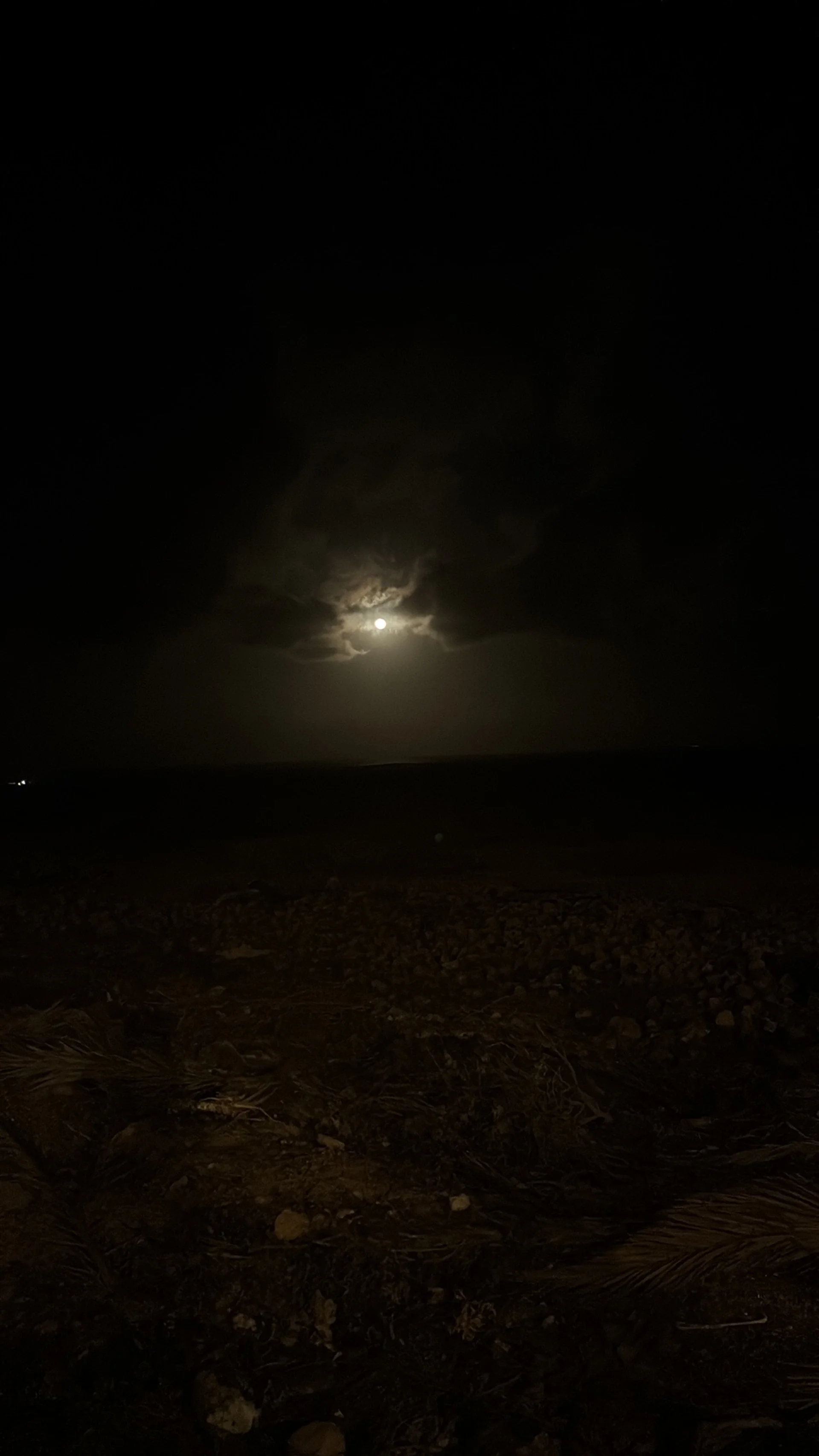
  • ….Support your local "Dark Sky" initiatives: Join a local organisation or participate in community events that raise awareness about the importance of preserving the night sky. .. Apoya las iniciativas locales de “cielos oscuro”: únete a una organización local o participa en eventos comunitarios que conciencien sobre la importancia de preservar el cielo nocturno. ….

….This holiday season, let's make a conscious effort to be more mindful of our lighting choices. By making small adjustments, we can create a brighter Christmas for everyone while ensuring a sustainable future for generations to come. .. Estas fiestas, hagamos un esfuerzo consciente por prestar más atención a nuestras decisiones en materia de iluminación. Con pequeños cambios, podemos crear una Navidad más luminosa para todos y, al mismo tiempo, garantizar un futuro sostenible para las generaciones venideras. ….

....Christmas. What are its origins? And what is the connection to the Winter Solstice? .. La Navidad. ¿Cuáles son sus orígenes? ¿Y qué relación tiene con el solsticio de invierno? ....

….

The Origins of Christmas stem as far back as Pagan Roman times. The festival was called Saturnalia, an ancient Roman celebration of the God Saturn, which lasted from Dec 17th-23rd. The God Saturn, is usually connected with the Greek Cronos, but it was the Romans who actively worshipped the God, associating him with agriculture and abundance. Saturnalia was a raucous affair! A time where anything goes and the boundaries between Master and Slave no longer exist, implying freedom and the equal standing of all people. Gifts were also exchanged and gambling, drinking and playing games was seen as the norm. Nobody was to work during this time. The Romans saw it as returning to the Golden Age, when the God Saturn ruled over Earth. It was a time of Universal harmony and Saturnalia was a way of spreading that love. Other accounts are that it was more an excuse for illicit activity and that it was only the children of the Masters who served the Slaves. We will never know, but the similarities between Saturnalia and Christmas are undeniable with drinking, feasting, sharing gifts and not working as the main component

The Winter Solstice has been celebrated on the 21st or 22nd of December since ancient times. In the Norse tradition, the Winter Solstice celebrated the rebirth of Sol with offerings to Freyr. In ancient Persia and Iran, honoring Mithra is called Yalda. In the Ancient Roman pantheon, the feast of Saturnalia honored the Gods of Harvest and Plenty, Saturn and Ops. To them, the sun decreasing in visibility as the days of the year moved forward spoke of the dying of the sun. They believed that at the time of the winter solstice the sun actually needed to be reborn so that it could live another year. That’s why, in their religious superstition, they organized annual festivals that were held during the days just before and after the day of the winter solstice. These festivals were celebrations dedicated to the sun god, whatever name that god went by. December 25th, then, was celebrated with a feast to commemorate the birth (rebirth) of the sun.

In English, the world solstice comes from the Latin word solstitium, meaning "sun standing still". It seems to suggest a brief pause as the sun reaches its most extreme Southerly point (as experienced on Earth) before the direction of travel is reversed, resulting in the shortest day and longest night of the Year. On a spiritual level, it teaches us about resilience and hope in the face of darkness. The Sun will rise again, even after the longest night of the Year, bringing new beginnings and brighter days. It's a time to reflect on your inner light and the continuous cycle of growth and renewal.

So the origins of Christmas are based on pagan celebrations, that were slowly transitioned into more christian ideologies and later emerged into the modern Christmas that we celebrate around the globe today.

..

Los orígenes de la Navidad se remontan a la época de la Roma pagana. La fiesta se llamaba Saturnalia, una antigua celebración romana en honor al dios Saturno, que se celebraba del 17 al 23 de diciembre. El dios Saturno suele asociarse con el Crono griego, pero fueron los romanos quienes lo veneraban activamente, relacionándolo con la agricultura y la abundancia. ¡Las Saturnalia eran una fiesta muy bulliciosa! Una época en la que todo valía y las fronteras entre amo y esclavo dejaban de existir, lo que implicaba libertad e igualdad entre todas las personas. También se intercambiaban regalos, y era habitual apostar, beber y jugar. Nadie debía trabajar durante esos días. Los romanos lo veían como un retorno a la Edad de Oro, cuando el dios Saturno gobernaba la Tierra. Era una época de armonía universal y las Saturnales eran una forma de difundir ese amor. Otras versiones cuentan que se trataba más bien de una excusa para actividades ilícitas y que solo los hijos de los amos servían a los esclavos. Nunca lo sabremos, pero las similitudes entre las Saturnales y la Navidad son innegables, siendo el consumo de alcohol, los banquetes, el intercambio de regalos y el descanso laboral los elementos principales.

El solsticio de invierno se celebra el 21 o el 22 de diciembre desde la antigüedad. En la tradición nórdica, el solsticio de invierno celebraba el renacimiento de Sol con ofrendas a Freyr. En la antigua Persia e Irán, el homenaje a Mitra se denomina Yalda. En el panteón de la antigua Roma, la fiesta de las Saturnales honraba a los dioses de la cosecha y la abundancia, Saturno y Ops. Para ellos, el hecho de que el sol perdiera visibilidad a medida que avanzaban los días del año simbolizaba la muerte del sol. Creían que, en el momento del solsticio de invierno, el sol necesitaba renacer para poder vivir otro año más. Por eso, según sus creencias religiosas, organizaban festivales anuales que se celebraban durante los días inmediatamente anteriores y posteriores al solsticio de invierno. Estas fiestas eran celebraciones dedicadas al dios del sol, independientemente del nombre con el que se le conociera. El 25 de diciembre, pues, se celebraba con una fiesta para conmemorar el nacimiento (renacimiento) del sol.

En inglés, la palabra «solstice» proviene del latín «solstitium», que significa «el sol se detiene». Parece sugerir una breve pausa cuando el sol alcanza su punto más extremo hacia el sur (tal y como se percibe en la Tierra) antes de que se invierta su trayectoria, lo que da lugar al día más corto y a la noche más larga del año. A nivel espiritual, nos enseña sobre la resiliencia y la esperanza frente a la oscuridad. El sol volverá a salir, incluso tras la noche más larga del año, trayendo consigo nuevos comienzos y días más luminosos. Es un momento para reflexionar sobre tu luz interior y el ciclo continuo de crecimiento y renovación.

Así pues, los orígenes de la Navidad se basan en celebraciones paganas, que se fueron adaptando poco a poco a ideologías más cristianas y que más tarde dieron lugar a la Navidad moderna que celebramos hoy en día en todo el mundo.

….

Capture the Magic: Night Photography in Fuerteventura

photo courtesy of Simon Waldram Photography

….Photography can be about capturing the essence of a moment, weaving a narrative, and connecting with the viewer on an emotional level. As the saying goes, 'Without the darkness we can not see the light,' just because we can´t see it, does not mean it´s not there. Night photography shows us what our eyes can´t see. By embracing the darkness, we unlock a world of hidden beauty, where the stars shine brightly and the cosmos unfolds its wonders.

One technique that constantly captivates is long exposure, with its ability to transform ordinary scenes into something ethereal and dramatic. And what better subject for this transformative technique than the night sky? A realm of endless wonder and a canvas of twinkling stars, the night sky has captivated stargazers and photographers for generations. Combining these passions allows us to not only observe the cosmos but also capture its ethereal beauty, creating a truly enriching experience. Fuerteventura can offer  a stargazer's paradise—the perfect location to merge astronomy with the magic of night photography. Here's your guide to capturing the magic of Fuerteventura's night sky.

..

La fotografía puede consistir en capturar la esencia de un momento, tejer una narrativa y conectar con el espectador a un nivel emocional. Como dice el refrán: «Sin la oscuridad no podemos ver la luz»; el hecho de que no podamos verla no significa que no esté ahí. La fotografía nocturna nos muestra aquello que nuestros ojos no pueden percibir. Al abrazar la oscuridad, descubrimos un mundo de belleza oculta donde las estrellas brillan con intensidad y el cosmos despliega sus maravillas. Una técnica que cautiva constantemente es la de larga exposición, gracias a su capacidad para transformar escenas cotidianas en algo etéreo y espectacular. ¿Y qué mejor escenario para esta técnica transformadora que el cielo nocturno? Un reino de maravillas infinitas y un lienzo de estrellas centelleantes, el cielo nocturno ha fascinado a observadores de estrellas y fotógrafos durante generaciones. Combinar estas pasiones nos permite no solo observar el cosmos, sino también capturar su belleza etérea, creando una experiencia verdaderamente enriquecedora. Fuerteventura ofrece un paraíso para la observación astronómica: el lugar perfecto para fusionar la astronomía con la magia de la fotografía nocturna. Aquí tienes una guía para capturar la magia del cielo nocturno de Fuerteventura.

....

….Why Fuerteventura is Ideal for Stargazing and Night Photography (and what to consider): ..
Por qué Fuerteventura es ideal para la observación de estrellas y la fotografía nocturna (y qué tener en cuenta): ….

….Dark Skies, a Valuable Asset: Fuerteventura's commitment to minimizing light pollution as a Starlight Reserve creates the potential for outstanding stargazing and night photography.

Weather and Atmospheric Conditions: While the Canary Islands generally have favorable weather, cloud cover and calima are factors to consider. Successful stargazing and photography require careful planning, including checking weather forecasts and being flexible with your schedule to take advantage of clear nights.

Diverse Landscapes: From volcanic landscapes to pristine beaches, Fuerteventura offers diverse foregrounds to complement your night sky images.

Planning Your Stargazing and Photography Trip:

Check the Moon Phase: A new moon (when the moon is not visible) provides the darkest skies for stargazing and capturing faint celestial objects.

Weather Forecast: Look for clear skies and calm conditions. Websites like Meteoblue or AEMET (Spanish Meteorological Agency), Windy can provide detailed forecasts. Always look up and constantly check, what was true in the morning may change by the evening. 

Location Scouting: Explore potential locations during the day to identify interesting foreground elements and ensure safe access at night. Inland areas away from towns: Provide the darkest skies.

Timing: The best time for stargazing is typically a few hours after sunset, once the sky is fully dark.

..

Cielos oscuros, un activo valioso: El compromiso de Fuerteventura de minimizar la contaminación lumínica, como Reserva Starlight, ofrece un entorno excepcional para la observación de estrellas y la fotografía nocturna. Condiciones meteorológicas y atmosféricas: Aunque las Islas Canarias suelen gozar de buen tiempo, la nubosidad y la calima son factores a tener en cuenta. Para disfrutar de la observación de estrellas y la fotografía con éxito, es necesaria una planificación cuidadosa que incluya consultar las previsiones meteorológicas y mantener cierta flexibilidad en el horario para aprovechar las noches despejadas. Paisajes diversos: Desde paisajes volcánicos hasta playas vírgenes, Fuerteventura ofrece una gran variedad de elementos en primer plano para complementar tus imágenes del cielo nocturno. Planificación de tu viaje de observación de estrellas y fotografía: Consulta la fase lunar: La luna nueva (cuando la luna no es visible) ofrece los cielos más oscuros para observar las estrellas y captar objetos celestes tenues. Previsión meteorológica: Busca cielos despejados y condiciones de calma. Sitios web como Meteoblue, AEMET (Agencia Estatal de Meteorología) o Windy ofrecen previsiones detalladas. Observa siempre el cielo y mantente atento a los cambios; las condiciones de la mañana pueden variar al llegar la noche. Exploración de ubicaciones: Explora los lugares potenciales durante el día para identificar elementos interesantes en primer plano y asegurarte de que el acceso sea seguro por la noche. Zonas del interior alejadas de núcleos urbanos: Ofrecen los cielos más oscuros. Momento adecuado: El mejor momento para observar las estrellas suele ser unas horas después del atardecer, una vez que el cielo está totalmente oscuro.

….

….Here are some tips for capturing stunning images in low-light conditions:

Fast Lens: A lens with a wide aperture (f/2.8 or wider) is crucial for gathering as much light as possible.

Sturdy Tripod: Essential for long exposures, ensuring sharp images.

Remote Shutter Release: Minimizes camera shake for crisp shots.

Extra Batteries: Cold temperatures drain batteries faster, so bring spares.

Red Light Flashlight or Headlamp: Red light preserves your night vision.

Manual Mode: Provides full control over settings.

Aperture: Use the widest aperture your lens allows for maximum light.

Shutter Speed: Start with a longer shutter speed (e.g., 10 seconds) and adjust as needed.

ISO: Keep it as low as possible to minimize noise, but increase if the image is too dark.

White Balance: Adjust according to the light source (e.g., Tungsten for city lights). 

Focus: Use manual focus and zoom in to ensure sharpness.

Night photography can be a rewarding experience for photographers of all levels. 

..

Aquí tienes algunos consejos para capturar imágenes impresionantes en condiciones de poca luz: Objetivo luminoso: Un objetivo con una gran apertura (f/2.8 o mayor) es fundamental para captar la mayor cantidad de luz posible.

Trípode robusto: Esencial para exposiciones largas, ya que garantiza imágenes nítidas.

Disparador remoto: Minimiza las vibraciones de la cámara para lograr tomas nítidas.

Baterías adicionales: Las bajas temperaturas agotan las baterías más rápido, así que lleva repuestos.

Linterna o frontal de luz roja: La luz roja preserva la visión nocturna.

Modo manual: Ofrece un control total sobre los ajustes.

Apertura: Utiliza la apertura más amplia que permita tu objetivo para obtener la máxima luz.

Velocidad de obturación: Empieza con una velocidad de obturación más lenta (por ejemplo, 10 segundos) y ajústala según sea necesario.

ISO: Mantenlo lo más bajo posible para minimizar el ruido, pero auméntalo si la imagen queda demasiado oscura.

Balance de blancos: Ajústalo según la fuente de luz (por ejemplo, tungsteno para las luces de la ciudad).

Enfoque: Utiliza el enfoque manual y amplía la imagen (zoom) para asegurar la nitidez. La fotografía nocturna puede ser una experiencia gratificante para fotógrafos de todos los niveles.

….

photo courtesy of Simon Waldram Photography

....AUGUST 2018 NIGHT SKY.. AUGUSTO 2018 CIELO NOCTURNO....

….August is the month most expected by everyone who loves the shooting stars. The Perseids, called locally Tears of Saint Lawrence, are back and around the 12th of the month they are filling our island's skies with their brilliant lights. This year too, the absence of the Moon and the presence of the 4 major planets will make this event even more special, if possible. As a long time tradition, the Antigua's municipality organizes a public and free observation in the Prehispanic village of La Atalayita (information in 928 549653), but you can admire them from all the dark places of the island.

And back to the planets, in the Firmament it's easy to find Venus to the West in the first hours after sunset, while Jupiter shines very high during most of the night. A telescope reveals his dark atmospheric bands and his 4 major satellites, bright dots dancing restlessly around the giant. From the East, Saturn will leave you incredulous when admiring his famous rings, and sometimes also a few of his more than 60 satellites. Mars, the Red Planet, destination of so many exploring missions, is also reaching this area following his apparent retrograde movement.

The Moon accompanies us in the second part of the month. Her mountains, her seas and her craters are all a surprise due to their sharpness and closeness through the telescope, leaving us fascinated every time we admire them.

Clear skies to everybody! ..

Agosto es el mes más esperado por todos los amantes de las estrellas fugaces. Vuelven las Perseidas, las Lágrimas de San Lorenzo, que alrededor del 12 de este mes llenan los cielos de nuestra isla con sus brillantes destellos. Este año, la ausencia de Luna y la presencia de los 4 planetas mayores en el cielo nocturno hará de este evento algo aún más especial. Como ya es tradición, el Ayuntamiento de Antigua organiza una observación pública y gratuita en el Poblado Prehispánico de la Atalayita (información en el 928 549653), pero el espectáculo podrá admirarse desde todos los sitios oscuros de la isla.

Y volviendo a los planetas, en el Firmamento destaca Venus, que se pone bastante pronto en el Oeste, así como Júpiter, que brilla muy alto en el cielo ya a la caída de la noche. El telescopio nos revelará sus bandas atmosféricas oscuras y sus 4 satélites mayores, unos puntos brillantes que danzan incansablemente a su alrededor. Cada vez más alto en el Este, Saturno deja a todo el mundo admirado al contemplar sus anillos, con frecuencia también acompañados por algunos de sus más de 60 satélites. También Marte, el Planeta Rojo destino de tantos programas de exploración, va acercándose a esta zona en su aparente movimiento retrógrado.

La Luna nos acompaña en la segunda mitad del mes. Sus montañas, sus mares y su cráteres nos sorprenden por su nitidez y su aparente cercanía a través del telescopio, dejándonos fascinados cada vez que los admiramos.

¡Cielos despejados para todos! ….

CONVERSATION WITH ANDY, CARLY AND MARISA

I had a great email conversation with photography enthusiast Andy Bailey the other week that i had to share his questions with our resident photographer Carly Higgins and here were our  answers: 

MARISA AND ANDY

I sell a lot of full spectrum cameras to astrophotographers but I have never been able to use one here in the uk due to light pollution. 

1) would I need to use a full spectrum camera or would a unmodified one be ok?

2) where is the closest point to corralejo where I could capture the Milky Way.  Could I achieve this in a single image or would I need to stack several shots?

3) I understand that at around 28mm I could use a maximum exposure of around 30 seconds. Does that sound right?

Could you advise what settings you would use?

I have various compact, bridge and dslr camera to choose from but would like to carry something practical and as cheap as possible. 

Hi Andy

You don't have to use a full spectrum camera. Most of our photos are taken with dslr's. As a collective we own full frame Canon body's and 3/4sensor bodies. Our previous photographer and the founder are Nikon lovers. As you can see from our website: www.starsbynight.es and Instagram account: instagram.com/starsbynightfv/ you can still produce amazing photos with basic equipment. 

We are very lucky in Fuerteventura that you don't have to go too far out to see the milky way or to see stars at night. We do observations just 5mins away from the RIU hotel near the dunes which is about 10min drive from the centre of Corralejo. You won't really see the Milky way in April. From July onwards we have a good view but September/October are the best months to see it with with the naked eye. Yes, you can take a photo of this in a single image. 

As for your 28mm lens... well that depends if its a full frame, APSC or Micro4/3  camera, what fstop of your lens ( this will change the light qualities depending on what sensor size you have)? What iso? as a general rule and depending on what you are shooting - be it milky way or stars in general, or light/star trails  you would be looking at anything from minimum of 20sec-30secs for a night photo ( depending on what you are photographing). 

If you are specifically looking at taking night time photos i  would recommend bringing a dslr with the widest and brightest lens you have. If this is not what you have then a good start would be something with a lens that is f4 and/or brighter (f2.8, f2, f1.8, f1.2 - are nice to play with). Yet you can still take a good quality photo with even a standard 18-55 kit lens if its only milky way that you want to shoot. 


CARLY AND ANDY

"Have you ever tried using a Ricoh theta S fir astrophography"

No I have never tried 360 degree photography

"The Milky Way is the object that I wanted to try and capture. I have several apps on my phone to help track it. I guess planets and nebulas would potential need longer exposures and equatorial mount. " 

You can capture images of the planets (looking like stars) using only a DSLR and actually as some are very bright you don't need a long exposure, but If you are looking to take more deep space images yes you would need a very long exposure so an equatorial mount or tracker of some kind would be essential.

"This is the style of photo I'd like to achieve. Astroscape!  Is the following a series of images (foreground / background) or still just the one?"( see above picture for reference)

This is all one image in camera, where possible I prefer to do this and reduce processing time

"If it's easy to explain how would you achieve the above image? "

This image is just a single exposure of 15s at f/2.8 and ISO 2000 and would be very easy for even a beginner to take, its the kind of image we will learn to take on workshops. It was a beautiful clear night and the milky way was clearly visible to the naked eye. There is of course a little post processing in Photoshop

"Finally one last question, assuming there was a clear sky with no foreground subject like the windmill, how would you advise achieving the image of the Milky Way like it is in the image above (assuming I was using an APS C with kit lens)"

You would need to use your widest angle lens to get as much of the sky in as possible, if you have a kit lens I am guessing something like 18-55mm which on a crop sensor is equivalent to 27mm on full frame - not massive wide but definitely workable. You also want to use the lowest aperture possible f/2.8 or below if you have it. Using the 500 hundred rule (something else we teach on the workshop) you can workout how long an exposure (shutter speed) you can have without starting to get star trails. For 27mm I would recommend no more than 18 seconds. You will then need to adjust your ISO to get a properly exposed image balancing it against the other 2 elements of the exposure triangle Aperture and Shutter Speed. It would be really great to have you attend a workshop as I can demonstrate exactly how to capture and image like this and work with you to get exactly what you want.

To note: content has been edited slightly to remove places and dates. 

who is Andy Bailey: INFRAREADYUK & BESTGHOSTHUNTING


The star of Bethlehem and the Three Kings

The Christmas story often brings to mind the tale of three wise men guided by a celestial light to the birthplace of Jesus Christ. Scientists have proposed various explanations for this "Star of Bethlehem."

It must be remembered that the Chaldeans who occupied Mesopotamia 2,000 years ago were assiduous observers of the night sky and were very familiar with the motions of the sun, moon and planets. The three kings were religious scholars known as the Magi - revered Babylonian astronomers and astrologists. They studied the stars and planets, interpreting the meaning behind cosmic events. Anything very unusual was considered an omen, so the star must have been both rare and visually spectacular, and if something very rare took place in the sky, the ancient skywatchers would have noticed it immediately.

After countless reading of articles i’ve summarised a few to ponder over:

  • This year, on August 27th, we witnessed a remarkable celestial event: a very close encounter between Venus and Jupiter. The two brightest planets appeared to almost touch each other in the night sky. Such a close alignment is a rare occurrence, and a similar event may have taken place over 2,000 years ago.

    The biblical story of the Star of Bethlehem intriguingly mentions two separate celestial events. One marked the beginning of the Magi's journey, while the other guided them to Bethlehem.

    Interestingly, in 3 BC, Venus and Jupiter were prominent in the pre-dawn eastern sky. On August 12th of that year, they came incredibly close, appearing only 9 arc minutes apart from the perspective of the Middle East. This would have been visible to people "in the east," as mentioned in the Book of Matthew.

    Ten months later, in June 2 BC, the two planets had another, even more spectacular conjunction. At sunset from Babylonia, they were separated by a mere 4 arc minutes, shining brightly in the western sky. As darkness fell, they drew closer together until they appeared to merge into a single, extremely bright "star."

    This historical celestial event has led some to speculate that it could be the explanation for the Star of Bethlehem. The close alignment of Venus and Jupiter, particularly the dramatic conjunction in 2 BC, would have been a striking and unforgettable sight.

  • The other theory is that the star of Bethlehem was probably not a star at all, and that it was more than one single event.  Astronomer-astrologers reported omens to the king; these were anything unusual - perhaps the moon moving in front of a planet, or a lunar eclipse. Their job was to interpret the meaning of these phenomena. There was also an elite class of diviners who created nativity charts. They recorded the positions of the planets, the Sun, the Moon and other astronomical data at the time of a child's birth, in order to make predictions about that person's life.  Some believe that the wise men from the East, or the "Magi" of the nativity, were astrologers from Mesopotamia, and that the star rising in the east was the horoscope that predicted the birth of a king. If so, they were reading a nativity chart in reverse; they had the prediction and sought to find the child who had been born at that precise moment.

  • Best explanation for this series of events is something known as a triple conjunction between Jupiter and Saturn - with the two planets coming close together in the sky three times over a short period. This happens when] you get an alignment between the Sun, the Earth, Jupiter and Saturn.  Tim O'Brien, associate director of Jodrell Bank Observatory in Cheshire, suggests this would have looked striking. "It's remarkable how much your attention is drawn when two very bright objects come together in the sky," he explains.And once the planets lined up in their orbits, Earth would "overtake" the others, meaning that Jupiter and Saturn would appear to change direction in the night sky. "You would [only] get a triple conjunction like this about every 900 years," he says, so for astronomers in Babylon 2,000 years ago, it would have been a signal of something very significant."A triple conjunction of this kind ticks all the boxes."

  • Another theory suggests that a very bright comet could have been the Star of Bethlehem. While comets are often described as "dirty snowballs" traveling through space, they can be incredibly beautiful and awe-inspiring. As a comet approaches the Sun, its ice melts, and solar winds blow this material into space, creating a spectacular tail. This tail, always pointing away from the Sun, is one of the key characteristics that has made the comet theory popular.

    One of the most relevant historical records is the sighting of a bright comet in the constellation of Capricorn in 5 BC, documented by Chinese astronomers.

  • A less likely, but well-known candidate is Halley's Comet, which was visible around 12 BC. Supporters of this theory point out that the 5 BC comet would have been in the southern sky as seen from Jerusalem, with the comet's head near the horizon and its tail pointing vertically upward.

  • Another theory suggests that the Star of Bethlehem could have been the light from a newborn star, known as a nova. Chinese astronomers recorded a new star in the small, northern constellation of Aquila in 4 BC. Proponents of this theory argue that this nova would have been directly over Jerusalem. Dr. Robert Cockcroft, manager of the McCallion Planetarium at McMaster University in Ontario, considers a nova a "good candidate" for the Star of Bethlehem. 

From all us to you at StarsByNight, hope you have a fabulous holiday period!


Scale of the Universe

A fantastic interaction that shows you how small we are and how big out there is. Quick fun.  By moving the scroll bar across the bottom, you can explore, while clicking on different items will bring up the descriptive information. Created by Cary and Michael Huang. If you want to play with the interaction click on this link: http://scaleofuniverse.com/

BUYING A TELESCOPE

I wrote this article in 2012 when StarsbyNight was just a passionate project that Karen (founder of SBN) would brainstorm with me on how to make her passion into a reality. We were both uber excited and it was a massive learning curve, even in buying equipment. After the years have passed we know a lot more and technology and equipment and brands  are evolving but the theory and idea behind buying your first telescope still apply. 

I just want to add , just like buying a new camera lens, that the most important characteristic of a telescope is its aperture — the diameter of its light-gathering lens or mirror, often called the objective. Look for the telescope's specifications near its focuser, at the front of the tube, or on the box. The aperture's diameter (D) will be expressed either in millimeters.  Your telescope should have at least 2.8 inches (70 mm) aperture — and preferably more.

The little bit I know about buying a telescope - 21/12/2012

Let me start by saying I am no expert. My experience in the past is selling and using photographic equipment in a professional capacity. I wanted to buy a telescope. After doing a lot of research I found its really similar to buying a camera. My colleagues are in the process of buying a high end telescope for our clients to view the night sky here in Fuerteventura, but I would like one so I can learn at home in the meantime. Sure I can use the fancy one they will buy, but I’m occasional user, I have more of an amateur interest rather than a professional one.

Questions I used to always ask my customers in photography. ‘What is the main purpose for?’ ‘In what conditions?” ‘How often would you use it? ‘Is it for you? ” ‘what previous experience do you/or other person have?”  “What do you really want to do with a it?” ‘how much money do you want to spend?”

I’ve done a lot of research. What I used to find often with cameras is people have too much money, buy the latest thing that has all the bells and whistles and never use it to its full capacity and it sits in the corner of the room gathering dust and just looking pretty. It appears its the same with telescopes. I also asked an ex colleague who worked for a company who specialized in astronomy gear and he said the same. He said. “ If someone wanted to spend under £200 I would probably recommend a good pair of binoculars that last a lifetime. Often what happens is the  kind of telescope people think they want and what they really need are two different things.”

I was told do not even consider a telescope that advertises it power on the box (300x, 500x,650x, 725x).  Avoid telescopes that are advertised by their magnification — especially implausibly high powers like 600×. For most purposes, a telescope's maximum useful magnification is 50 times its aperture in inches (or twice its aperture in millimeters).  Even the best telescopes are limited to about 50x-75x per inch (25.4mm) of aperture. The big number with a ‘x’ after it, I was told  is actually a  marketing ploy and high-powered scopes tend to have fixed eyepieces. What you want is a removable eyepiece. Also even though these type of telescopes appear attractive advertised with a high number, all this means is the high magnification the light is gathered and spread over a larger area making it fuzzy and faint.  You should look for the magnification in the eyepiece. You calculate a telescope's maximum useful magnification by multiplying the size of the lens or mirror in inches by 50.  I was also told that alower power/magnification in the telescope tends to provide a better viewing experience.

Start with binoculars. If you don’t have much money and don’t want to spend over the £200 mark you may be happier with a very good pair of binos. Even for travel its actually quite a good idea to have a back up anyways of about 10x50, 7x50 for a more general use or an 8x56 or a 9x63 for something a bit more ‘astro’ and its less heavier, but can be slightly expensive. Buy something you can use, not something you will get frustrated with . If it rattles when you shake it, try a different pair of binos. Good telescopes will be expensive regardless of the type. Cheap binoculars are much, much more useful than cheap telescopes and  good binoculars can last you forever.

What you can see with a pair of binoculars look at this link: http://www.lightandmatter.com/binosky/binosky.html

binocular basics: http://www.chuckhawks.com/binocular_basics.htm

Should I get a refractor or a reflector telescope?

Now I had to get some help to explain this from another website as I couldn’t think of the any other way to explain it but share someone else’s informationhttp://www.astronomyforbeginners.com/equipment/telescope.php:

Reflector

Reflectors have one open end and a curved mirror at the back. Light is reflected and focused by this mirror onto a secondary mirror, which reflects it up into the eyepiece. Refractors are generally cheaper per inch of aperture and are in general better for the beginner on a budget, but aren't very good for ground observing, as the image is upside-down.

Refractor

refractor1.jpg

A refractor has a lens at the front which refracts light from the stars and focuses it at the eyepiece (often by means of a 45° mirror-in which case the image is reversed left-to-right). The image is the right way up meaning that these are better suited if you want to do ground observing as well. If the optics are good, then refractors can form better images, but are usually more expensive per inch of aperture.

Reflector telescopes have one optical surface (less mirrors) and tend to be cheaper and have no chormatic abberration. The mirror in this type of telescope may need recoating after years of use but if you are a beginner like me and will not use it outside on a rough surface (and tend to use it on your balcony like me) and not have much money then these type are a quick fix to look at the sky.

Refracting telescopes the light bends from one medium to another. A refractor uses two lenses. At one end, is the larger lens is called the objective. On the other end is the lens you look through, called the ocular or eyepiece. Also an advantage of a refractor is that by default they have a totally clear aperture and are low maintenance. A disadvantage is that some telescope lens/glass pieces will give off  chormatic aberrations. The only way I can describe it with my experience is light fringing around a subject like you get where you take a photo with a cheap lens on a sunny day sometimes the object has a faint fuzz around it, also kind of like a lens flare.  Inexpensive refractors have problems with false color, but they are often more compact and therefore better for traveling. Also, refractors tend to give more pleasing views when used in the daylight. Most reflectors tend to be very large by comparison, but will have better light gathering capability.  I was also told that whether buying either telescope look out for2.4 inch (60mm) and 3.1 inch(80mm) refractors and 4.5 inch and 6 inch reflectors are popular for most amateurs. Your new scope should have at least 1 eyepiece, and often 2 or 3. An eyepiece is rated by millimeters (mm), with smaller numbers indicating higher magnification. A 25mm eyepiece is common and appropriate for most beginners.While a higher magnification eyepiece may provide more details, it may be harder to keep an object in view, unless you are using a motorized mount. They also require the scope to gather more light to provide a clearer image.

A lower power eyepiece makes it easier to find objects and keep them in view. Lower magnification eyepieces require less light, so viewing dimmer objects is easier.

Remember the view through a telescope with not be exact to what you see in astrophotography on the internet or magazines. Planets will be tinier and some not in fantastic colours .

I started getting lost looking at all the brands. It seemed for over the £200 mark, the Meade does a introductory good telescope for anything over the £350 you are looking at more advanced Meade, Newtonians, Dobinsonians and Stellarvuemodels.  Lower cost options can include Maksutov-Cassegrains and “long” achromatic refractors.  Schmidt-Cassegrain Telescopes (SCT) can also offer pleasing views of the planets.

I recommend trying before buying. Observe through as many telescopes as you can, and ask as many questions as you can think of. Ask about setup time, maintenance and accessories.

This is a great list of things to help you set up your basic kit: http://www.astronomy.com/Equipment/How-To.aspx

To me it really is buying an extension of my camera equipment. Learning about glass wear, apertures and brands from various websites, magazines and asking professionals has helped me. Hopefully it won't just sit in the corner of my room.

Disclaimer: I am not a professional but someone who is interested. Within our team we have a professional astronomer but I write this article out of pure interest and passion for a subject am learning about.


100000 STARS CHROME WORKSHOP EXPERIMENT

We love this. Fantastic idea!

Called 100,000 stars  this is a fully-immersive 3D plot of (in fact) 119,617 stars. This is an interactive visualization of the stellar neighborhood created for the Google Chrome web browser/App. It shows the real location of nearby stars. Zooming in reveals 87 individually identified stars and our solar system. The galaxy view is an artist's rendition.

According to Aaron Koblin's blog posting to announce the project, "Visualizing the exact location of every star in the galaxy is a problem of, well, galactic proportions. With over 200 billion stars, capturing every detail of the Milky Way currently defies scientists and laptops alike. However, using imagery and data from a range of sources, including NASA and the European Space Agency (ESA), we were recently able to take one small step in that direction by plotting the location of the stars closest to our sun.

"The result is a new Chrome Experiment called 100,000 Stars that visualizes the stellar neighborhood. Using your mouse or trackpad, you can zoom in and out to explore our galaxy. Zooming in reveals the names of the most prominent stars close to our sun - click each name to learn more about it and see a digital rendition."

Koblin concludes, "As you explore this experiment, we hope you share our wonder for how large the galaxy really is. It's incredible to think that this mist of 100,000 measurable stars is a tiny fraction of the sextillions of stars in the broader universe." Author: Google Data Arts Team Sources: Programmed by some space enthusiasts at Google. Galaxy images provided by Wikipedia and ESO/IDA/Danish 1.5m/R.Gendler and A. Hornstrup. Star renderings derived from Wikipedia Sun images courtesy of NASA/SDO and the AIA, EVE, and HMI science teams. Star data provided by: HYG Database, by Astronomy Nexus Gliese/Jahreiß Catalog, by Dr. Wilhelm Gliese and Dr. Hartmut Jahreiss Bright Star Catalog (5th edition), by Dr. E. Dorrit Hoffleit and Dr. Wayne H. Warren Jr, and the Department of Astronomy at Yale University HIPPARCOS Catalog (3rd Edition) by the European Space Agency.

Click/view via this link and you can play with the real thing: https://stars.chromeexperiments.com/

ENG
ESP